Content optimization is simply the process of fine-tuning your content so it works for two audiences at once: search engines and human readers.
It’s about more than just writing—it’s about strategically improving everything from the keywords you use and how easy your text is to read, to the technical bits like image alt text and metadata.
Ultimately, the goal is simple: get more eyes on your content, drive more organic traffic, and give people who land on your page a great experience.
Understanding Content Optimization From The Ground Up

Think of it like this: writing a great article is like building a powerful race car. You’ve put all the essential parts together—fantastic ideas, solid research, and a compelling argument.
But just having a car sitting in the garage doesn’t mean you’ll win any races.
Content optimization is the expert tuning. It’s the final aerodynamic adjustments that give your car the edge it needs to actually win.
It’s the difference between a high-performance machine that no one ever sees and one that crosses the finish line in first place.
This process is all about systematically refining your content to satisfy two distinct, but equally important, audiences.
For search engines, it’s about giving them the right signals so they understand what your page is about.
For your human readers, it’s about creating an experience that is clear, engaging, and actually solves their problem.
The Two Sides of The Same Coin
Truly effective optimization never sacrifices one audience for the other. It’s all about finding that sweet spot where the needs of algorithms and people overlap perfectly.
Here’s a quick breakdown:
- For Search Engines: This is the technical side. It means weaving in relevant keywords naturally, using proper headings (H1, H2, etc.) to structure your thoughts, optimizing your images, and writing crisp meta descriptions. These actions help algorithms crawl, index, and rank your content for the right searches.
- For Human Readers: This is all about the experience. It means making your content easy to read with shorter sentences, breaking up big blocks of text with visuals, and making sure you get straight to the point. The goal here is to keep people on your page and give them a reason to stick around.
Content optimization is the bridge between creating brilliant content and ensuring that content gets discovered.
Without it, even the most insightful article is just a whisper in a hurricane of digital noise. Optimization turns your creative work into a tangible business asset.
So, what is content optimization at its core? It’s the essential practice of making your content discoverable, readable, and valuable.
It’s how you make sure all your hard work pays off by reaching the people you want to reach and hitting your goals, whether that’s getting more leads, making sales, or just building your brand’s authority.
To really get a handle on the fundamentals, I recommend checking out these 10 powerful content optimization strategies. They provide a deeper dive into the specific tactics you can start using right away.
To break it down even further, think about the core pillars that hold up any good optimization strategy. The table below lays them out clearly.
The Core Pillars of Content Optimization
| Pillar | Objective for Search Engines | Objective for Human Readers |
|---|---|---|
| Relevance | Match content to specific keywords and search queries. | Directly answer the reader’s question or solve their problem. |
| Readability | Use clear structure (headings, lists) for easy crawling. | Provide a smooth, scannable, and easy-to-understand reading experience. |
| Authority | Signal expertise through internal/external links and comprehensive coverage. | Build trust by providing credible, well-researched, and valuable information. |
| User Experience (UX) | Reward fast-loading pages and mobile-friendly design with higher rankings. | Keep visitors engaged with an intuitive layout, visuals, and interactive elements. |
As you can see, what’s good for your reader is almost always good for Google, and vice-versa. Mastering these pillars is the key to creating content that truly performs.
Why Content Optimization Is a Non-Negotiable Strategy
Look, creating fantastic content is a huge accomplishment, but it’s really only half the job.
Publishing a piece of content without optimizing it is like brewing the perfect cup of coffee and then just leaving it on the counter to get cold. Who’s going to drink it?
Content optimization is how you serve that coffee. It’s about pouring it into a great mug, adding just the right amount of cream and sugar, and putting it directly into the hands of someone who needs that caffeine boost.

It’s the critical step that turns your creative work into something that actually grows your business.
If you skip this part, your content is basically invisible. It doesn’t matter how brilliant or helpful it is; if the right people can’t find it, it might as well not exist.
Optimization is the bridge between your hard work and the audience you created it for.
Ultimately, it all comes down to getting a return on your investment. You pour time, money, and expertise into every blog post, video, or guide.
Optimization is how you make sure that investment actually pays you back with organic traffic, new leads, and real sales. It’s not just a box to check for SEO—it’s smart business.
Driving Tangible Business Growth
When you get this right, the benefits go way beyond just ranking for a few keywords. A consistently optimized content strategy becomes a powerful, self-sustaining engine for growth that works for you 24/7.
Here’s what that looks like in the real world:
- Increased Organic Visibility: Optimized content gets you to the top of Google, right in front of people actively searching for what you offer. This is high-quality traffic, and you’re not paying for every single click.
- Improved User Engagement: When you optimize for readability, structure, and what the user actually wants, people stick around longer. Search engines notice low bounce rates and long visit times, see it as a sign of quality, and reward you with even better rankings. It’s a virtuous cycle.
- Higher Conversion Rates: Content that directly answers a person’s question and makes it easy for them to take the next step is far more likely to convert. Whether that’s signing up for a newsletter or buying a product, a smooth, optimized experience gets them there.
The numbers don’t lie. Companies with a documented content strategy report a 33% higher ROI than those flying blind.
And with the average cost per lead from content marketing falling by 19% year-over-year, it’s proving to be a much more efficient channel than paid ads for a lot of businesses.
Building Authority and Trust
Beyond the immediate numbers, content optimization is how you build a reputation as the go-to expert in your field.
When people consistently find your content at the top of their search results and it genuinely helps them, they start to trust you.
That trust is gold. A huge 58% of consumers say they trust educational content from a brand more than its ads.
Optimized, high-value content is exactly what they’re looking for, building a relationship long before they’re even thinking about making a purchase. You become the first name they think of when it’s time to buy.
By focusing on optimization, you shift from simply publishing content to building a library of high-performing digital assets that appreciate in value over time.
Each optimized piece becomes a long-term source of traffic, leads, and authority for your business.
Of course, you have to be able to measure what’s working. Mastering content performance analysis is the key to proving the value of your efforts and getting better over time.
It shows you what’s a hit so you can do more of it and what’s a miss so you can fix it. This ensures your investment is always pointed directly at your business goals.
Simply put, optimization isn’t an expense; it’s an investment in predictable, scalable growth.
Your On-Page Content Optimization Checklist

Theory is one thing, but action is what gets results. Think of this checklist as your pre-flight routine before you hit “publish.”
It’s a simple, repeatable process that gives every piece of content the best possible shot at ranking and connecting with your audience.
Following these steps isn’t about just ticking boxes. It’s about methodically building a strong foundation for performance, making sure you’re hitting all the key signals that both search engines and real people care about.
Let’s get into the nitty-gritty of what turns good content into a high-performing asset.
Strategic Keyword Integration
First things first: you need to build your content around the right search terms. This goes way beyond just stuffing your main keyword in a few times.
The goal is to weave a natural network of related phrases that tells Google you’re an authority on the subject.
- Primary Keyword: This is your north star, the main phrase you want to rank for. It should feel natural in your title, pop up within the first 100 words or so, and appear a couple more times in the body.
- Secondary Keywords: These are close cousins of your primary keyword. If your main target is “what is content optimization,” a secondary keyword might be “content optimization strategies.”
- LSI Keywords: Latent Semantic Indexing (LSI) keywords are just a fancy way of saying “topically related terms.” For a piece on content optimization, this would include concepts like “user experience,” “search intent,” “readability,” and “meta description.” Sprinkling these in shows your content is comprehensive.
By layering these keywords, you’re signaling to search engines that your article covers the topic from all angles, making it a better answer for a much wider range of searches.
Compelling Title Tags and Meta Descriptions

On the search results page, your title tag and meta description are your entire sales pitch. They have one job: earn the click.
They need to be sharp enough for search engines to understand and compelling enough for a human to choose you over the competition.
A great title tag is short and sweet (under 60 characters), features your primary keyword, and sparks a little curiosity.
Your meta description (under 160 characters) is the ad copy—it should summarize the value inside and end with a gentle nudge, like “Learn more” or “Discover how.”
A high-ranking article with a boring title and meta description is a missed opportunity. Optimizing these two little snippets is one of the highest-impact things you can do to get more eyes on your work.
Nailing these elements is a direct line to better results. For a much deeper dive, our guide on how to improve click-through rates is packed with specific tactics you can start using today.
Logical Content Structure with Headings
Nobody likes hitting a giant wall of text. Headings (H1, H2, H3) are your best friend for creating a scannable, logical flow that makes life easier for both your readers and search engine crawlers. They’re like a roadmap for your article.
Here’s the simple hierarchy to follow:
- H1 Tag: This is your main title. You only get one H1 per page, and it absolutely has to include your primary keyword.
- H2 Tags: Use these to break up the major sections of your article. They’re a great place to put your secondary keywords.
- H3-H6 Tags: These are for sub-sections. Use them to organize your points within each major H2 section, adding more detail and structure.
This clean organization makes your content a breeze for people to skim and helps search algorithms quickly figure out what your page is all about.
Image Optimization and Alt Text
Images do more than just make your content look good—they’re a powerhouse for SEO if you treat them right.
Before you upload any image, compress it. A massive image file will slow your page to a crawl, and page speed is a huge ranking factor.
Beyond that, always write descriptive alt text. Alt text is the text that describes an image for two key reasons:
- Accessibility: Screen readers use it to describe the image to visually impaired users.
- SEO: It gives search engines crucial context, helping them understand and rank your image in image searches.
Keep your alt text short and accurate. If you can include a relevant keyword naturally, go for it.
Smart Internal and External Linking
Finally, let’s talk about links. The links on your page are powerful signals of authority and trust. They connect your content to the wider web.
- Internal Links: These point to other relevant pages on your own site. They’re fantastic for helping Google discover more of your content and for guiding your readers to other useful articles, keeping them around longer.
- External Links: These point to other high-quality, authoritative websites. Linking out to credible sources shows you’ve done your homework and makes your own content more trustworthy. You’re essentially borrowing a little bit of their authority.
You need a healthy mix of both. A good rule of thumb is to add 2-4 internal links and 1-2 relevant external links for every 1,000 words.
Optimizing for People, Not Just Search Engine
We’ve spent a lot of time on keywords, headings, and the technical bits that get search engines to notice you.
But here’s the real secret to modern content optimization: the surest way to win over an algorithm is to create an incredible experience for a human.
The days of writing robotic, keyword-stuffed articles are long gone. Today, search engines like Google are sophisticated enough to recognize and reward content that truly answers a person’s question and makes their visit easy and enjoyable.
Think of it like being a great party host. You don’t just hand guests a list of facts when they walk in the door. You create a welcoming vibe they want to stick around for.
This focus on user experience sends all the right signals to search engines, telling them your content is the real deal, which in turn boosts your rankings and builds genuine audience loyalty.
Match Your Content Format to Their Search Intent
The first step in creating a great experience is figuring out what your reader actually wants to do. This is search intent—the “why” behind every single Google search.
Are they trying to learn something new, compare products before buying, or find a specific page?
Matching your content format to their intent is everything. Getting it wrong is like showing up to a casual book club with a dense academic textbook. It just doesn’t fit the situation, and your audience will tune out.
Here are the main types of search intent and the formats that work best for each:
- Informational Intent: The user needs an answer or wants to learn. Think “what is content optimization?”
- Best Formats: In-depth blog posts, step-by-step guides, and checklists.
- Best Formats: In-depth blog posts, step-by-step guides, and checklists.
- Navigational Intent: The user is trying to get to a specific site. For example, “Post Paddle login.”
- Best Formats: A crystal-clear homepage or a dedicated login page.
- Best Formats: A crystal-clear homepage or a dedicated login page.
- Transactional Intent: The user is ready to make a purchase, like “buy Pinterest automation tool.”
- Best Formats: Product pages, pricing tables, and sales pages with a clear path to purchase.
- Best Formats: Product pages, pricing tables, and sales pages with a clear path to purchase.
- Commercial Intent: The user is in the research phase before buying, searching for things like “Post Paddle vs Later.”
- Best Formats: Comparison articles, unbiased product reviews, and detailed case studies.
When you nail the format, you instantly tell the reader, “You’re in the right place.” That alone can drastically lower your bounce rate.
Make Your Content Effortless to Read
Once someone lands on your page, you have mere seconds to convince them to stick around. Nothing sends visitors running for the “back” button faster than a giant, intimidating wall of text.
Making your content easy to read isn’t a nice-to-have; it’s a must-do for keeping people engaged. Your goal is to make it skimmable and simple to digest.
Today’s readers are scanners first and readers second. If they can’t quickly find what they’re looking for by glancing at your page, they will assume it isn’t there and leave.
Strategic formatting is your best friend here. Here are a few simple but powerful ways to improve readability:
- Use Short Paragraphs: Keep them to 1-3 sentences, max. This creates white space and makes the page feel much more approachable.
- Write Simple Sentences: Ditch the complex jargon and long, winding sentences. A tool like the Hemingway Editor can be a huge help.
- Use Headings and Subheadings: Break up your article into logical, bite-sized chunks with clear H2s and H3s.
- Embrace Lists: Use bullet points and numbered lists to highlight key information and make it easy to scan.
These small changes can turn a dense article into a user-friendly resource people will actually take the time to read.
Don’t Forget the Technical Experience
Finally, a fantastic user experience goes beyond the words on the page. How your site performs technically plays a huge role in how people feel about your content.
After all, the most brilliant article in the world is useless if the page takes forever to load or looks broken on a phone.
Site speed and mobile-friendliness aren’t optional anymore. With over 60% of all web traffic now coming from mobile devices, a responsive design is an absolute must. Slow-loading pages are a one-way ticket to a high bounce rate and, eventually, lower rankings.
A winning experience is the whole package. It’s the perfect blend of answering a user’s question, presenting that answer in an easy-to-read format, and delivering it all on a fast, reliable website. When you get all three right, you create content that wins over both people and search engines.
How AI Is Reshaping Content Optimization

Let’s be clear: Artificial Intelligence has officially moved out of the “futuristic buzzword” category and into the everyday toolkit of smart marketers. It’s not here to replace human creativity.
Instead, it’s become an indispensable co-pilot, helping us make smarter, faster, and more data-backed decisions.
Think of it like having a research assistant who can read every article on the internet in a few seconds. AI can sift through thousands of competitor posts, spot hidden keyword opportunities, and even suggest how to structure your content for maximum impact.
These are tasks that would take a human analyst days, if not weeks, to get through.
This shift frees us up from the soul-crushing parts of the job—like manual data pulls—and lets us focus on what we do best: building a real connection with our audience through great storytelling.
And this isn’t just a fleeting trend. It’s a seismic shift in how top-tier content gets made. By 2025, an estimated 90% of content marketers will be using AI tools, a massive leap from 64.7% in 2023.
The results speak for themselves: only 21.5% of AI users reported their strategies were underperforming, compared to 36.2% of their non-AI counterparts.
Speeding Up the Entire Workflow
One of the first things you’ll notice when you start using AI is just how much faster everything becomes. From the initial spark of an idea to the final polish, AI tools can jump in at every single stage to help you create better content in a fraction of the time.
This isn’t just about working faster; it’s about being more competitive. In crowded markets, getting timely, relevant content out the door is crucial.
AI levels the playing field, giving smaller teams the power to compete with industry giants by working smarter, not just harder.
It’s a huge piece of a larger movement toward smarter workflows, a topic we dive into in our guide on what is content automation.
Here are just a few ways AI is changing the game:
- Finding Hidden Gems: AI can analyze search trends to uncover high-potential topics and related keywords that your competitors have completely missed.
- Building Your Blueprint: Platforms can generate detailed content briefs in minutes, outlining word count goals, necessary headings, and common questions to answer—all based on what’s already ranking.
- Polishing Your Draft: These tools analyze your writing for readability, suggest simpler ways to phrase things, and recommend structural tweaks to keep readers engaged.
AI isn’t about writing the perfect article for you. It’s about giving you the data-driven blueprint to build that perfect article yourself, only faster and more effectively.
Turning Data Into Action
The real magic of AI is its ability to take a mountain of messy data and turn it into simple, actionable steps. It can scan the entire first page of Google for your target keyword and tell you exactly what users and search engines want to see.
For example, an AI tool might analyze the top-ranking articles and come back with a simple report: “Most of these include a ‘how-to’ guide, have an FAQ section, and are around 1,800 words long.”
Suddenly, you’re not just guessing anymore. You have a clear roadmap for creating content that aligns with what’s already working, giving you a much stronger chance of ranking well right from the get-go.
Building Your Content Optimization Toolkit
A solid strategy is the foundation of content optimization, but the right tools are what bring that strategy to life. Think of it like a workshop—you wouldn’t build a table with just a hammer. You need different instruments for different jobs, from planning and drafting to measuring the final result.
A smart, curated set of tools helps you work faster and, more importantly, make decisions based on data, not guesswork.
Instead of throwing spaghetti at the wall to see what keywords stick, these tools give you a clear roadmap based on what’s already working for your competitors and resonating with your audience.
They don’t replace good writing; they amplify it, making sure your hard work actually gets seen.
Core Tool Categories
Your optimization toolkit will likely fall into three main categories. Each one plays a distinct role in the content lifecycle.
- All-in-One SEO Platforms: These are the command centers of your operation. Platforms like Ahrefs or Semrush are fantastic for the big-picture stuff—keyword research, competitor analysis, and tracking your site’s overall health. They help you find untapped content opportunities and see where you stand in the market.
- Content Intelligence Tools: Once you’ve chosen your topic, these tools become your co-pilot for writing. Software like SurferSEO or Clearscope analyzes the top-ranking pages for your target keyword and essentially builds you a data-driven blueprint. They’ll suggest key terms to include, give you a target word count, and recommend a structure, ensuring you cover the topic better than anyone else.
- Performance Analytics Tools: After you hit “publish,” you need to know what’s happening. How are people finding your article? Are they sticking around? This is where Google Analytics and Google Search Console come in. They are non-negotiable. They give you the raw truth about your traffic, click-through rates, and user behavior.
Comparison of Content Optimization Tool Types
To help you decide what you need and when, here’s a quick breakdown of how these tool categories fit into your workflow.
| Tool Category | Primary Function | When to Use It | Example Tools |
|---|---|---|---|
| All-in-One SEO Platforms | Strategy, research, and high-level tracking. | At the beginning of your process for keyword and topic discovery, and ongoing for competitor and backlink analysis. | Ahrefs, Semrush, Moz |
| Content Intelligence Tools | On-page optimization and content briefing. | During the writing and editing phase to ensure your content is comprehensive and SEO-friendly. | SurferSEO, Clearscope, Frase |
| Performance Analytics Tools | Measurement and post-publication analysis. | After your content is live to track performance, identify what’s working, and find opportunities for updates. | Google Analytics, Google Search Console |
This table shows there’s a tool for every stage. The key is to start with the essentials and build out your toolkit as your needs become more sophisticated.
The goal isn’t to collect a massive library of software you barely use. It’s about building a lean, effective stack where each tool has a specific job.
A well-chosen toolkit turns optimization from a guessing game into a repeatable, predictable process for creating content that consistently performs.
Just look at the kind of impact a focused optimization effort can have on key metrics.
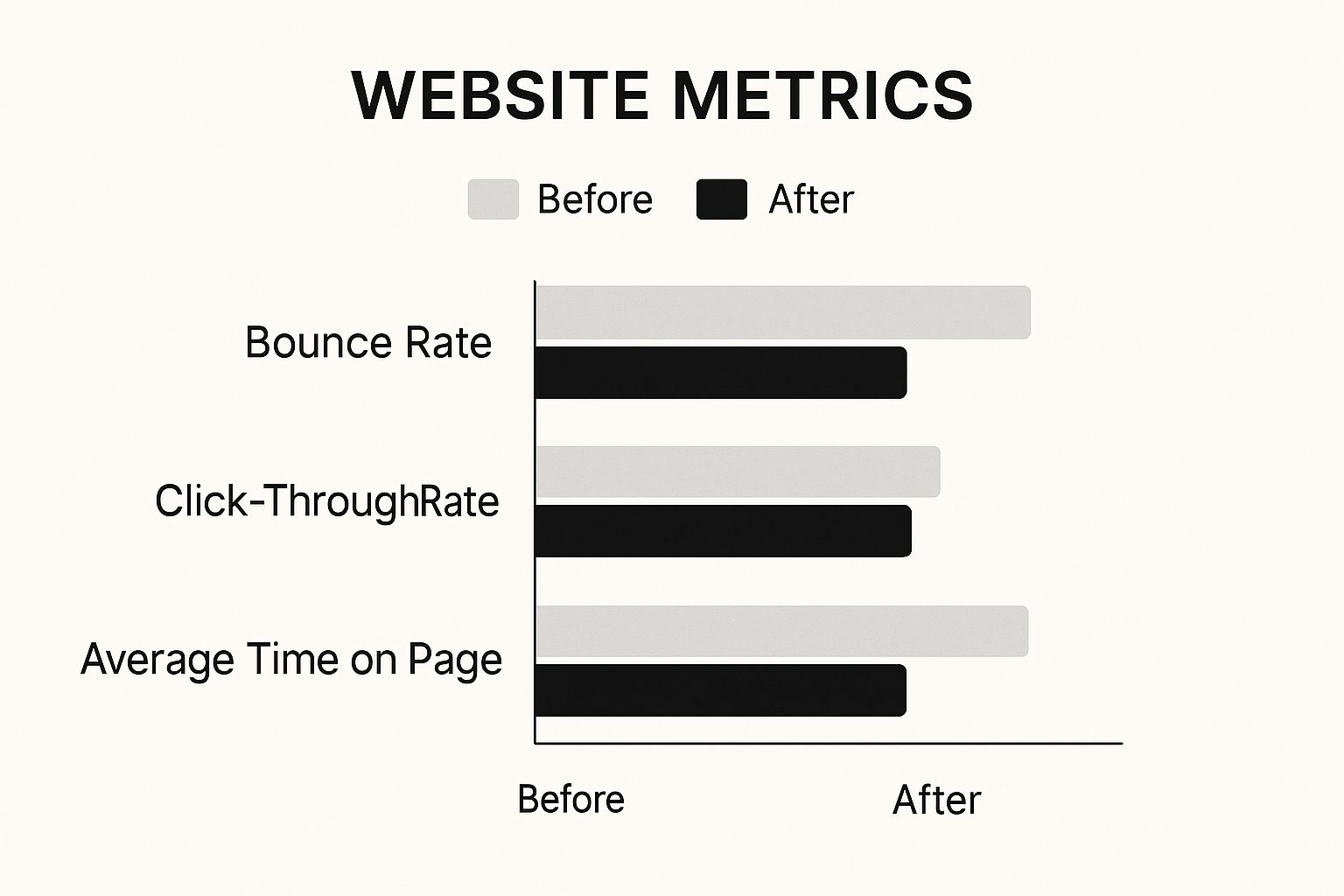
As you can see, the data speaks for itself. Proper optimization can lead to a dramatic decrease in bounce rates while simultaneously boosting click-through rates and the average time people spend engaged with your content.
These aren’t just vanity metrics; they’re signs of a healthy, growing audience.
Get AI help for titles, descriptions, and keyword ideas
If you’re serious about content optimization, the real challenge isn’t knowing what to do—it’s doing it consistently across every post, page, and Pin. That’s where our free Pinterest GPTs come in.
They help you turn a finished article into SEO-friendly Pinterest assets without the usual back-and-forth of rewriting, reformatting, and guessing which keywords to use.
Use the GPTs to generate multiple title variations, stronger descriptions that naturally include target keywords, and new angles you can test (checklists, how-to hooks, “mistakes to avoid,” and quick-win formats).
You can also create board name ideas and keyword clusters that match search intent, so your optimized content doesn’t just rank—it actually gets discovered and clicked.
Instead of optimizing once and moving on, you’ll have a repeatable system: publish your content, run it through the GPTs, create several optimized Pin versions, and schedule them over time.
That’s how your content keeps working long after you hit “publish.”
Common Questions About Content Optimization
Even with a solid plan, a few questions always pop up when you start putting content optimization into practice. It’s totally normal. This isn’t a one-and-done task; it’s a living, breathing part of any smart content strategy.
Let’s clear up some of the most common sticking points. Answering these helps shift the mindset from seeing optimization as a chore to seeing it as a continuous cycle of improvement.
How Often Should I Re-Optimize My Content?
This is a big one. Content optimization is definitely not a “set it and forget it” game. A good rule of thumb is to run a content audit every 6-12 months. This helps you spot which articles have gone stale and are prime for a refresh.
For your most important content, especially if you’re in a fast-moving industry, you might want to tighten that up to every 3-6 months. Keep an eye out for outdated stats, add new examples, or simply improve the flow. It’s this consistent upkeep that keeps your content relevant and performing well for the long haul.
Is Content Optimization The Same As SEO?
Not quite, but they’re very closely related.
Think of it like this: SEO is the entire race car—it includes the engine, the aerodynamics, the tires, and the driver. It’s the whole strategy for winning the race, covering everything from technical site health to backlinks.
Content optimization is the engine itself. It’s a vital piece of on-page SEO that focuses squarely on making a single piece of content as powerful as possible for both people and search engines.
Can You Optimize For Search Engines And Humans At The Same Time?
Absolutely. In fact, that’s the only way to win today.
Years ago, SEO was a clumsy game of keyword stuffing that made content almost unreadable. Thankfully, those days are over. Search engines like Google have gotten incredibly smart, and they now reward content that genuinely helps people.
Optimizing for people is now the best way to optimize for search engines. When you write clearly, answer the reader’s question thoroughly, and make your content easy to scan, you’re sending the strongest possible signals to Google.
Of course, you can’t improve what you don’t measure. To see how your efforts are paying off, check out our guide on how to measure content performance. It’ll help you figure out what’s working and what needs another look.