A social media strategy is more than just a posting schedule.
For a small business, it’s a concrete plan that spells out your goals, the exact tactics you’ll use to hit them, and how you’ll track what’s working.
Think of it as the roadmap that turns random social media activity into a real engine for growth—whether that means boosting sales or creating a die-hard community around your brand.
Building Your Foundation for Social Media Success

Before you even think about sending a tweet or posting a photo, you need a solid foundation. This is what separates guessing from growing.
It’s the practical groundwork that acts as a compass for every piece of content you create and every platform you choose. It’s all about being intentional from day one.
Today’s customer journey almost always starts online. By 2025, social media has become the go-to channel for small businesses to find new customers.
In fact, 58% of consumers say they discover new businesses through social platforms—beating out traditional search and TV ads.
With over 5.41 billion people on social media globally, the opportunity to connect with buyers is massive.
Define Your Business Objectives First
One of the biggest traps for small businesses is chasing “vanity metrics” like follower counts and likes.
A huge following looks great on the surface, but it doesn’t mean much if it isn’t actually helping your business.
Your social media goals need to be a direct reflection of your overall business objectives.
Ditch vague goals like “get more followers” and get specific.
- Instead of: “Increase sales.”
- Try: “Increase online bookings by 15% through Instagram Stories links in the next quarter.” This ties a real sales goal to a specific social media action.
- Try: “Increase online bookings by 15% through Instagram Stories links in the next quarter.” This ties a real sales goal to a specific social media action.
- Instead of: “Get more leads.”
- Try: “Generate 25 qualified leads per month from our LinkedIn content downloads.” This focuses on a critical step in your sales funnel.
- Try: “Generate 25 qualified leads per month from our LinkedIn content downloads.” This focuses on a critical step in your sales funnel.
- Instead of: “Be better at customer service.”
- Try: “Reduce customer support response time by 20% by actively using Twitter as a service channel.” This uses social media to improve how your business runs.
A social media strategy without clear business goals is like a ship without a rudder. You might be moving, but you’re not heading toward a specific destination.
Setting these SMART (Specific, Measurable, Achievable, Relevant, Time-bound) goals gives you clarity and, just as importantly, helps you prove that your efforts are paying off.
Understand Who You’re Talking To
You can’t create content that resonates if you don’t know who you’re talking to. This is where building detailed customer personas becomes non-negotiable.
These aren’t just demographic checklists; they are rich, semi-fictional profiles of your ideal customers that feel like real people.
Go deeper than just age and location. Dig into their psychographics:
- What are the real-world challenges and pain points your business solves for them?
- What kind of content do they actually enjoy online? Short-form videos, in-depth articles, or funny memes?
- Where do they hang out online to unwind, learn, or connect with others?
- What’s their online “language”? Do they prefer a professional tone or something more casual and humorous?
Getting this right is fundamental. Once you have these personas down, you can start shaping your message and choosing the right platforms, which is a core part of learning how to develop content strategy.
Analyze Your Competitive Environment
Finally, take a good look at what your competitors are up to. The goal here isn’t to copy them—it’s to find opportunities they’ve missed.
A simple competitive analysis can be as easy as checking out 3-5 of your direct or indirect competitors.
Ask yourself a few key questions:
- Which platforms are they most active on?
- What kinds of posts get the most engagement for them?
- What’s their brand voice, and how are they positioning themselves?
- Where are the gaps? Is there a content format they aren’t using or an audience they seem to be ignoring?
This analysis will help you carve out a unique angle so you can stand out instead of just adding to the noise.
For a deeper dive into getting this initial setup right, these social media marketing tips for small business success are a great place to start.
Choosing Your Platforms and Crafting Your Content

Trying to be on every social media platform at once is a classic rookie mistake, and it’s the fastest way for a small business owner to burn out.
A much smarter play is to focus your precious time and energy on the right platforms—the digital hangouts where your ideal customers are already scrolling, ready to listen.
This is where all that customer persona research you did really starts to pay off.
Your mission is to show up where your audience is most likely to welcome you.
A local artisan bakery, for instance, is going to get a lot more love on highly visual platforms like Instagram and Pinterest.
On the other hand, a B2B consulting firm will build credibility and find qualified leads by establishing its authority on LinkedIn.
Don’t spread yourself thin. Get really good at one or two channels before even thinking about adding a third.
This is exactly what you see happening below—a business owner digging into customer profiles to make a strategic choice, not just a popular one.
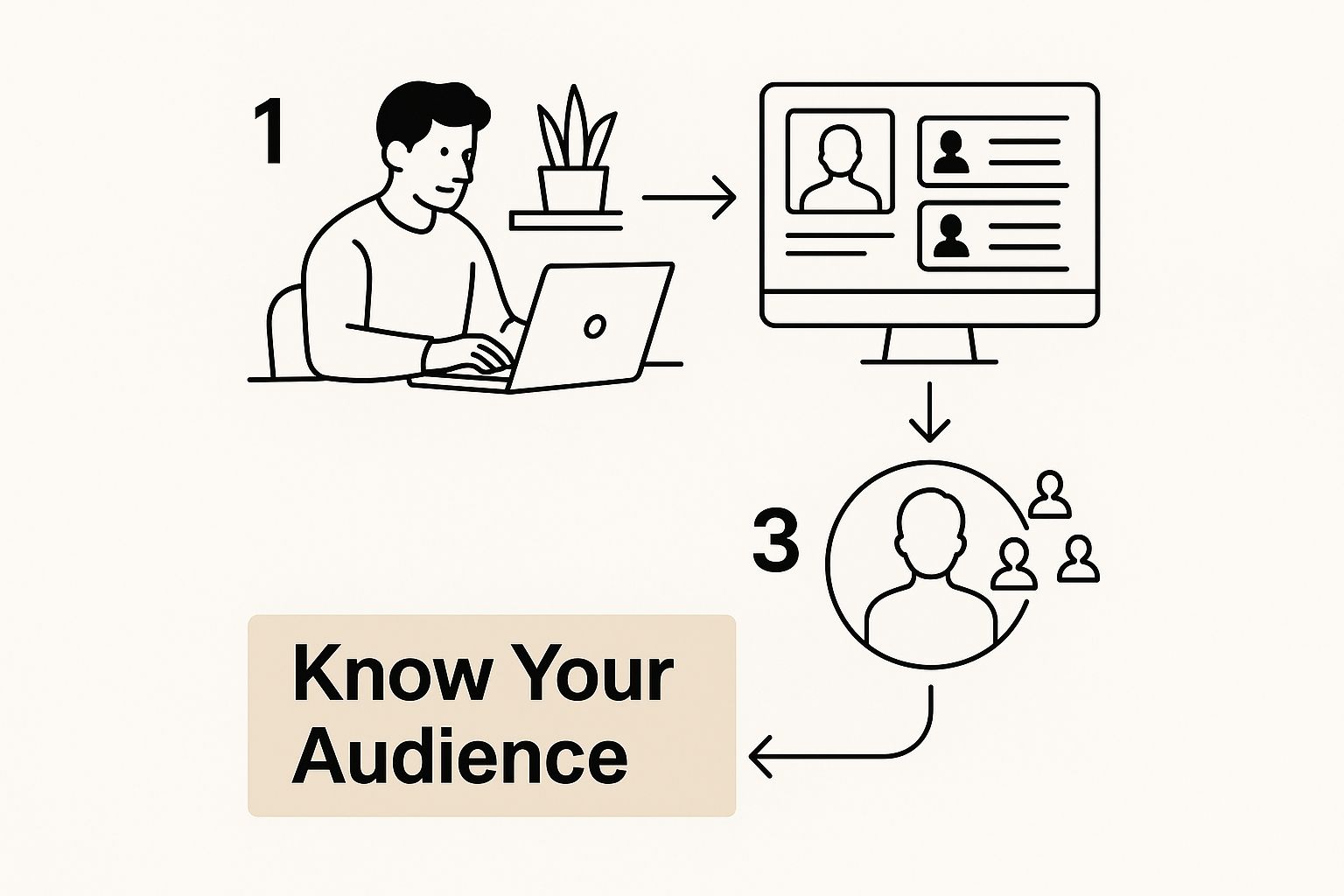
The big takeaway? Your platform choice isn’t about chasing trends. It’s about knowing where your people are and meeting them there.
Selecting the Right Social Media Channels
Every social platform has its own unique vibe and user mindset.
Think about it: the same person scrolling LinkedIn during their lunch break is in a completely different headspace than when they’re laughing at TikToks later that night.
Understanding these nuances is critical to creating content that actually lands.
Picking the right platform can feel overwhelming, so I’ve put together a quick comparison to help you narrow down the best fit for your business.
Social Media Platform Selector for Small Businesses
| Platform | Primary Audience | Best For Content Type | Key Small Business Benefit |
|---|---|---|---|
| Instagram & Pinterest | Gen Z & Millennials (Aesthetically driven) | High-quality photos, short videos (Reels), infographics, tutorials | Excellent for product discovery and building a strong, visual brand identity. |
| Gen X & Baby Boomers (Community-focused) | Community updates, events, long-form video, customer testimonials | Powerful local targeting through ads and building loyal community groups. | |
| TikTok | Gen Z & Younger Millennials (Trend-driven) | Short, entertaining, authentic videos, behind-the-scenes content | High potential for viral reach and showing the human side of your brand. |
| Gen X & Millennials (Professionals & B2B) | Industry articles, case studies, company news, professional insights | The best place to establish thought leadership and connect with B2B clients. |
Ultimately, you’re not just picking a platform; you’re choosing an audience and the context in which you’ll speak to them.
This table should serve as a solid starting point for making that strategic decision.
Building Your Content Pillars
Okay, you’ve picked your channels. Now, what on earth are you going to post? This is where content pillars save the day.
Content pillars are the 3-5 core themes or topics your brand will consistently talk about.
These aren’t random ideas; they should flow directly from your business goals, your customers’ biggest questions, and your unique brand story.
Let’s imagine you run a local coffee shop. Your content pillars might look something like this:
- Behind the Beans: Stories about your coffee sourcing, roasting techniques, and partnerships with farmers.
- Community Spotlight: Featuring local artists whose work hangs in your shop or shouting out other small businesses in the neighborhood.
- Barista Tips & Tricks: Quick videos showing customers how to make a better latte at home or explaining different brewing methods.
- Café Life & Events: Announcing new seasonal drinks, special offers, and promoting your open mic nights.
These pillars act as a creative guardrail. They ensure your content is always relevant and on-brand, which stops the dreaded “what do I post today?” panic right in its tracks.
Consistency builds trust, and trust builds a loyal following.
This approach also makes your life way easier.
You can batch-create content for each pillar, guaranteeing a healthy mix of posts that educate, entertain, and inspire your audience without ever feeling repetitive.
Crafting Content That Connects
With your pillars in place, it’s time to create the actual posts. Let’s be real, we all scroll through our feeds at lightning speed.
Your content has to be designed for a thumb-stopping, mobile-first experience.
As social media becomes a bigger and bigger engine for business growth, the competition for attention is fierce.
Global social media ad spending is projected to climb to around $276.7 billion in 2025. That number tells you one thing: creating high-quality, engaging content isn’t optional anymore.
You can dive deeper into these social media advertising trends to see what this means for small businesses.
Here are a few practical tips for making content that turns casual scrollers into genuine fans.
Eye-Catching Visuals on a Budget
You don’t need a fancy camera crew. Your smartphone is a powerhouse.
- Find good light: Natural light is your best friend. Seriously, just shoot near a window. It makes a world of difference.
- Use free design tools: Platforms like Canva are a game-changer. They have thousands of templates that make it easy to create professional-looking graphics and videos.
- Stay on-brand: Pick a few consistent fonts and colors. Slap your logo on things. Over time, people will recognize your content instantly.
Captions That Encourage Conversation
A great visual makes them stop; a great caption makes them stay.
- Lead with a hook: The first sentence is everything. Ask a question, state a surprising fact, or make a bold claim to pique their curiosity.
- Tell a story: People connect with people. Share the “why” behind your brand or a funny story about what happened in the shop today.
- Always include a call-to-action (CTA): Don’t just post—prompt a response! Ask a direct question like, “Which one of these is your favorite?” or “What are you most excited for this weekend?”
Executing Your Strategy with Smart Tools and Tactics
A brilliant social media strategy is just a document until you bring it to life.
This next part is all about the “doing”—the practical side of managing your social media without it completely taking over your day.
We’re moving from planning to action, using smart tools and clever tactics to make your daily tasks feel less like a chore and more like a smooth, scalable system.
Consistency is the engine that drives social media success. But as a small business owner, who really has the time to create and post something new every single day?
This is precisely where a content calendar becomes your new best friend. Don’t think of it as some rigid, complicated spreadsheet. It’s simply your roadmap for what you’ll post and when.

A good calendar lets you plan out content for weeks, or even a full month, at a time.
This allows you to “batch” your creative work into focused blocks, putting an end to that daily “what should I post?” panic and ensuring you always have a healthy mix of content ready to go.
Automate Your Consistency with Scheduling Tools
Once you have your calendar mapped out, scheduling tools are the logical next step.
Think of these platforms as your personal assistant, automatically publishing your content at the best possible times for your audience to see it.
Suddenly, you can have a presence on weekends or late evenings without actually being tied to your desk.
This is a huge win. The ability to schedule posts frees you up to focus on the human side of social media—actual engagement.
To keep your presence steady across different platforms, it’s worth exploring some of the top social media scheduling tools out there.
They turn your calendar from a static plan into an active, automated workflow.
For a closer look at how these platforms work, check out our guide on https://www.postpaddle.com/blog/social-media-scheduling-software.
The goal of automation isn’t to “set it and forget it.” It’s to handle the repetitive tasks so you can invest your limited time in what truly matters: connecting with your community.
By putting the posting process on autopilot, you carve out precious time for real-time conversations, responding to comments, and building genuine relationships.
Spark Creativity with AI Assistants
Let’s be real—even the most creative person hits a wall sometimes. This is where simple AI-powered assistants can be a massive help.
These tools aren’t the complex, expensive things they used to be; many are now built right into the scheduling platforms you might already be considering.
Treat them like a brainstorming partner. You can lean on AI to:
- Generate post ideas when you’re feeling stuck on a topic.
- Rewrite captions to strike different tones—from witty to professional.
- Suggest relevant hashtags to help your posts reach people beyond your current followers.
- Summarize long-form content, like a blog post, into a few punchy social media updates.
Artificial intelligence is quickly becoming a non-negotiable for small businesses.
In fact, research shows more than 75% of social media strategists now use AI tools in their workflow, helping with everything from content creation to analyzing results.
Master the Art of Community Management
Your social media feed is a two-way street. Pushing out great content is only half the job. The other, arguably more important half, is nurturing a real community through active engagement.
Community management is simply the art of listening to your audience and making them feel heard.
This goes way beyond just liking comments. It’s about answering questions, thanking people for their input, and jumping into conversations.
The way you handle both praise and criticism really defines your brand’s personality and builds a foundation of trust.
Here’s a practical way to approach it:
- Set aside dedicated time: Block out 15-20 minutes, a couple of times a day, just for engagement. This keeps you from getting distracted by notifications all day long.
- Respond to every real comment: A simple “Thanks so much!” shows you’re paying attention. For deeper comments, ask a follow-up question to keep the chat alive.
- Handle negative feedback gracefully: Never just delete a negative comment (unless it’s spam or abusive). Address the issue publicly and calmly, then offer to move the conversation to DMs to solve it. This shows everyone you’re transparent and you care.
Turning followers into a true community doesn’t happen by accident. It’s the direct result of consistent, thoughtful interaction that makes your brand feel less like a business and more like a friend.
Measuring What Matters And Optimizing For Growth

Creating great content is only half the battle. The real insight comes when you learn what’s clicking—and why.
Instead of chasing likes or followers, focus on metrics that actually move the needle for your bottom line.
Is your social media driving people to your website? Turning scrolls into sign-ups? You don’t need to drown in spreadsheets.
Learn to read the story behind your numbers and make smarter decisions each week.
Focusing On Key Performance Indicators
Rather than wrestling every stat, zero in on a few Key Performance Indicators (KPIs) that align with your business goals. These figures give you a clear snapshot of whether your efforts are paying off.
- Engagement RateShows how your audience interacts with posts. Calculate it by dividing total likes, comments, and shares by your follower count, then multiply by 100. A strong engagement rate means your content is resonating.
- Click-Through Rate (CTR)Tracks how many people clicked the link in your post after seeing it. Ideal when you want to move followers from a social platform to your website or product page.
- Conversion RateMeasures how many visitors completed a desired action—like making a purchase or signing up for a newsletter—after clicking through from social media.
“The goal isn’t just to collect data; it’s to collect the right data. Focusing on a few core KPIs that align with your business goals will provide actionable insights instead of just noise.”
Using Platform Analytics To Your Advantage
You don’t need pricey software to gather these insights. Every major platform offers free analytics:
- Instagram Insights (https://business.instagram.com/insights)
- Facebook Business Suite (https://business.facebook.com)
These dashboards reveal your top-performing posts, audience demographics, and peak engagement times.
For example, you might discover that your community loves quick behind-the-scenes videos but scrolls past static images.
Pull demographic details—age, location, active hours—to refine your customer personas. Then schedule posts when your crowd is most likely to see them.
Turning Insights Into Actionable Improvements
Your analytics should guide your next move. Think of data as a living playbook for optimizing content:
- Double Down On What WorksIf short-form videos consistently win high engagement, shift more resources there. You’ll save time and boost results.
- Experiment With A/B TestingTry two different captions or imagery on similar posts to see which performs better. Test calls-to-action, designs, or even posting times.
- Refine And RepeatTreat your strategy as a living document. Set a monthly check-in to review your KPIs, celebrate wins, and tweak underperformers.
This cycle of measuring, learning, and adjusting separates a stagnant presence from one that drives tangible growth.
Before you dive into your next campaign, use the table below to match your objectives with the metrics that matter.
Key Social Media Metrics by Business Goal
This table matches common small business goals with the most relevant social media metrics to track for success.
| Business Goal | Primary Metric to Track | Example KPI | Why It Matters |
|---|---|---|---|
| Increase Brand Awareness | Reach | Impressions per post | Shows how many unique users saw your content. |
| Drive Website Traffic | Click-Through Rate (CTR) | Percentage of link clicks vs. views | Indicates interest and directs visitors. |
| Generate Leads | Conversion Rate | Sign-ups from social campaigns | Reflects how many contacts enter your funnel. |
| Boost Engagement | Engagement Rate | Likes, Comments, Shares per post | Measures how well content resonates. |
| Grow Community | Follower Growth | Net New Followers per month | Tracks expansion of your audience. |
Use this as a checklist when planning posts or campaigns. Match your goal to the KPI, then monitor it closely.
By consistently focusing on the right metrics, you turn guesswork into a clear action plan—and prove the real value of social media.
To dive deeper, check out our guide on how to measure ROI on social media.
Common Mistakes to Avoid in Your Strategy
Look, the fastest way to get your social media right is to learn from everyone else’s mistakes.
Even with the best plan in the world, it’s incredibly easy to fall into a few common traps that can kill your momentum and leave your audience cold.
Think of this section as a field guide to the pitfalls I see small businesses stumble into time and time again.
By knowing what they are ahead of time, you can sidestep them completely.

Treating Social Media Like a Billboard
One of the biggest and most frequent mistakes is turning your social feed into a non-stop sales pitch.
It’s the digital equivalent of being that person at a party who only talks about their job and what they’re selling.
You’d make an excuse to walk away, right? Your followers will do the same—just with a tap of the “unfollow” button.
A feed that’s just a wall of “Buy Now!” posts feels robotic and totally misses the point. Social media is meant to be social.
People are there to connect, to be entertained, and to learn something new. They aren’t there to be yelled at to buy something every five minutes.
This purely promotional approach always backfires. It leads to abysmal engagement, a revolving door of followers, and a reputation for being spammy.
Eventually, the algorithms notice no one is interacting, and they’ll stop showing your content to anyone at all.
Ignoring Your Audience and Feedback
Your social media page is a live, direct line to your customers. Ignoring their comments, DMs, questions, and yes, even their complaints, is a massive blunder that can do real damage to your brand.
When someone takes the time to reach out, silence is the absolute worst response. This goes for the good and the bad.
Failing to say “thanks” for a nice comment is a small miss, but ignoring a complaint can explode a tiny issue into a public-facing disaster.
A brand that responds is a brand that builds trust.
When you ignore your community, you’re telling them you don’t value their business or their experience, which is a great way to send them running to your competition.
Make it a non-negotiable part of your daily routine to check in and respond. It shows there’s a real, caring human behind the logo.
Having an Inconsistent Brand Voice
Another classic error is a chaotic brand voice. If your posts are funny and full of memes one day, then stiff and corporate the next, you’re giving your audience whiplash.
They won’t know what to expect, and that confusion makes it impossible to build a memorable brand personality.
This usually happens when different people are posting without any ground rules. The end result is an identity crisis that makes your brand feel flaky and unreliable.
The fix is simple: create a basic style guide. It doesn’t have to be a novel, just a one-pager that covers:
- Your Brand Voice: Are you witty, inspiring, professional, or quirky? Pick three or four words to define it.
- Visual Style: Decide on a consistent color palette, a couple of fonts, and a go-to filter or editing style for your visuals.
- Content Pillars: Stick to the core topics you defined earlier. This keeps your content focused and always on-brand.
Chasing Vanity Metrics Over Real Results
Being obsessed with follower counts and likes is a fool’s errand. These are what we call vanity metrics—they look impressive on the surface but often mean absolutely nothing for your bottom line.
I’d take 1,000 die-hard fans who buy from me and spread the word over 10,000 passive followers any day of the week.
Chasing vanity metrics leads you down the wrong path, wasting time on things like follow-for-follow schemes that just attract other people trying to grow their own follower count, not actual customers.
Instead, you need to get real and focus on the numbers that actually move the needle for your business:
- Engagement Rate: Are people actually talking back to you? (comments, shares, saves)
- Click-Through Rate (CTR): Are they leaving the app to check out your website?
- Conversion Rate: Are those clicks turning into sales, leads, or email sign-ups?
Tracking these more meaningful KPIs is the only way to know if your social media strategy for your small business is actually working.
Want your Pins to get more clicks without guessing?
Pinterest can be a major traffic source for small businesses—but only if your Pins are optimized.
Grab our free Pin Optimization Checklist to make sure every Pin is set up to perform before you hit publish.
A Few Common Questions (and Our Straight-Up Answers)
Let’s be real, diving into social media can feel like opening a can of worms. You’ve got a business to run, and the last thing you need is more confusion. So, let’s cut through the noise and tackle a few of the questions that probably keep you up at night.
“How Much Time Do I Really Need to Spend on This Every Day?”
This is the big one, isn’t it? It’s less about a magic number and more about being intentional. Forget endless scrolling. What you need are focused bursts of activity.
A solid framework I always recommend is the 15-15-15 rule:
- 15 minutes in the morning: Kick off your day by clearing your notifications. Reply to comments, answer DMs, and acknowledge any new mentions. It immediately shows your audience you’re present and listening.
- 15 minutes midday: Shift your focus outward. Go engage with other accounts. Drop a meaningful comment on a post from a local business you admire, an influencer in your niche, or even one of your most loyal followers.
- 15 minutes in the evening: Time to set yourself up for tomorrow. Get your posts scheduled and do one last sweep for any messages that need a quick reply.
This adds up to just 45 minutes a day. Pair that with a dedicated couple of hours once a week for planning and creating content, and you’ve got a system that builds momentum without burning you out.
“Should I Just Bite the Bullet and Pay for Ads?”
Paid ads can definitely pour gasoline on the fire, but you have to make sure you’ve got a fire going first. My advice is always this: never pay for ads until you know what works for free.
Think of your organic posts as your research and development lab. You’re testing what resonates with your audience at no cost.
Once you spot a post that’s getting great comments, shares, and clicks, that’s your winner. That’s the one you should put money behind.
Paid ads are an accelerator, not a magic wand. They amplify what’s already working. If your organic content isn’t connecting, paying to show it to more people won’t fix the core problem.
When you’re ready, start small. You don’t need a massive budget. Even $5 to$ 10 a day on a highly targeted campaign can give you incredible insights.
Just make sure you have a clear goal, like getting sign-ups for a webinar or driving sales on a specific product.
“Help! I Got a Negative Comment. What Now?”
Okay, first things first: take a breath. Don’t hit delete (unless it’s spammy or genuinely hateful, of course).
A negative comment feels personal, but it’s actually a public opportunity to show everyone how much you care.
Here’s a simple, three-step playbook for handling criticism with grace:
- Acknowledge and Validate (Publicly): Jump in quickly with something simple. “Hi [Name], thanks for bringing this to our attention. We’re really sorry to hear you had this experience.” This immediately de-escalates the situation.
- Show Empathy: A little understanding goes a long way. Let them know you get why they’re frustrated.
- Move It to a Private Channel: This is the key. End your public reply by inviting them to a private conversation. “Could you please send us a DM with your order number? We want to look into this and make it right.”
This approach makes the customer feel heard while protecting you from a drawn-out public back-and-forth.
More importantly, it shows every other person reading that you’re a business that listens and takes responsibility.