
Creating high-quality blog posts is only half the battle.
The most successful content marketers know a powerful secret: the real value lies in giving your existing content a second, third, and even fourth life.
Instead of constantly chasing new ideas, you can strategically reuse blog content to reach new audiences, reinforce your message, and maximize the return on your initial time investment.
In a landscape where content saturation is a constant challenge, working smarter, not harder, is the key to sustained growth.
To truly unlock your content’s hidden potential, it’s crucial to understand the fundamental mechanics behind extending its lifecycle.
Exploring practical strategies on how to repurpose content provides a solid foundation for this approach, emphasizing how one core idea can be spun into multiple wins.
This guide builds on that concept by walking you through eight proven, actionable methods to transform a single blog post into a powerhouse of engagement across diverse channels.
Forget generic advice; we’re diving deep into the specific tactics, tools, and examples you need. From atomizing posts for social media to developing entire educational courses, you will learn how to repurpose your content like an expert and amplify your brand’s voice without burning out.
Let’s get started.
8 Clever Strategies to Repurpose Blog Content and Expand Your Audience
Repurposing your blog posts isn’t about recycling old ideas—it’s about giving your best content new life in formats your audience actually prefers.
The strategies below will help you squeeze more traffic, leads, and engagement out of what you’ve already created, so every strong blog post becomes a multi-channel asset instead of a one-and-done publish.
1. Social Media Content Atomization

One of the most powerful ways to reuse blog content is through a process called atomization. This strategy involves deconstructing a single, comprehensive blog post into numerous smaller, platform-specific pieces of content for social media.
It goes far beyond simply sharing a link; it’s about extracting the most valuable elements of your article and reformatting them to fit the context and user expectations of each social network.
For instance, an in-depth guide on “10 Ways to Improve Your Home Office” can be atomized into a full week of content.
This could include a Twitter thread summarizing the ten tips, an Instagram carousel with a slide for each tip featuring high-quality images, and a LinkedIn post focusing on the productivity benefits of an optimized workspace.
By adapting your core message, you meet your audience where they are, in the format they prefer.
How to Implement Content Atomization
Successfully atomizing your content requires a strategic approach rather than a simple copy-paste job. Consider how different platforms cater to different content styles.
- For Twitter: Extract key statistics, bold statements, or actionable one-liners. Create a thread that walks followers through the main arguments of your blog post.
- For Instagram & Pinterest: Turn key steps or data points into visually compelling graphics, carousels, or Reels. A “how-to” section from your blog is perfect for a step-by-step carousel.
- For LinkedIn: Focus on the professional or industry-level implications of your blog post. Pull out insights that spark discussion among peers and potential clients.
- For TikTok & Reels: Demonstrate a single, quick tip from your article in a short, engaging video format. This is ideal for showing, not just telling.
Key Benefits of Atomization
This method dramatically extends the reach and lifespan of your original work. The infographic below highlights the core benefits you can expect when you effectively reuse blog content through atomization.
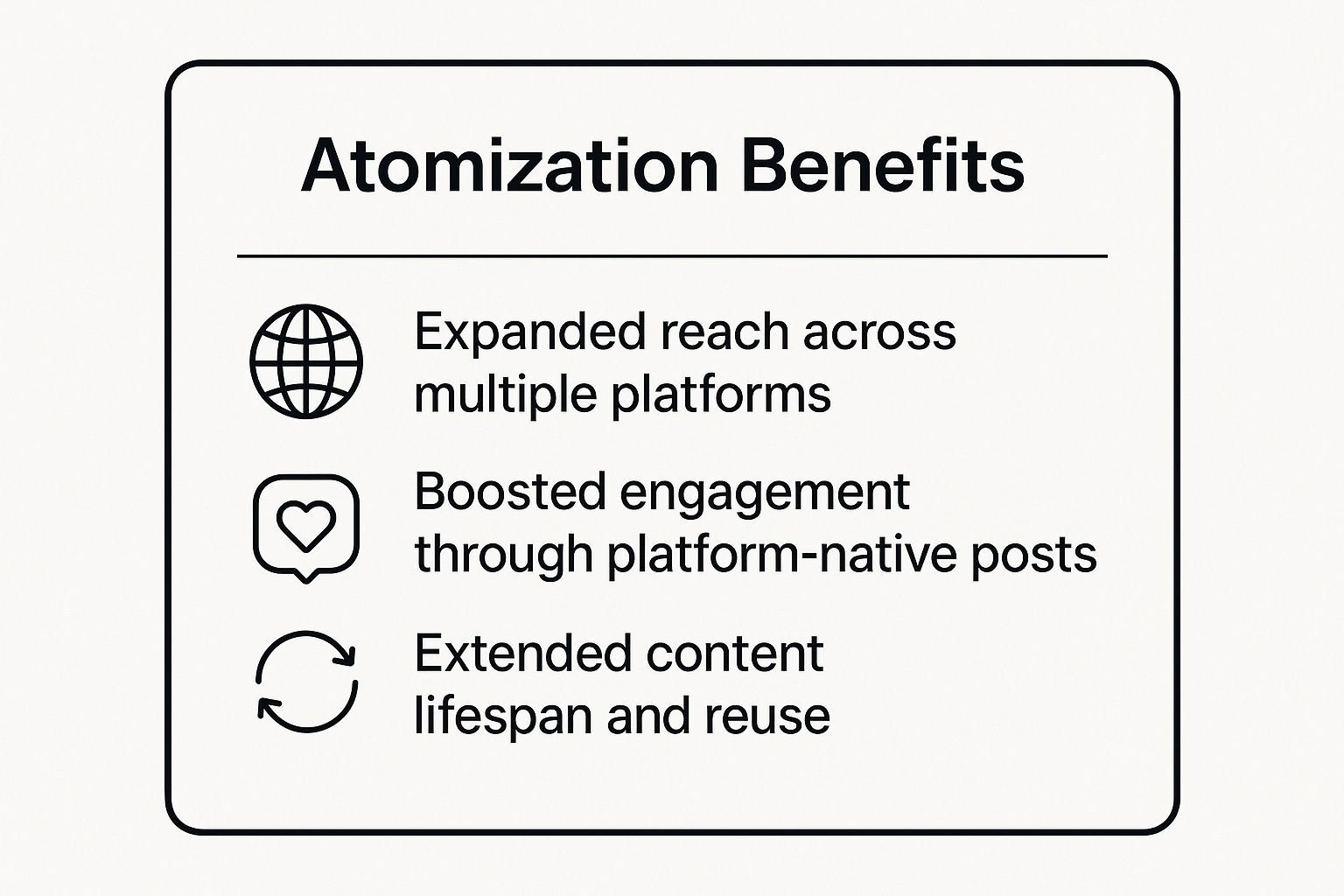
As the visualization shows, this strategy directly impacts your ability to connect with a wider audience and keep your content relevant for longer.
By creating platform-native posts, you’re more likely to see increased interaction, which is a critical factor for success. To dive deeper into platform-specific strategies, you can learn more about how to improve social media engagement on postpaddle.com.
This approach ensures your hard-earned blog content continuously works to build your authority and drive traffic.
2. Email Newsletter Repurposing
Another highly effective way to reuse blog content is by transforming it into engaging material for your email newsletter.
This strategy moves beyond simply sending a link to a new post; it involves thoughtfully repackaging your article’s value into formats designed specifically for the inbox.
By delivering content directly to your most dedicated audience, you nurture relationships and drive repeat traffic back to your site.
For example, a long-form article detailing “The Ultimate Guide to SEO for Small Businesses” can become the foundation for an entire email series. You could send a weekly email breaking down one chapter at a time, creating a serialized course for your subscribers.
This method keeps your audience engaged and anticipating your next send, turning one blog post into a multi-part value delivery system.
How to Implement Newsletter Repurposing
Adapting blog content for email requires a focus on delivering value directly within the message while encouraging click-throughs for more depth.
The format you choose depends on your goals and audience preferences.
- Create a Digest: Curate a “best of” roundup of your recent blog posts. Frame it as a weekly or monthly digest that summarizes the key takeaways from each article, with clear links to “read more.”
- Offer Exclusive Insights: Repurpose a single blog post but add a new, subscriber-only section. This could be an extra tip, a downloadable checklist, or a personal anecdote that wasn’t in the original article.
- Serialize Your Content: Break down a comprehensive pillar post into a multi-part email series. Each email can cover a specific sub-topic, building anticipation and providing bite-sized, digestible lessons.
- Spotlight a Single Post: Dedicate an entire newsletter to one high-value blog post. Rewrite the introduction to hook the reader, present the core arguments or steps, and use a strong call-to-action to drive them to the full post on your website.
Key Benefits of Newsletter Repurposing
This approach strengthens the relationship with your most loyal followers and consistently drives high-intent traffic to your blog. It positions your newsletter as a must-read source of information rather than just a notification system.
By providing tailored content directly to their inbox, you build authority and keep your brand top-of-mind. This ensures that every piece of content you produce has an extended lifecycle and a direct line to your core audience.
This strategy is a cornerstone of many successful content marketing programs. To explore how this fits into a broader plan, you can discover more about various content repurposing strategies on postpaddle.com.
Ultimately, this method makes your blog content work harder, fostering community and supporting your long-term growth goals.
3. Video and Podcast Content Creation

Another highly effective way to reuse blog content is by transforming your written articles into engaging multimedia formats like videos and podcasts.
This strategy directly taps into the massive and growing audience preference for audio and visual content. Instead of just reading about a topic, your audience can watch a demonstration, listen during their commute, or connect with your personality through a more dynamic medium.
Pioneers like Pat Flynn, who regularly turns blog posts into episodes for his Smart Passive Income podcast, have proven the model’s success. Similarly, Rand Fishkin’s famous “Whiteboard Friday” series began by visually explaining concepts from Moz’s blog content.
By converting your text-based assets, you cater to different learning styles and consumption habits, significantly broadening your content’s accessibility and appeal.
How to Implement Video and Podcast Creation
Getting started with multimedia doesn’t require a Hollywood-level production budget. Your blog post can serve as the script or detailed outline for various formats.
- Talking-Head Videos: Simply set up a camera and discuss the main points of your blog post. This is a fantastic way to build a personal connection with your audience.
- Animated Explainers: Use tools to turn complex data or step-by-step processes from your article into a simple, easy-to-follow animated video.
- Podcast Episodes: Record an audio-only version where you discuss the blog topic in-depth. You can even repurpose the audio from your talking-head videos for this.
- Live Discussions: Host a live stream on YouTube or LinkedIn where you present the blog content and engage with your audience through a real-time Q&A session.
Key Benefits of Multimedia Repurposing
This approach allows you to reach entirely new audiences on platforms like YouTube and Spotify, which function as powerful search engines in their own right.
The video below provides a great overview of how to turn a single blog post into a video.
As the video illustrates, a single piece of written work can become a cornerstone for your entire video strategy.
Creating multimedia content also boosts your SEO efforts, as pages with embedded videos often see higher engagement and longer dwell times.
Furthermore, the clips and audio snippets from your primary video or podcast can be used as promotional assets across all your social media channels, creating a powerful content ecosystem.
4. Interactive Content Transformation
Another highly effective way to reuse blog content is to transform it from a static, passive experience into a dynamic, interactive one.
This strategy involves converting the information from a blog post into engaging formats like quizzes, polls, calculators, or assessments. Instead of just reading, your audience gets to participate, which dramatically increases engagement and time spent with your content.
For example, a detailed blog post on “How to Choose the Right Marketing Software” can be repurposed into an interactive assessment that guides users to the best software for their specific needs based on their answers.
Similarly, a post on personality types can become a viral “What’s Your [Blank] Personality?” quiz, a format famously perfected by BuzzFeed. This approach turns consumption into an active, personalized journey.
How to Implement Interactive Content
Creating interactive experiences is more accessible than ever thanks to modern tools. The key is to identify the right blog content and the best interactive format to enhance its value.
- Create Quizzes and Assessments: Use a blog post’s core concepts to build a quiz. A listicle like “7 Signs You Need a New Website” is perfect for a “Should You Redesign Your Website?” assessment. Tools like Typeform or Interact make this process straightforward.
- Develop Calculators: If your blog post involves numbers, data, or ROI calculations (e.g., “The ROI of Content Marketing”), create a simple calculator that allows users to input their own figures and see personalized results.
- Build Interactive Infographics or Polls: Take a data-heavy post and convert it into an interactive infographic where users can click on elements to reveal more information. Alternatively, pull a single, compelling question from your article and turn it into a social media poll to spark immediate engagement.
Key Benefits of Transformation
This method is exceptional for boosting user engagement and generating qualified leads.
By requiring active participation, you create a more memorable and valuable experience for your audience. Interactive content often has a much higher conversion rate than passive content because it delivers personalized results.
For example, gating the results of a detailed assessment behind an email sign-up, like HubSpot’s Website Grader, is a proven lead-generation tactic.
This strategy ensures your evergreen blog content continues to deliver tangible business value long after its initial publication.
5. Long-Form Content Compilation

Another highly effective way to reuse blog content is by compiling several related posts into a single, comprehensive long-form asset.
This strategy involves gathering your existing articles on a specific topic and weaving them together to create a high-value resource like an e-book, an ultimate guide, or a detailed whitepaper.
Instead of leaving visitors to find individual posts, you present them with an authoritative, all-in-one resource.
For example, a series of blog posts covering different aspects of content marketing—like keyword research, on-page SEO, link building, and content promotion—can be aggregated into “The Ultimate Guide to Content Marketing.”
This not only creates a powerful lead magnet to capture email addresses but also positions your brand as a definitive authority in the field. Companies like HubSpot and Moz have famously used this method to build their entire content libraries, turning blog series into cornerstone assets.
How to Implement Long-Form Compilation
Creating a cohesive long-form piece from existing posts requires more than just combining documents. It’s about crafting a new, seamless reading experience that is greater than the sum of its parts.
- Create a Logical Flow: Organize your chosen blog posts into a logical sequence, like chapters in a book. Ensure there is a natural progression from one section to the next.
- Write New Connective Tissue: Add a new introduction to set the stage and a compelling conclusion to summarize the key takeaways. Write transitional sentences or short paragraphs to smoothly link the original articles together.
- Update and Refresh: Review all statistics, examples, and case studies to ensure they are current. Replace outdated information with fresh data to maintain credibility and relevance.
- Design for Impact: Professionally design the final asset as a downloadable PDF, a dedicated landing page, or even a printable booklet. A strong visual design enhances its perceived value.
Key Benefits of Compilation
This approach transforms disparate pieces of content into a substantial asset that can drive significant business results. It packages your expertise in a way that is easy for your audience to consume and save, making it a powerful tool for lead generation and brand building.
By compiling content, you give your best work a second life, solidifying your authority and providing immense value to your audience.
This method ensures your efforts to create quality blog content continue to pay dividends long after the initial publication date.
6. Visual Content Recreation

Another highly effective way to reuse blog content is by transforming your written articles into compelling visual assets.
This strategy involves converting text-heavy posts into infographics, slide decks, charts, and image carousels.
Since a large portion of the population learns visually, this method makes your core message more accessible, memorable, and significantly more shareable across visual-first platforms like Pinterest and Instagram.
For instance, a blog post detailing “The Top 5 E-commerce Trends of the Year” can be reimagined as a vibrant infographic that visualizes each trend with icons and data.
Similarly, a lengthy how-to guide can become a step-by-step image carousel for Instagram or a professional slide deck for SlideShare and LinkedIn. This approach captures attention quickly and distills complex information into an easily digestible format.
How to Implement Visual Content Recreation
Creating effective visuals requires more than just copying text onto a background. It’s about thoughtful design and clear communication that enhances the original content.
- For Infographics: Extract the most impactful statistics, key takeaways, or sequential steps from your blog post. Use tools like Canva or Venngage to design a visually engaging narrative that guides the viewer through the information.
- For Slide Decks/Carousels: Break down each major heading or point from your article into a single slide or image. Each slide should feature a clear headline, a concise supporting point, and a relevant visual element.
- For Charts & Graphs: Identify any data within your blog post that can be visualized. Transforming lists of statistics into bar graphs, pie charts, or line graphs makes the data more understandable and authoritative.
- For Visual Summaries: Create a single, branded graphic that acts as a “cheat sheet” or summary of your article’s main points. This is perfect for sharing on Pinterest and driving traffic back to the full post.
Key Benefits of Visuals
This strategy excels at increasing the shareability and lifespan of your content. By catering to visual learners, you tap into a broader audience segment and make your information more sticky.
A well-designed visual can communicate value instantly, encouraging users to save and share it widely. It reinforces your brand identity through consistent use of logos, colors, and fonts, building recognition with every share.
To get inspired for your next creation, you can explore some effective Pinterest content ideas on postpaddle.com. This approach ensures your insights reach new audiences in a format they love.
7. Community and Discussion Content
Another strategic way to reuse blog content is by transforming it into valuable community and discussion content.
This approach involves adapting your insights to fuel conversations on platforms like Reddit, LinkedIn Groups, Quora, or niche industry forums.
Instead of just sharing a link, you’re using your blog’s core arguments to answer questions, start debates, and provide genuine value, establishing yourself as a helpful expert within a dedicated community.
For example, a detailed blog post comparing two marketing software tools can be repurposed into a highly useful response on Reddit’s r/marketing or as a discussion starter in a relevant LinkedIn group.
The key is to extract the most relevant parts of your analysis and present them as standalone, helpful advice tailored to the community’s specific context. This builds trust and positions your blog as a go-to resource.
How to Implement Community-Driven Content
Engaging effectively in communities requires a value-first mindset. Your goal is to contribute to the conversation, not just to promote your content.
- For Reddit & Niche Forums: Find subreddits or forums where your audience gathers. Extract key findings, data, or step-by-step instructions from your blog post and share them directly in a comment or a new post to answer a question or solve a problem.
- For Quora: Identify questions directly related to your blog post’s topic. Write a comprehensive, well-structured answer using information from your article, then link back to the full post for readers who want more detail.
- For LinkedIn & Facebook Groups: Adapt your blog’s main points into a discussion prompt. Pose a question related to the article’s central theme to encourage professional debate and interaction among group members.
Key Benefits of Community Engagement
This method is incredibly effective for building authority and driving highly qualified traffic. By participating authentically, you connect with an engaged audience actively seeking the information you provide.
This direct interaction not only extends the life of your content but also generates valuable feedback that you can use to improve your original blog posts.
It’s a powerful way to ensure your efforts to reuse blog content lead to meaningful community-building and brand loyalty.
8. Course and Educational Content Development

One of the most valuable ways to reuse blog content is by transforming your expertise into premium educational products.
This approach involves bundling related blog posts, expanding on their concepts, and structuring them into comprehensive online courses, webinar series, or paid workshops. It elevates your best content from free resources into a structured learning experience that generates revenue and solidifies your authority.
For example, a series of blog posts on different aspects of SEO can be compiled and deepened to create a full-fledged “SEO Mastery” course.
Industry pioneers like Brian Dean have successfully used this model, turning their extensive Backlinko blog content into highly sought-after training programs.
This strategy capitalizes on the trust and audience you have already built, offering them a clear path to master the topics you cover.
How to Implement Educational Content Development
Creating a course requires more than just compiling posts. It’s about building a structured, value-driven educational journey for your audience.
- Identify Core Themes: Analyze your most popular blog posts to find recurring themes or pillar topics that resonate with your audience. These will form the foundation of your course modules.
- Structure the Curriculum: Outline a logical learning path, starting with foundational concepts and progressing to more advanced topics. Use your existing blog content as a script or starting point for each lesson.
- Enrich the Content: Add exclusive, premium elements not found in your free content. This can include video lessons, downloadable worksheets, practical exercises, quizzes, and live Q&A sessions.
- Start Small: Test the waters with a mini-course or a live webinar series. This allows you to validate demand and gather feedback before investing the time and resources into creating a full-scale course.
Key Benefits of Course Creation
This method provides a powerful way to monetize your expertise and build a deeper relationship with your most engaged audience members.
It moves beyond simple traffic and engagement, creating a direct revenue stream from your intellectual property.
By offering a structured path to success, complete with certifications or badges, you provide tangible value that users are willing to pay for.
This is a premier strategy to reuse blog content for maximum impact and profitability, as demonstrated by experts like Amy Porterfield, who has built an empire teaching others how to create courses from their own knowledge.
8 Methods for Reusing Blog Content Compared
| Method | Implementation Complexity 🔄 | Resource Requirements ⚡ | Expected Outcomes 📊 | Ideal Use Cases 💡 | Key Advantages ⭐ |
|---|---|---|---|---|---|
| Social Media Content Atomization | Medium (requires platform knowledge and multiple content versions) | Moderate (design and scheduling tools) | Expanded reach and engagement; extended content lifespan | Brands aiming to maximize social media presence across platforms | Multi-platform reach; increased engagement; content reuse |
| Email Newsletter Repurposing | Medium (email formatting and list management) | Moderate (email tools and list building) | Higher engagement; direct audience access; stronger relationships | Businesses focusing on subscriber engagement and traffic back to blogs | Direct inbox access; personalized communication; high engagement |
| Video and Podcast Content Creation | High (equipment, editing skills, multimedia production) | High (audio/video gear, editing software) | Strong personal branding; higher engagement; improved SEO | Creators targeting audio-visual learners and platforms | Multimedia reach; storytelling richness; personal branding |
| Interactive Content Transformation | High (technical skills and specialized tools needed) | High (development time and tools) | Significantly higher engagement; lead generation; data collection | Marketers seeking active user participation and data insights | High engagement; valuable data; strong lead gen potential |
| Long-Form Content Compilation | Medium to High (editing and design intensive) | Moderate to High (design and editing resources) | Authority building; lead magnets; evergreen value | Thought leadership and content monetization strategies | High-value lead magnets; authority positioning; evergreen content |
| Visual Content Recreation | Medium (design skills required) | Moderate (graphic design tools) | Increased shareability; appeals to visual learners | Brands leveraging visual platforms like Instagram or Pinterest | Highly shareable; visually engaging; better comprehension |
| Community and Discussion Content | Medium (deep community knowledge required) | Low to Moderate (time investment) | Thought leadership; targeted traffic; networking | Brands engaging niche communities and forums | Builds authority; targeted engagement; valuable community feedback |
| Course and Educational Content Development | High (curriculum design and tech platform management) | High (time, instructional design, platform hosting) | New revenue streams; strong expertise positioning | Experts creating premium educational resources | Revenue generation; thought leadership; deep learner engagement |
From Single Post to Content Ecosystem

The journey from a single published blog post to a thriving, multi-platform content ecosystem might seem daunting, but as we’ve explored, it’s a process built on strategy, not strain.
The core principle is a fundamental shift in perspective. Stop seeing your articles as finish lines and start viewing them as starting blocks, each one a rich source of potential for dozens of new content pieces.
Mastering the ability to reuse blog content is no longer a “nice-to-have” skill for efficient marketers; it’s an essential strategy for sustainable growth and authority in a crowded digital landscape.
Key Takeaways: From Theory to Action
We’ve covered a wide range of actionable methods, from atomizing posts for social media snippets to compiling them into comprehensive e-books. The common thread is value multiplication.
You aren’t just repeating yourself; you are translating your core message into the native language of different platforms and audiences.
- For the Visual Learner: You transform data points and key steps into compelling infographics and Pinterest pins.
- For the Passive Consumer: You convert detailed guides into engaging podcast episodes or bite-sized video tutorials.
- For the Engaged Community: You spark discussions in Facebook groups or on X with provocative questions drawn from your post’s main arguments.
- For the Action-Oriented Professional: You build out your most popular articles into mini-courses, webinars, or in-depth email series that nurture leads and build trust.
This strategic approach ensures your hard-earned insights don’t just get a single moment in the spotlight. Instead, they get a full-fledged promotional tour, reaching new people and reinforcing your message at every turn.
Your Next Steps: Building a Repurposing Engine
Feeling overwhelmed by the possibilities is normal. The solution is to start small and build momentum. Don’t try to implement all eight strategies at once. Instead, follow this simple plan:
- Identify a Champion: Go to your analytics and find a blog post that is already performing well. Look for high traffic, strong engagement, or a large number of organic keyword rankings. This is your prime candidate.
- Choose One Channel: Pick a single repurposing strategy from this list that aligns with your current goals. If you want to grow your email list, focus on creating a content upgrade. If you want more video engagement, script a short YouTube video based on the post’s key points.
- Execute and Measure: Create the repurposed asset and promote it. Track its performance. Did it drive traffic? Did it increase engagement? Use this data to refine your process.
By focusing on one high-value post and one new format, you create a manageable test case.
As you see the positive results, you can build a repeatable system, creating a content engine that works smarter, not harder. To truly build a content ecosystem from a single post, it’s essential to consider how different formats can feed into one another.
For example, a detailed Podcast Repurposing Guide can show you how to transform audio content into a myriad of other valuable assets, maximizing your reach. The ultimate goal is to create a sustainable cycle where your content perpetually fuels itself, building your brand’s authority and reach long after you hit “publish.”
Ready to Turn Every Blog Content Into Pinterest-Ready Traffic?
You’ve mapped out smart ways to repurpose your blog content, now make sure every Pin you create from it is set up for success.
Use PostPaddle’s FREE Pin Optimization Checklist to quickly review each Pin before you publish, so you stay consistent, follow best practices, and avoid missing simple details that can cost you clicks.
FAQs
What does it mean to repurpose blog content?
Repurposing blog content means taking an existing post and turning it into new formats—like social media posts, carousels, emails, videos, or lead magnets—so you can reach more people without starting from zero each time.
Why should I repurpose my blog posts instead of just creating new ones?
Repurposing saves time, maximizes the work you’ve already done, and helps your best ideas reach people on different platforms. It also reinforces your key messages and can drive more consistent traffic and leads from content that’s already proven to work.
How do I decide which blog posts to repurpose first?
Start with your top-performing posts—those that already get strong traffic, engagement, or conversions. Evergreen topics, how-tos, and in-depth guides are especially good candidates because they translate well into multiple formats and stay relevant longer.
Will repurposing blog content hurt my SEO?
No, as long as you’re not simply duplicating the exact same text across multiple URLs. Repurposing usually involves adapting the content for different platforms and contexts, which supports your SEO by driving more engagement, shares, and backlinks to your original post.
How often should I repurpose or update my blog content?
You can repurpose content on an ongoing basis, especially when you publish a strong new post or notice an older one performing well. It’s also smart to periodically update and refresh key posts—adding new examples, data, or visuals—before turning them into fresh assets for other channels.