Pinterest has evolved far beyond a digital mood board; it is a powerful visual search engine where hundreds of millions of users actively discover ideas and plan their purchases.
Unlike other social platforms where content has a fleeting lifespan, a single Pin can consistently drive website traffic for months, even years. This long-term value makes mastering the platform a critical component of any robust digital strategy.
To succeed here, you need more than just visually appealing images. You need a data-driven approach.
This guide delivers exactly that, breaking down ten of the most effective Pinterest marketing techniques you can implement today.
Forget generic advice; we are diving deep into actionable strategies that turn passive pinners into loyal customers and brand advocates.
10 Smart Pinterest Marketing Techniques
Learn different Pinterest marketing techniques from advanced Pinterest SEO and Rich Pin optimization to creating compelling video content and leveraging seasonal trends.
Each technique is designed to provide you with the specific steps needed to build a powerful, evergreen traffic source for your business.
1. Rich Pins Optimization

Rich Pins are a powerful Pinterest marketing technique that enhances standard Pins by automatically syncing information directly from your website.
This feature provides users with more context at a glance, transforming a simple image into an actionable, informative snapshot.
There are four main types: Product, Recipe, Article, and App Pins, each designed to pull specific metadata to enrich the user experience.
For example, e-commerce brands like Target use Product Rich Pins to display real-time pricing and stock availability, which can significantly drive purchase intent.
Similarly, food bloggers leverage Recipe Rich Pins to show ingredient lists and cooking times, encouraging users to save the Pin for a future meal. This dynamic information makes your content more valuable and trustworthy, boosting engagement without requiring an immediate click-through.
How to Implement Rich Pins
Getting started with Rich Pins involves a one-time technical setup.
First, you must add the appropriate metadata (using Schema.org or Open Graph markup) to the relevant pages on your website.
After adding the code, you’ll use Pinterest’s Rich Pin Validator to apply and get your website approved.
- For E-commerce: Prioritize Product Rich Pins to automate pricing and availability updates.
- For Content Creators: Use Article Rich Pins to display headlines and descriptions, making your content more compelling.
- For Food Bloggers: Implement Recipe Rich Pins to provide crucial details like ingredients and prep time upfront.
The infographic below summarizes the key types and benefits of this feature.
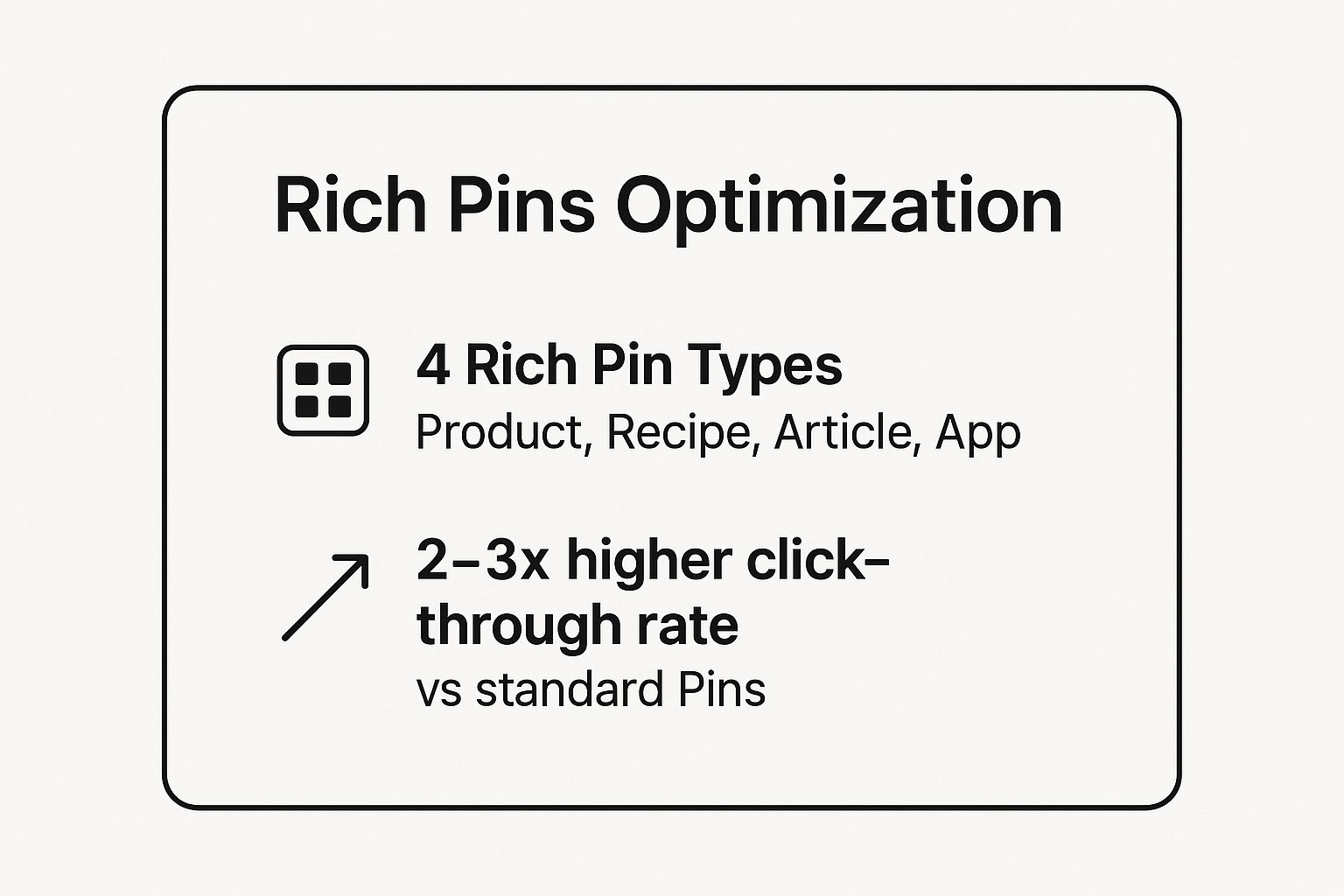
The data clearly shows that the added context from Rich Pins can lead to a substantial increase in user engagement and click-through rates.
By providing extra value directly on the Pin, you create a more seamless and informative journey for potential customers or readers, making it a highly effective optimization strategy.
2. Pinterest SEO Strategy
Pinterest functions as a visual search engine, making search engine optimization a crucial component of any successful Pinterest marketing technique.
This strategy involves using keywords strategically in your Pin descriptions, board titles, and profile information to ensure your content appears in relevant user searches.
Unlike traditional social media, Pinterest content has an exceptionally long shelf life, with optimized Pins continuing to drive traffic for months or even years.
For example, the food blog Pinch of Yum drives over a million monthly visitors from the platform by optimizing recipes for search terms like “healthy weeknight dinners.” Similarly, Canva dominates searches for “Instagram templates” by consistently using relevant keywords across its Pins and boards.
This approach ensures content is discovered by users actively looking for inspiration and solutions. You can learn more about crafting a powerful Pinterest SEO Strategy on PostPaddle.com.
How to Implement a Pinterest SEO Strategy
Getting started requires a search-first mindset. Research how your target audience uses the platform and what terms they search for.
The key is to integrate these keywords naturally where they will have the most impact.
- Keyword Research: Use Pinterest’s search bar autocomplete and the Pinterest Trends tool to identify popular and seasonal keywords.
- Pin Optimization: Place your primary keyword in the first 50-60 characters of your Pin description and include it in your image file name before uploading.
- Board and Profile SEO: Create boards with keyword-rich titles that match user queries and optimize your profile name to include your niche (e.g., “Design Co | Branding Tips”).
The data is clear: treating Pinterest like a search engine is fundamental to long-term success.
By optimizing your content for discoverability, you create a sustainable source of traffic and engagement that works for you around the clock, making it an indispensable marketing tactic.
3. Idea Pins (formerly Story Pins)
Idea Pins are a multi-page, video-first content format designed to keep users engaged directly within the Pinterest platform.
Unlike standard Pins, they do not link to external websites but instead offer a narrative experience with up to 20 pages of video, images, and text. This format is ideal for tutorials, guides, and storytelling, making it a powerful tool for brand awareness and community building.
For instance, a home decor brand can use an Idea Pin to showcase a room transformation with before-and-after videos.
Similarly, a beauty influencer might create a step-by-step makeup tutorial using multiple video clips and text overlays.
This approach makes your content a destination rather than a gateway, encouraging follows and saves directly on Pinterest, which is a key signal to the platform’s algorithm.
How to Implement Idea Pins
The primary goal of this Pinterest marketing technique is engagement, not immediate website traffic.
To succeed, focus on creating valuable, self-contained content that educates or inspires your audience without needing an external link.
- For Brand Awareness: Use Idea Pins to share how-to guides, tutorials, or behind-the-scenes content that showcases your brand’s expertise and personality.
- For Community Building: Create content that encourages user interaction, like asking questions or sharing tips they can try themselves.
- For Content Repurposing: Efficiently adapt short-form video content from platforms like Instagram Reels or TikTok for your Idea Pins.
The video below offers a detailed walkthrough of creating an effective Idea Pin.
By prioritizing in-app engagement, Idea Pins help you build a loyal following on the platform.
This strategy signals to Pinterest that you are a valuable creator, which can lead to greater visibility for all your content, including your standard traffic-driving Pins.
4. Pin Design Best Practices
Effective Pin design is the foundation of successful Pinterest marketing techniques, as the platform is inherently visual.
Well-designed Pins capture attention and dramatically outperform generic or poorly constructed ones. This practice involves combining eye-catching imagery, readable text overlays, brand consistency, and a mobile-first approach to create content that stops the scroll.
A strong design quickly communicates value, making users more likely to save, click, and engage.
For example, Canva leverages bold text and branded templates to create Pins that are instantly recognizable and highly shareable, while lifestyle brands like Real Simple use clean photography with clear, benefit-driven text to entice clicks.
HubSpot, on the other hand, designs infographic-style Pins to present data visually, making complex information digestible.
These brands understand that professional design isn’t just about aesthetics; it directly impacts click-through rates and campaign performance.
How to Implement Pin Design Best Practices
Creating high-performing Pins requires adhering to a few key principles that optimize for the platform’s user experience. The goal is to be clear, compelling, and consistent.
- Optimal Sizing: Always use a 2:3 aspect ratio (e.g., 1000×1500 pixels) to maximize screen real estate on mobile feeds.
- Text & Branding: Add a concise, bold text overlay to communicate your Pin’s main idea quickly. Place a small, non-intrusive logo in a corner for brand recognition.
- Visual Elements: Use high-quality, vibrant images or video. Bright, warm-toned visuals tend to perform better than dark ones.
- Tools: Utilize design tools like Canva or Adobe Express, which offer pre-sized Pinterest templates and easy-to-use design features.
By systematically applying these design standards, you ensure your Pins are visually appealing and strategically crafted to meet your marketing goals.
Creating multiple Pin variations for a single piece of content is also a smart strategy to test which designs resonate most with your audience.
5. Pinterest Ads & Promoted Pins
Pinterest Ads, also known as Promoted Pins, are a powerful marketing technique that allows you to pay to place your content in front of a highly targeted audience.
These ads blend seamlessly with organic Pins, so users can save, share, and engage with them long after a paid campaign ends, creating a unique compounding effect. Pinterest offers diverse formats, from standard and video Pins to carousels and shopping ads, catering to various campaign goals.
For example, e-commerce brands like Wayfair have used Pinterest Shopping ads to double their return on ad spend by connecting their product feeds directly to the platform. Similarly, Mejuri, a jewelry brand, achieved a 35% lower cost-per-acquisition by leveraging targeted shopping campaigns. This demonstrates the platform’s strength in driving lower-funnel conversions when users are actively seeking inspiration and products.
How to Implement Pinterest Ads
To get started, you’ll need a Pinterest Business account and the Pinterest Tag installed on your website for conversion tracking.
Once set up, you can create campaigns through the Ads Manager, targeting users based on keywords, interests, demographics, and past engagement. For marketers looking to efficiently scale their video ad production on Pinterest, consider leveraging an AI video ad generator to create compelling visuals quickly.
- For E-commerce: Use Shopping and Carousel ads to showcase multiple products and drive direct sales.
- For Brand Awareness: Leverage Video ads to tell a story and capture attention in the feed.
- For Lead Generation: Run conversion campaigns that direct users to a landing page with a compelling offer.
This paid strategy is one of the most effective pinterest marketing techniques for accelerating growth, reaching users with high purchase intent, and accurately measuring your return on investment.
By starting with conversion-focused campaigns and retargeting engaged users, you can turn inspiration into action.
6. Content Curation and Board Strategy

A strong Content Curation and Board Strategy is a foundational Pinterest marketing technique that builds your profile’s authority and reach.
Boards are themed collections that organize your Pins, helping users discover your content through search and browsing. An effective strategy involves creating keyword-optimized boards with a healthy mix of your original content and high-quality curated Pins from other creators within your niche.
For example, Joanna Gaines’ Magnolia brand uses boards like “Farmhouse Style” and “Fixer Upper” to capture broad, high-volume search terms.
Similarly, a wedding planner might create distinct boards for “Wedding Dresses,” “Wedding Venues,” and “Floral Arrangements” to target specific queries.
This strategic organization makes your profile a valuable resource, encouraging follows and improving your visibility in search results.
How to Implement a Board Strategy
Start by mapping out the core topics and subtopics of your niche. Each of these can become a board, creating multiple opportunities to rank for relevant keywords.
A balanced approach to pinning keeps your boards active and engaging, signaling to Pinterest’s algorithm that your profile is a current and valuable resource.
- Optimize Board Details: Use keyword research to create board titles that match user search queries. Write detailed, keyword-rich descriptions (150-500 characters) to provide context.
- Curate Strategically: When starting, follow an 80/20 rule: 80% high-quality curated content and 20% your own. This builds your profile’s value without being overly self-promotional.
- Maintain Activity: Keep boards fresh by adding 5-10 new Pins to each one monthly. Using a scheduling tool is an effective way to maintain this consistency. You can find more information on how to schedule Pins on Pinterest here.
- Organize and Refine: Place your most important boards at the top of your profile. Use Board Sections for sub-categorization and periodically archive underperforming boards to maintain a high-quality profile.
7. Pinterest Analytics & Data-Driven Strategy
A data-driven strategy is one of the most powerful Pinterest marketing techniques, moving your efforts from guesswork to calculated action.
Pinterest Analytics offers a comprehensive suite of tools that provide deep insights into Pin performance, audience demographics, and traffic patterns. By leveraging this data, you can understand exactly what resonates with your audience, refine your content, and optimize your approach for maximum impact.
For instance, a home decor brand might discover through analytics that their “budget-friendly DIY” Pins outperform luxury decor content by a 3-to-1 margin, prompting a strategic shift in their content pillars.
Similarly, an e-commerce store can use conversion tracking to find that Pinterest users often convert 2-3 weeks after their initial engagement, highlighting the platform’s role in the consideration phase of the buyer’s journey.
This analytical approach ensures your resources are invested in what truly works.
How to Implement a Data-Driven Strategy
Building a strategy based on analytics involves regularly monitoring key metrics and using the insights to inform your next steps.
The goal is to create a feedback loop where performance data directly influences future content creation and optimization.
- For E-commerce: Install the Pinterest Tag to track website conversions, adds-to-cart, and checkout events to measure the direct ROI of your Pinning efforts.
- For Content Creators: Monitor your top 10 Pins monthly to identify recurring themes, visual styles, or keyword patterns that lead to high engagement and outbound clicks.
- For All Businesses: Check analytics weekly to spot emerging trends early. Focus on metrics like saves and outbound clicks, which are stronger indicators of user intent than impressions alone.
By consistently analyzing this data, you can stop creating content blindly and start making informed decisions.
This transforms your Pinterest presence from a simple image-sharing activity into a predictable and scalable marketing channel.
8. Video Pin Marketing

Video Pins are a dynamic and high-performing Pinterest marketing technique that leverages motion to capture user attention far more effectively than static images. This format is one of Pinterest’s fastest-growing, with videos autoplaying in user feeds to create an immediate, engaging experience.
They are perfect for storytelling, product demonstrations, tutorials, and bringing your brand’s personality to life in a way that static content cannot.
For example, food brands like Tasty have built a massive following with short, overhead recipe videos that are both mesmerizing and informative.
Similarly, Home Depot uses Video Pins for quick DIY project tutorials, while Sephora showcases makeup applications and product textures. This format allows brands to demonstrate value quickly, which is crucial for a platform where users are actively seeking inspiration and solutions.
The increased engagement on video content often translates to higher visibility and reach.
How to Implement Video Pin Marketing
Creating effective Video Pins involves designing for the platform’s unique user behavior. The primary goal is to stop the scroll and deliver a key message within seconds, even without sound.
- For E-commerce: Use short videos (6-15 seconds) to demonstrate a product in use, highlight key features, or show it from multiple angles.
- For Service Providers: Create quick tip videos or animated infographics that solve a common problem for your target audience.
- For Content Creators: Repurpose successful Instagram Reels or TikToks, ensuring they are optimized with a vertical aspect ratio (9:16 or 2:3) for mobile viewing.
The key is to front-load the most compelling content within the first few seconds and use text overlays or captions to convey your message without relying on audio.
A strong cover image is also crucial, as it acts as the thumbnail before the video autoplays. By integrating video, you tap into a format prioritized by Pinterest’s algorithm, making it a powerful strategy for growth.
9. Seasonal and Trend-Based Content Strategy
A seasonal and trend-based content strategy is a powerful Pinterest marketing technique that involves creating and publishing content well in advance of relevant holidays, seasons, and events. Pinterest users are planners, often searching for ideas months ahead.
By aligning your content calendar with these predictive search behaviors and emerging trends, you can capture high-intent traffic during peak planning periods and dramatically increase your visibility.
This forward-thinking approach is essential for staying relevant on a platform built around future planning.
For instance, home decor brands often begin pinning Christmas decoration ideas in September, just as user searches start to rise. Similarly, food bloggers will share Thanksgiving recipes starting in August to build momentum.
This proactive strategy ensures your content is already established and circulating when search volume peaks, maximizing engagement and reach.
How to Implement a Seasonal and Trend-Based Strategy
Implementing this strategy requires careful planning and a deep understanding of your audience’s search timeline.
The key is to publish content early enough to gain traction before the season officially begins.
Start by mapping out a content calendar at least six months in advance, using tools like the Pinterest Trends report to identify when search interest for specific topics begins to climb.
- Plan Ahead: Begin pinning seasonal content 45-60 days before the event or holiday. For major holidays like Christmas, start even earlier (90+ days).
- Leverage Pinterest Trends: Use the official Pinterest Trends tool to identify rising search volumes for your niche and pinpoint the optimal time to publish.
- Study Pinterest Predicts: Review the annual “Pinterest Predicts” report to get ahead of emerging trends that will shape user behavior in the coming year.
- Refresh Evergreen Content: Update and repin successful seasonal content from previous years to capitalize on its existing authority and engagement.
By anticipating user needs and aligning your content with seasonal demand, you create a highly effective funnel that draws in an engaged, ready-to-act audience.
This makes a trend-based approach one of the most reliable Pinterest marketing techniques for driving consistent traffic and conversions year-round.
10. Pinterest Communities and Group Board Collaboration

Pinterest communities and group boards are a powerful marketing technique that allows multiple creators to contribute Pins to a single, shared board.
This collaborative approach expands your content’s reach far beyond your own followers, tapping into the established audiences of other contributors. Participating in high-quality, relevant group boards can significantly boost your exposure and build valuable relationships within your niche.
For instance, a travel influencer might join a “Wanderlust Travel Inspiration” board with hundreds of thousands of followers, instantly putting their Pins in front of a massive, pre-qualified audience.
Similarly, food bloggers often collaborate on boards like “Best Dessert Recipes,” pooling their content to create a comprehensive resource for users. This strategy leverages the collective power of a community to amplify individual reach and drive traffic.
How to Implement Group Board Collaboration
Effective collaboration requires a strategic and selective approach rather than joining every board you find. The goal is to find engaged communities where your content adds value.
To expand your reach and collaborate effectively, learn how to find influencers on Pinterest for your campaigns.
- For Bloggers: Find niche-specific boards to share your articles, focusing on boards with high engagement rates, not just large follower counts.
- For E-commerce Brands: Join group boards focused on product curation, such as “Farmhouse Decor Finds,” to showcase your items to interested shoppers.
- For Service Providers: Contribute helpful tips and infographics to industry-specific boards like “Social Media Marketing Tips” to establish your expertise.
The key to this technique is quality over quantity.
Vet boards carefully using tools like PinGroupie, contribute your best content consistently, and monitor your analytics to see which collaborations are actually driving results.
Don’t rely on group boards as your sole strategy, but use them as a supplement to amplify your primary content efforts.
Pinterest Marketing Techniques Comparison Table
| Item | Implementation Complexity 🔄 | Resource Requirements ⚡ | Expected Outcomes 📊 | Ideal Use Cases 💡 | Key Advantages ⭐ |
|---|---|---|---|---|---|
| Rich Pins Optimization | Medium – Requires technical setup with meta tags and website verification | Moderate – Web development skills needed | Higher engagement & 2-3x click-through rates | E-commerce, food blogs, publishers, app developers | Automatic syncing, improved SEO, professional appearance |
| Pinterest SEO Strategy | Medium – Ongoing keyword research and optimization | Moderate – Time for research and consistent updates | Long-term traffic growth with evergreen Pins | Visual search optimization, broad niche discoverability | Evergreen content lifespan, less competition than Google SEO |
| Idea Pins (formerly Story Pins) | Medium-High – Content creation for multi-page video | High – Video production and creative effort | Increased reach and engagement, community building | Brand awareness, tutorials, educational content | Prioritized by algorithm, higher engagement vs standard Pins |
| Pin Design Best Practices | Medium – Requires design skills or tools | Moderate – Design tools and time for creation | 30%+ more engagement, higher CTR | All Pinterest marketing efforts needing strong visuals | Improves brand recognition, stands out in crowded feed |
| Pinterest Ads & Promoted Pins | High – Paid campaigns setup, conversion tracking | High – Ad budget, creative & analytical resources | Immediate traffic, conversions, ROI potential | E-commerce, home decor, fashion, food & beverage | Combines paid & organic effect, high purchase intent |
| Content Curation and Board Strategy | Medium – Continuous board creation and updating | Moderate – Time for curation and organization | Increased discoverability and profile authority | SEO diversification, topical authority, audience retention | Builds community goodwill, improves SEO, organized profile |
| Pinterest Analytics & Data-Driven Strategy | Medium – Requires setup and regular data analysis | Moderate – Time investment in analytics | Optimized strategy, better ROI tracking | All marketers aiming for data-informed decisions | Identifies top content, reveals user behavior, free tool |
| Video Pin Marketing | Medium-High – Video production and optimization | High – Resources for quality video creation | 2-3x higher engagement, increased time on content | Tutorials, product demos, recipes, storytelling | Prioritized by algorithm, effective engagement and saves |
| Seasonal and Trend-Based Content Strategy | Medium – Advanced planning and trend monitoring | Moderate – Planning and content scheduling | High intent traffic during peaks | Holiday marketing, event planning, seasonal niches | Early trend capture, predictable traffic, less competition |
| Pinterest Communities and Group Board Collaboration | Low-Medium – Joining and managing group boards | Low-Moderate – Time for networking | Expanded reach beyond followers | Niche communities, networking, supplemental reach | Builds relationships, content inspiration, reach amplification |
Bringing It All Together: Your Blueprint for Pinterest Success
Navigating the landscape of Pinterest marketing can feel like assembling a complex puzzle. You have all the pieces: Rich Pins, SEO, Idea Pins, compelling visuals, and strategic ads.
However, true success isn’t found in mastering just one of these elements; it’s in how you connect them to create a cohesive and powerful engine for growth. The ten Pinterest marketing techniques detailed in this guide are not isolated tactics but interconnected components of a holistic strategy.
Think of it as building a house.
Your foundation is a robust Pinterest SEO strategy combined with a meticulously organized content and board strategy. This ensures your presence is discoverable and provides a clear, valuable experience for users who land on your profile.
On top of that foundation, you build the structure with consistently high-quality visuals, adhering to Pin design best practices, and diversifying your content portfolio with engaging formats like Video Pins and dynamic Idea Pins. These are the elements that capture attention and draw people in.
From Tactics to a Sustainable System
Once the core structure is in place, the real work of optimization begins.
This is where you leverage Pinterest Analytics to become a data-driven marketer. Instead of guessing what works, you’ll know. You’ll see which Pins drive the most traffic, which boards generate the most engagement, and how your seasonal content performs.
This data empowers you to refine your approach, doubling down on successful strategies and adjusting those that fall flat.
Furthermore, you can amplify your reach strategically through Promoted Pins and expand your influence by engaging with Pinterest Communities and Group Boards. This transforms your profile from a simple content repository into a dynamic hub for your niche.
The most important takeaways from this journey are:
- Integration is Key: No single technique works in a vacuum. Your SEO efforts support your Pin design, which in turn fuels the performance of your Idea Pins and Promoted campaigns.
- Consistency Over Intensity: A steady stream of well-optimized content will always outperform sporadic bursts of activity. Pinterest rewards consistent, long-term effort.
- Data is Your Compass: Your analytics are not just numbers; they are direct feedback from your audience. Listen to them, and let them guide your every move.
Mastering these Pinterest marketing techniques requires dedication, but the payoff is immense. It allows you to build an evergreen traffic source that works for your business around the clock, connecting you with an audience that is actively searching for inspiration, ideas, and products.
By implementing this blueprint, you’re not just pinning images; you’re building a sustainable asset for your brand.
Ready to Let AI Help You Implement These Pinterest Techniques?
You don’t have to execute all of this manually. You can use Post Paddle’s FREE GPT Collection as an AI sidekick for your Pinterest marketing—helping you brainstorm Pin ideas, refine titles and descriptions, and stay consistent as you roll out the strategies from this guide.
It’s a simple, no-cost way to start using AI alongside your Pinterest workflow while you decide how far you want to scale with automation.
FAQs
What are Pinterest marketing techniques?
Pinterest marketing techniques are strategic ways to use the platform to increase saves, clicks, and conversions. They include tactics like optimizing Rich Pins, using Pinterest SEO, leveraging Idea and Video Pins, running ads, and planning content around trends and seasons.
Why is Pinterest so effective for long-term traffic?
Pinterest works like a visual search engine, not just a social feed. Well-optimized Pins can continue to appear in searches and recommendations for months or even years, turning a single strong Pin into a long-term traffic and sales asset for your business.
What are Rich Pins and why do they matter?
Rich Pins automatically pull extra information from your website—such as product details, article titles, or recipe ingredients—into your Pins. This added context makes your content more informative and trustworthy at a glance, which can boost engagement and click-through rates.
How does Pinterest SEO fit into this strategy?
Pinterest SEO is about using the right keywords in your Pin titles, descriptions, board names, and profile so your content shows up in relevant searches. By researching what your audience is looking for and optimizing around those terms, you increase your chances of being discovered by high-intent users.
How often should I post on Pinterest to see results?
Consistency matters more than volume. A steady schedule of fresh, optimized Pins—supported by a clear board strategy and seasonal planning—helps signal to Pinterest that your account is active and valuable, which can improve your reach and performance over time.