Today, Pinterest has solidified its position not just as a social platform, but as a powerful visual search engine and a crucial e-commerce discovery tool.
For creators, bloggers, and businesses, mastering a robust Pinterest growth strategy is no longer optional; it’s essential for driving targeted traffic, building brand authority, and boosting sales.
With constant algorithm updates and evolving user behavior, the tactics that worked last year may fall flat today.
Generic advice like ‘create beautiful pins’ simply won’t cut it anymore.
To truly succeed, you need a multi-faceted approach that combines technical SEO, consistent content creation, strategic engagement, and data-driven optimization. Success on Pinterest isn’t about one viral pin, but about building a sustainable system that consistently delivers results.
This requires moving beyond surface-level tips and implementing a cohesive, actionable plan.
This article provides a comprehensive roundup of 8 advanced strategies, each a critical component designed to transform your Pinterest presence from a passive mood board into a high-performing marketing channel.
We are skipping the fluff to dive deep into the ‘how’ and ‘why’ behind each tactic. You will find practical steps, real-world examples, and expert insights to help you implement a winning Pinterest growth strategy immediately.
Whether you are a small business owner, a seasoned social media manager, or a blogger looking to amplify reach, these techniques will provide the framework you need for significant growth.
8 Smart Pinterest Growth Strategy Tips
If you want Pinterest to become a real growth engine (not just a place to “be present”) you need a strategy that goes deeper than occasional pinning.
The following eight Pinterest growth tips focus on SEO, consistency, rich features, and data, so every Pin you publish has a clear job: to get discovered, saved, and clicked.
Use them to refine what you’re already doing and uncover the levers that will move your traffic and results the fastest.
1. SEO-Optimized Pin Descriptions and Board Names

The single most impactful element of any Pinterest growth strategy is treating the platform for what it is: a visual search engine.
Unlike other social media feeds where content is fleeting, your Pins can drive traffic for months or even years. To achieve this long-term visibility, you must master Pinterest SEO by optimizing your Pin descriptions, board titles, and profile with relevant keywords.
This ensures your content appears when users search for inspiration, ideas, and solutions.
This strategy is fundamental because it directly connects your content with an audience that has high intent. Users on Pinterest are actively looking for things to try, buy, or do.
When your Pins are properly optimized, you place your products, services, or blog posts directly in their path at the exact moment they are looking for them.
How to Implement Pinterest SEO
Effective implementation goes beyond just stuffing keywords. It involves weaving them naturally into helpful, compelling copy that encourages users to save, click, and engage.
- Pin Descriptions: Write detailed, user-focused descriptions that read like natural sentences. Instead of just “dinner recipe,” a food blogger should use “Easy vegan weeknight dinner recipe ready in 30 minutes.” This targets multiple search queries simultaneously. For a deeper dive into crafting the perfect copy, you can learn more about how to optimize your Pinterest Pins on PostPaddle.
- Board Titles: Name your boards with clear, searchable phrases. A home decor influencer should use “Small Apartment Living Room Ideas” instead of a vague or clever name like “Cozy Nooks.” Think about what a user would type into the search bar.
- Profile Optimization: Your bio and profile name are also indexed. Include your primary keywords here to signal your niche to both users and the Pinterest algorithm.
Actionable Tips for Success
To maximize your organic reach, integrate these practices into your regular pinning routine.
- Use the Search Bar: Type a broad keyword into the Pinterest search bar and pay close attention to the auto-suggestions. These are popular, high-volume search terms that real users are looking for.
- Front-Load Keywords: Place your most important keywords within the first 50-100 characters of your Pin description, as this is what users see in their feed before clicking.
- Analyze Your Data: Regularly check your Pinterest Analytics to see which keywords are driving the most impressions and outbound clicks. Double down on what’s working and adjust your strategy accordingly.
2. Consistent Daily Pinning Schedule

While SEO lays the foundation, consistency is the engine that drives your Pinterest growth strategy forward.
Pinterest’s algorithm favors active accounts that consistently provide fresh, valuable content to its users.
Establishing a regular daily pinning schedule signals to the platform that you are a reliable source of inspiration, which helps boost your visibility in follower feeds, search results, and “More Ideas” sections.
This strategy is crucial because it builds momentum and keeps your audience engaged. Sporadic pinning can lead to dips in traffic and impressions, whereas a steady stream of content ensures your profile remains active and your Pins are continuously distributed.
This approach transforms your Pinterest presence from a passive portfolio into a dynamic traffic-generating machine.
How to Implement a Consistent Schedule
Success with this strategy depends on quality and cadence, not just raw volume.
The goal is to share a mix of your own new content and relevant, high-quality Pins from other creators to provide constant value to your followers.
- Scheduling Tools: Use platforms like Tailwind, Later, or Buffer to automate your pinning. For example, a business can schedule a mix of 15-25 Pins per day, spreading them across different boards and time zones to maximize reach without manual effort.
- Manual Pinning: If you prefer a hands-on approach, dedicate a specific block of time each day, such as 20-30 minutes, to manually find and share Pins. This allows for real-time trend spotting and community engagement.
- Campaign Planning: Plan content around seasons, holidays, or product launches weeks in advance. A food blogger can schedule their holiday recipes in October and November to capture the early planning audience.
Actionable Tips for Success
To maintain a powerful yet manageable schedule, focus on smart distribution and strategic content curation.
- Find Your Cadence: Aim for a range of 10-25 Pins per day. Spacing them out ensures your followers see your content throughout the day rather than all at once. For more detailed guidance, you can explore the ideal Pinterest daily pin limit on PostPaddle.
- Apply the 80/20 Rule: To avoid appearing overly promotional and to build community goodwill, make roughly 80% of your daily Pins curated content from other creators and 20% your own original content.
- Analyze Peak Times: Use Pinterest Analytics to identify when your audience is most active. Schedule your most important Pins, especially those leading to your website or products, during these peak engagement windows.
3. Rich Pins Implementation

A critical, yet often overlooked, component of a sophisticated Pinterest growth strategy is the activation of Rich Pins.
These enhanced Pins automatically sync information directly from your website to your Pins, adding a layer of context and utility that standard Pins lack.
By pulling real-time metadata, Rich Pins make your content more actionable, professional, and trustworthy, which directly encourages more saves and, most importantly, more outbound clicks to your site.
This strategy is vital because it significantly improves the user experience. Instead of a user having to click through to find basic information, that data is presented directly on the Pin itself.
This added context, whether it’s product pricing, recipe ingredients, or an article headline, makes a user more likely to engage with and save your content, signaling to the Pinterest algorithm that your Pins are high-quality and valuable.
How to Implement Rich Pins
Implementation is a one-time technical setup on your website that pays long-term dividends. Once validated, any content pinned from your site will automatically become a Rich Pin. There are four main types you can leverage:
- Product Rich Pins: Essential for e-commerce, these display real-time pricing, availability, and product information. Major retailers like Target and Walmart use these to drive direct sales from Pinterest.
- Recipe Rich Pins: Food bloggers can display ingredients, cooking times, and serving sizes directly on the Pin, making their recipes far more appealing to users planning their meals.
- Article Rich Pins: Perfect for bloggers and content creators, these show the headline, author, and a story description, giving users a preview that entices them to click through and read more.
- App Rich Pins: These show an install button (on mobile), allowing users to download your app directly from Pinterest.
Actionable Tips for Success
To get the most out of this feature, focus on a clean technical setup and ongoing maintenance.
- Add Metadata to Your Site: Ensure your website has the necessary Open Graph or Schema.org metadata for Pinterest to read. Many website platforms and SEO plugins (like Yoast for WordPress) make this process straightforward.
- Validate with Pinterest: Once the metadata is in place, go to Pinterest’s Rich Pin Validator. Enter a URL from your site that has the metadata and apply for validation. The approval process is typically quick.
- Keep Website Info Updated: The beauty of Rich Pins is their automatic nature. If you update a product’s price or a recipe’s cook time on your website, the corresponding Pin will update automatically, ensuring accuracy.
4. Pinterest Advertising and Promoted Pins
While organic reach is the foundation of a strong Pinterest growth strategy, paid promotion is the accelerator.
Pinterest Advertising, through its Promoted Pins feature, allows you to boost your best content, reach highly targeted audiences, and drive specific actions far more quickly than organic efforts alone.
By investing in ads, you can guarantee visibility for your most important Pins, ensuring they are seen by users who are actively searching for products, services, and ideas just like yours.
This strategy is powerful because it allows you to get in front of your ideal customer with precision. Unlike other platforms where ads can feel interruptive, Pinterest ads are integrated seamlessly into the user’s discovery experience.
Brands can leverage various ad formats like Standard Pins, Video Pins, Carousel Ads, and Shopping Ads to achieve goals ranging from brand awareness and website traffic to direct sales and lead generation.
How to Implement Pinterest Advertising
Successfully implementing Pinterest ads involves a strategic approach to targeting, creative, and budgeting.
You must align your campaign objectives with the right ad format and audience to maximize your return on ad spend.
- Campaign Objectives: Start by defining your goal. Are you aiming for brand awareness, consideration (website traffic), or conversions (sales, sign-ups)? Pinterest’s campaign setup guides you through selecting the objective that best fits your business needs.
- Targeting Options: Combine interest, keyword, and demographic targeting to build a precise audience. For example, an e-commerce brand can use Shopping Ads to showcase products to users who have searched for “sustainable home decor” and have shown interest in minimalist design.
- Ad Creative: Use high-quality, vertical images or videos that are visually compelling and clearly communicate your value proposition. Ensure your branding is visible but not overpowering. For instance, Home Depot successfully promotes DIY project Pins that inspire users and drive in-store or online purchases for the necessary materials.
Actionable Tips for Success
To get the most out of your advertising budget, approach your campaigns with a plan for testing and optimization.
- Promote Your Winners: Start by promoting your best-performing organic Pins. These Pins have already proven to resonate with your audience, giving them a higher likelihood of success as an ad.
- Use Layered Targeting: Don’t rely on just one targeting method. Combine keyword targeting with interest-based audiences to reach users with both active and passive intent, broadening your reach without sacrificing relevance.
- Create Dedicated Landing Pages: Ensure the user experience is seamless by directing ad traffic to a dedicated landing page that directly corresponds to the Pin’s content. A Pin advertising a specific product should link directly to that product page, not your homepage.
- Test Different Ad Formats: Experiment with various formats to see what performs best. A service-based business might find that a short Video Pin explaining their process drives more qualified leads than a standard image Pin.
5. Leverage the Power of Video Pins
An essential component of any modern Pinterest growth strategy is embracing video content.
Video Pins are dynamic, eye-catching, and receive preferential treatment from the Pinterest algorithm, leading to higher engagement and reach.
Unlike static images, videos autoplay in the feed, immediately capturing user attention and telling a more complete story in a short amount of time. This format is incredibly effective for tutorials, demonstrations, and storytelling.
This strategy is powerful because it stops the scroll. A moving Pin stands out in a sea of static images, encouraging users to pause, watch, and engage. Brands like Tasty have built massive followings by creating short, satisfying recipe videos that are highly shareable and saveable.
This approach works across countless niches, from DIY craft tutorials showing a process from start to finish to fashion brands showcasing outfit combinations in motion.
How to Implement a Video Pin Strategy
Success with Video Pins requires a different approach than static content. The goal is to deliver value quickly and visually, with or without sound.
- Process Demonstrations: Show, don’t just tell. A food blogger can create a time-lapse of a recipe being made. A DIY creator can demonstrate a specific crafting technique. These short tutorials provide immense value and position you as an expert.
- Product Showcases: E-commerce brands can use video to show products in action. A video of a dress flowing as a model walks or a piece of equipment being used is far more compelling than a flat product photo.
- Storytelling: Use video to give a behind-the-scenes look at your brand, share a customer testimonial, or animate a series of tips. This builds a deeper connection with your audience.
Actionable Tips for Success
To maximize the impact of your Video Pins, optimize them for the platform’s unique viewing environment.
- Design for Vertical Viewing: Always create videos in a vertical aspect ratio (like 9:16) to fill the entire mobile screen. The majority of Pinterest users are on mobile, so this is critical.
- Hook Viewers Immediately: You have less than three seconds to capture attention. Start with the most compelling part of your video, such as the finished product or a dramatic action shot.
- Add Text Overlays: Since videos autoplay on mute, use text overlays to communicate your key message, list ingredients, or provide step-by-step instructions. This ensures your video is understood even without sound.
- Create a Compelling Cover Image: The cover image is what users see before the video plays and what appears on your boards. Make sure it’s a high-quality, well-designed image that works as a standalone Pin and entices users to watch.
6. Story Pins and Fresh Content Creation
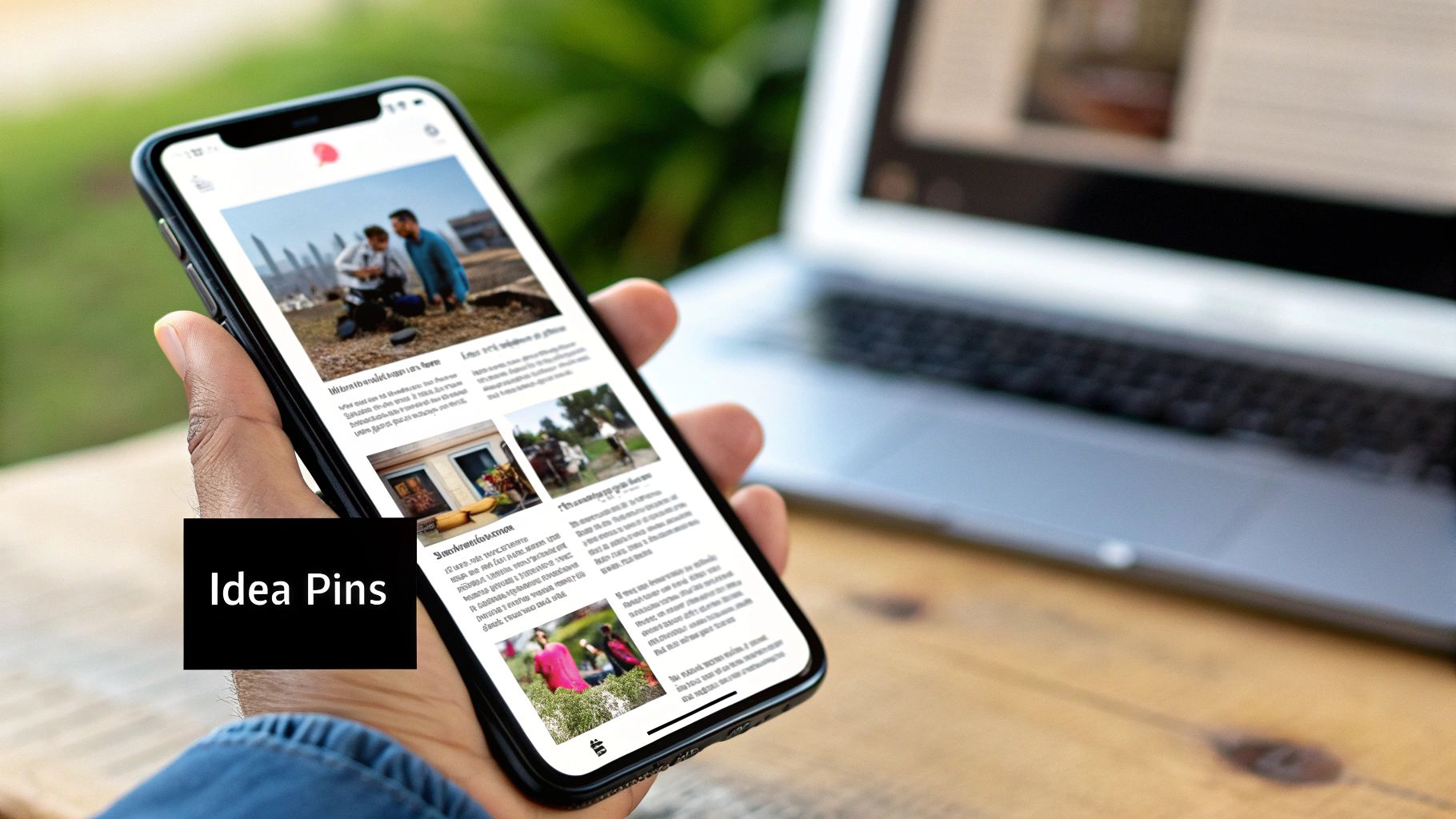
A powerful component of any modern Pinterest growth strategy involves prioritizing the creation of fresh content, especially through Pinterest’s native immersive format, Idea Pins (formerly Story Pins).
Idea Pins are multi-page video or image carousels that allow you to create step-by-step guides, tutorials, and behind-the-scenes narratives directly on the platform.
The Pinterest algorithm heavily favors this format because it keeps users engaged on the app longer, rewarding creators who use it with significant organic reach.
This strategy is crucial because it taps into user behavior that favors discovery and learning. By providing value upfront within the Pin itself, you build authority and brand loyalty.
For instance, a chef breaking down a complex recipe into simple, visual steps in an Idea Pin is more likely to earn a follow than a static image linking to a blog post, as the user receives immediate value.
How to Implement Idea Pins
Successful Idea Pins tell a compelling story. They should have a clear beginning, middle, and end, guiding the user through a process or narrative in a visually appealing way.
- Story Arc: Plan your narrative before you start creating. A home renovation Idea Pin could start with a “before” shot, show key steps in the process across several pages, and end with a dramatic “after” reveal.
- Step-by-Step Guides: This format is perfect for tutorials. A makeup artist can dedicate each page to a specific step in a transformation process, from foundation to finishing touches, using a mix of short video clips and static images.
- Valuable Information: Each page or “slide” of your Idea Pin should offer a tangible tip or piece of information. A gardener documenting plant growth can add text overlays on each page detailing watering schedules, sunlight needs, and pest control tips.
Actionable Tips for Success
To get the most out of Idea Pins and fresh content, integrate these practices into your content calendar.
- Maintain Visual Consistency: Use high-quality visuals and consistent branding (fonts, colors, logo placement) across all pages of your Idea Pin to create a professional and recognizable look.
- Include a Clear Call-to-Action: While Idea Pins don’t have direct outbound links, your final page should always include a call-to-action. Encourage users to “Follow for more tips” or “Save this idea for later.”
- Create Thematic Series: Boost engagement by creating a series of related Idea Pins. A fitness coach could create a “5-Day Ab Challenge,” releasing one short workout Idea Pin each day to keep their audience coming back for more.
7. Pinterest Analytics and Data-Driven Optimization

An effective Pinterest growth strategy is not built on guesswork; it’s built on data.
By consistently analyzing your performance, you can move from creating content you think your audience wants to creating content you know they engage with.
Pinterest Analytics provides a treasure trove of information about your audience, your top-performing Pins, and the content formats that drive the most engagement, allowing you to refine your approach for maximum impact.
This data-driven optimization is crucial because it eliminates wasted effort. Instead of blindly pinning, you can identify precisely what works and double down on it.
For example, data might reveal that your recipe Pins with “quick” in the title get three times more saves or that your vertical video Pins outperform square image Pins by a significant margin. This insight allows you to strategically allocate your creative resources to activities that yield the highest return.
How to Implement Data-Driven Optimization
The key to this strategy is turning raw data into actionable insights.
This involves regularly reviewing your analytics dashboard and asking critical questions about your content’s performance and your audience’s behavior.
- Audience Insights: Start by understanding who you are reaching. Pinterest Analytics shows you demographics like age, gender, and location, as well as their top interests. Use this information to ensure your content aligns with the people you are actually attracting.
- Content Performance: Dive into your Pin-specific data. Identify which Pins generate the most impressions, saves, and outbound clicks. Look for patterns in the topics, formats (static image vs. video), color schemes, and call-to-action phrases that characterize your top performers.
- Track Traffic and Conversions: To measure the true business impact of your Pinterest efforts, use UTM parameters on your Pin URLs. This allows you to see exactly how much traffic and which conversions originate from Pinterest within your Google Analytics account. For a comprehensive guide on this, explore the fundamentals of Pinterest tracking on PostPaddle.
Actionable Tips for Success
Incorporate data analysis into your weekly workflow to stay agile and responsive to audience preferences.
- Schedule Weekly Check-ins: Dedicate 30 minutes each week to review your Pinterest Analytics. Focus on key metrics like impressions (reach), saves (future intent), and outbound click rate (immediate action).
- A/B Test Your Creatives: Use data to form hypotheses. If Pins with bold text overlays perform well, create two versions of your next Pin: one with a bold overlay and one with a subtle one. Track their performance to see which design resonates more.
- Monitor Seasonal Trends: Use the “Trends” tool within analytics to identify rising search terms related to your niche. Plan your content calendar around these seasonal peaks to capture high-intent traffic. For instance, a home decor blogger can anticipate the surge for “cozy fall living room” searches in late summer.
8. Community Engagement and Collaboration Strategy
Pinterest is often viewed as a solitary discovery platform, but building relationships is a powerful and underutilized Pinterest growth strategy.
By engaging with other creators, participating in group boards, and collaborating on content, you can tap into established audiences and significantly amplify your reach.
This approach transforms Pinterest from a simple content repository into an interactive community hub.
This strategy is effective because it leverages the network effect.
When you collaborate with another creator or contribute to a popular group board, you gain exposure to their followers, who are likely interested in your niche.
It’s a reciprocal relationship that builds authority, drives referral traffic, and signals to the Pinterest algorithm that your content is valuable and endorsed by others in your field.
How to Implement Community Engagement
Authentic engagement is key. This isn’t about spamming other people’s content with generic comments; it’s about building genuine connections that lead to mutual growth and support.
- Group Boards: These are collaborative boards where multiple creators can pin content related to a specific topic. Joining high-quality, relevant group boards places your Pins in front of a larger, targeted audience. For example, a travel blogger specializing in European destinations could join a board like “Europe Travel Inspiration” to reach thousands of interested pinners.
- Creator Collaborations: Partner with creators in your niche on a shared project, such as a collaborative board or a seasonal guide. A fashion creator and a beauty blogger could team up to create a “Summer Wedding Guest Style Guide” board, cross-promoting each other’s content to both audiences.
- Authentic Interaction: Regularly engage with content from other creators in your niche. Leave thoughtful comments, save their Pins to your relevant boards, and share their work when it aligns with your audience’s interests. This builds goodwill and makes others more likely to reciprocate.
Actionable Tips for Success
To make community building a core part of your Pinterest strategy, focus on quality over quantity.
- Research Group Boards: Before joining, vet group boards for high engagement and strict contributor rules. Look for boards with a good ratio of followers to contributors and active pinning. Avoid boards that feel spammy or have low-quality content.
- Follow the Rules: Every group board has its own set of rules regarding pin frequency, content type, and description formatting. Adhere to these strictly to maintain your contributor status and build a positive reputation.
- Give Before You Take: Build relationships gradually. Follow and engage with potential collaborators for a period before reaching out with a proposal. Show genuine interest in their work first.
- Participate in Trends: Engage with Pinterest’s official seasonal campaigns and trending topics. Creating content around these themes increases your visibility and connects you with a wider community of creators participating in the same trend.
Pinterest Growth Strategy: 8-Point Comparison Guide
| Strategy | Implementation Complexity 🔄 | Resource Requirements ⚡ | Expected Outcomes 📊 | Ideal Use Cases 💡 | Key Advantages ⭐ |
|---|---|---|---|---|---|
| SEO-Optimized Pin Descriptions and Board Names | Moderate – requires keyword research and ongoing updates | Moderate – time for research and writing | Long-term organic traffic growth, improved search rankings | Brands wanting sustainable, organic reach | Increases discoverability, boosts Google & Pinterest SEO |
| Consistent Daily Pinning Schedule | Medium to High – daily ongoing effort or automation | High – content creation and scheduling tools | Consistent visibility, audience engagement | Accounts seeking steady follower growth | Maintains high activity, leverages algorithm favoring active users |
| Rich Pins Implementation | High – technical website integration required | Moderate – developer time and Pinterest approval | Higher CTR, enhanced pin credibility | E-commerce, blogs needing rich contextual info | Automatic metadata syncing, professional appearance |
| Pinterest Advertising and Promoted Pins | High – requires budget allocation and campaign management | High – financial investment and ad optimization | Immediate visibility and targeted traffic | Businesses wanting fast growth via paid ads | Precise targeting, measurable ROI, scalable promotion |
| Video Pin Strategy | Medium to High – video creation skills needed | High – video production resources | Increased engagement and conversion rates | Brands leveraging storytelling and high engagement | Higher saves and reach, favored by algorithm |
| Story Pins and Fresh Content Creation | High – multi-page content planning and creation | High – time and creative effort | Increased organic reach and engagement | Creators focusing on tutorials and storytelling | Algorithm priority, strong audience connection |
| Pinterest Analytics and Data-Driven Optimization | Medium – requires consistent data review and interpretation | Moderate – analytics tools and time investment | Optimized strategy leading to better results | Marketers aiming to refine and scale efforts | Enables informed decisions, tracks ROI and growth |
| Community Engagement and Collaboration Strategy | Medium to High – requires ongoing interaction and networking | Moderate to High – time dedication | Expanded reach, stronger partnerships | Creators/brands focusing on community growth | Builds relationships, cross-promotion channels |
Bringing It All Together: Automate and Elevate Your Pinterest Strategy

You’ve just navigated a comprehensive blueprint for a powerful Pinterest growth strategy.
We’ve explored the foundational pillars, from mastering Pinterest SEO and implementing a consistent pinning schedule to leveraging the dynamic power of Video Pins and Idea Pins.
Each tactic, whether it’s setting up Rich Pins to pull metadata automatically or diving deep into your analytics, represents a crucial lever for growth. However, understanding these components individually is only the first step.
The true magic happens when you integrate them into a cohesive, streamlined, and sustainable system.
The core challenge for any creator, marketer, or business owner isn’t a lack of knowledge; it’s a lack of time and resources to execute consistently.
Juggling keyword research, content creation, daily scheduling, and performance analysis can quickly lead to burnout, causing your strategy to falter.
This is where the intersection of smart tactics and intelligent automation becomes your greatest competitive advantage.
Key Takeaways for Sustainable Growth
To truly succeed, shift your perspective from simply “doing Pinterest” to building an efficient Pinterest engine. This means treating your Pinterest growth strategy not as a list of tasks, but as an interconnected system.
- Consistency is Non-Negotiable: A sporadic approach yields sporadic results. Consistent daily pinning, driven by a well-planned content calendar, signals to the Pinterest algorithm that you are a reliable source of fresh, valuable content.
- Data-Driven Decisions Trump Guesswork: Your Pinterest Analytics is not a vanity dashboard; it’s a roadmap. Regularly analyzing which pins drive outbound clicks, which board topics resonate, and what content formats perform best allows you to refine your strategy with precision, allocating your resources where they will have the most impact.
- SEO is the Foundation of Discovery: Pinterest is a visual search engine. Every Pin description, board title, and piece of on-Pin text is an opportunity to be discovered by a user actively searching for inspiration, solutions, and products. A robust SEO approach ensures your content has a long-lasting life, driving traffic months or even years after being published.
Your Actionable Path Forward
Transforming this knowledge into results requires immediate, focused action. Don’t let this momentum fade. Here are your next steps to operationalize your new Pinterest growth strategy:
- Conduct a Content Audit: Review your existing pins and boards against the SEO best practices we discussed. Identify and optimize your top 10 underperforming but high-potential pins with new, keyword-rich descriptions.
- Schedule a “Fresh Pin” Brainstorm Session: Dedicate one hour this week to creating 5-7 new Pin designs for your single best-performing piece of content (like a blog post or product page). Remember, fresh creative is key.
- Explore an Automation Tool: The single most impactful step you can take to ensure consistency is to implement an automation and scheduling platform. This frees you from the daily grind of manual pinning, allowing you to focus on high-level strategy and creative development.
Ultimately, a winning pinterest growth strategy is one that works for you, not against you.
It should be a system that amplifies your efforts, automates the repetitive tasks, and provides clear insights for intelligent decision-making.
By combining the powerful, specific tactics covered in this article with the efficiency of modern tools, you are no longer just participating on Pinterest.
You are strategically engineering sustainable growth, driving qualified traffic to your website, and building a powerful asset for your brand that delivers results around the clock.
Ready to Turn Your Growth Strategy Into Consistently Strong Pins?
A smart Pinterest growth plan only works if every Pin you publish lives up to it.
Use PostPaddle’s FREE Pinterest Pin Optimization Checklist as a quick run-through before you hit “publish,” so you stay intentional, consistent, and aligned with the tactics from this guide on every single Pin—not just the first few.
Turn your strategy into a simple, repeatable habit you can follow in minutes.
FAQs
What is a Pinterest growth strategy?
A Pinterest growth strategy is a focused plan for how you’ll use the platform to increase your visibility, saves, followers, and website traffic. It typically includes SEO optimization, consistent pinning, strong visuals, strategic boards, and regular performance reviews.
How long does it take to see growth on Pinterest?
Pinterest is more of a long-term, compounding channel than a “go viral overnight” platform. With consistent implementation of a solid strategy, many creators and businesses start noticing meaningful improvements in impressions and clicks within a few weeks to a few months.
Do I need to Pin every day to grow on Pinterest?
You don’t have to Pin all day, every day—but you do need consistency. A steady schedule of high-quality, SEO-optimized Pins will usually outperform sporadic posting. Tools like schedulers and checklists can help you stay consistent without being glued to Pinterest.
What matters more for growth: design or SEO?
Both matter and work best together. Strong design helps your Pins stand out and get clicked or saved, while good SEO (keywords in titles, descriptions, and board names) helps those Pins actually get discovered in the first place.
How do I know if my Pinterest growth strategy is working?
Track metrics like impressions, saves, outbound clicks, and top-performing Pins and boards. Over time, you should see upward trends in visibility and traffic. Use that data to double down on what works—topics, formats, or styles—and adjust or drop what isn’t performing.