Think of your product description as more than just a block of text.
It’s your digital salesperson, working around the clock to answer one fundamental question in your customer’s mind: “Is this product for me?”
The best ones tell a story, focusing on the real-world benefits for the buyer, not just a dry list of features.
It’s about building a connection that makes someone confident enough to click “add to cart.”
Why Your Product Descriptions Are Losing You Sales

Before we get into the nitty-gritty of writing great copy, we need to talk about the elephant in the room: weak, uninspired product descriptions are silent sales killers.
So many e-commerce brands treat this crucial step as an afterthought, just another box to check before a product goes live.
That’s a huge, costly mistake.
This description is often the very last thing a person reads before they decide whether to buy from you or click away.
It’s your chance to close the deal, bridging that final gap between a casual browser and a loyal customer.
When it falls flat, the consequences are both immediate and expensive.
The Hidden Costs of Poor Copy
Vague, generic descriptions breed uncertainty. They leave shoppers with more questions than answers, forcing them to either abandon their cart or, even worse, buy based on a guess.
That uncertainty is a direct path to two of the biggest headaches for any online store:
- Sky-High Product Returns: When the product that shows up at their door doesn’t match the one they pictured in their head, it’s coming right back to you. This isn’t just a lost sale; you’re now dealing with the costs of reverse logistics, restocking, and a hit to your brand’s reputation.
- Rampant Cart Abandonment: If a customer feels even slightly unsure, they won’t risk their money. A description that fails to build confidence or answer key questions is basically an invitation for them to see what your competitors are offering. We talk more about this in our guide on how to improve website conversion rates.
The financial hit is staggering. A whopping 64% of users return online purchases simply because the product didn’t match the description.
Looking at the UK market, about 25% of all online orders are sent back. A major driver for this is inadequate product information, a problem costing businesses billions every year.
You can find more on these statistics about product description impacts at bigstarcopywriting.com.
Turning a Liability into an Asset
The moment you start seeing your product descriptions as a critical investment instead of a chore, everything changes.
They become your best opportunity to build trust, forge an emotional connection, and give customers the confidence they need to make a purchase.
A great product description doesn’t just describe; it persuades. It transforms a simple list of specs into a compelling solution for the customer’s problem, making them feel understood and secure in their decision.
This infographic really drives home the real-world cost of getting this wrong. It shows exactly how those returns and lost orders directly eat into your bottom line.
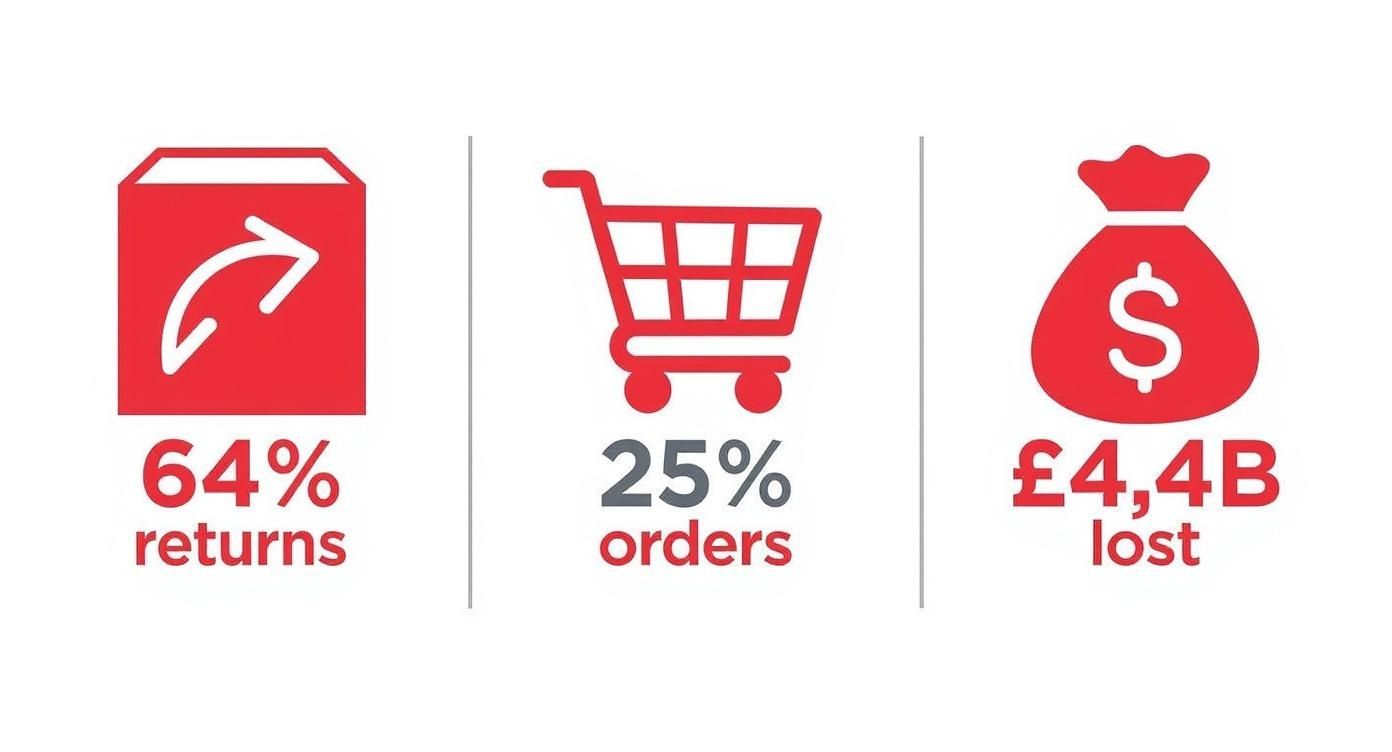
These aren’t just abstract numbers. They prove that subpar copy is a massive financial drain that erodes both your profits and your customers’ loyalty.
By learning how to write compelling descriptions, you’re not just creating better text; you’re building a more stable, profitable, and trusted brand.
Discover Who You’re Really Writing For

Here’s the thing about powerful product descriptions: they don’t just shout into the void. They start a conversation with a very specific person.
If you try to write for everyone, you’ll end up connecting with no one. That’s why the first, most critical step is to get crystal clear on exactly who you’re talking to.
Forget vague demographics like “women, ages 25-40.” That’s uselessly broad. What we really need is a practical customer persona—a detailed profile of your ideal buyer that feels like a real person.
This isn’t some fluffy marketing exercise; it’s the strategic foundation that will guide every single word you choose.
Moving Beyond Basic Demographics
To write copy that truly lands, you have to get inside your customer’s head. What keeps them up at night?
What are they hoping your product will help them achieve? More importantly, what specific problem are they trying to solve right now?
Answering these questions is how you turn a boring product description into an irresistible solution.
Let’s say you sell high-performance, ergonomic office chairs.
Your target isn’t just “remote workers.” It’s “Alex, a freelance graphic designer who spends 10+ hours a day at their desk and is terrified that long-term back pain will derail their career.”
See the difference? Now you know exactly what matters: long-lasting comfort, serious posture support, and durability. The color options are secondary.
Uncovering Customer Truths in Reviews
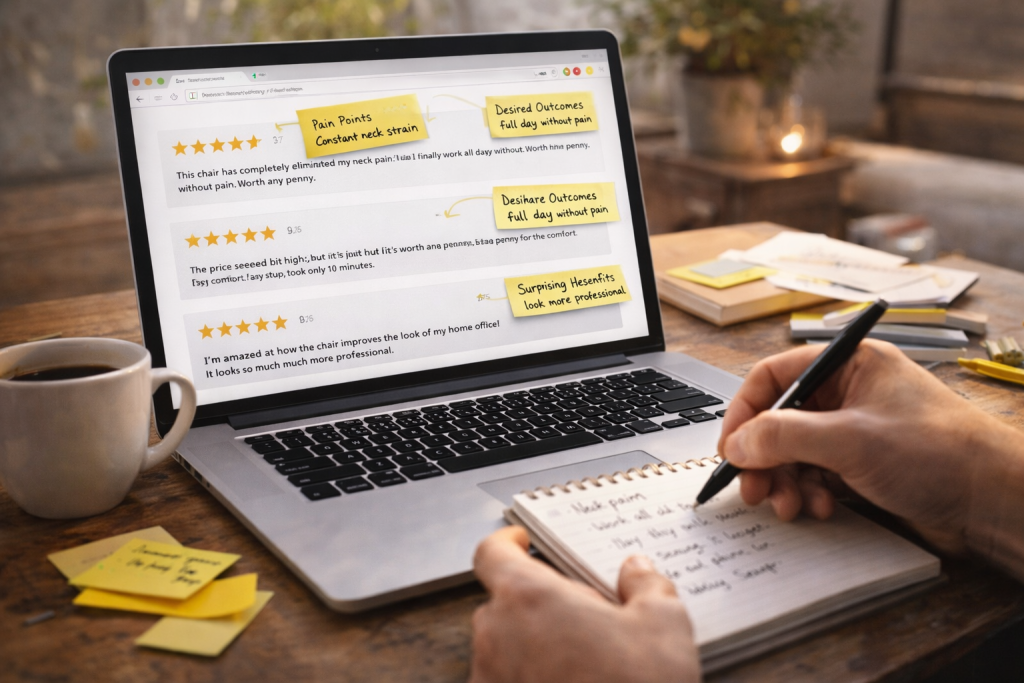
One of my favorite places to find raw, unfiltered customer insights is in product reviews—both on your own site and your competitors’.
This is where people drop the marketing speak and tell you what they really think, in their own words.
When you’re digging through reviews, keep an eye out for recurring themes and specific phrases. You’re looking for gold nuggets like these:
- Pain Points: What problem were they trying to fix? Look for phrases like “constant neck strain” or “my old chair was a total nightmare.”
- Desired Outcomes: What does success look like to them? Are they celebrating being able to “finally work a full day without pain”? That’s your goal.
- Purchase Hesitations: What almost stopped them from buying? Maybe they were worried about the price or “dreading a complicated assembly.”
- Surprising Benefits: Did they find a perk they didn’t expect? Perhaps they love how the chair’s design “makes my home office look so much more professional.”
These phrases are pure copywriting gold. They are the exact words your future customers are already thinking. Weaving them into your descriptions builds instant trust and makes people feel seen.
By listening to the language your customers use, you can mirror it back to them in your descriptions. This creates a powerful sense of being understood, which is a cornerstone of effective persuasion.
Listening to Social Conversations
Think of social media as a massive, ongoing focus group that you can tap into anytime.
Use social listening tools or just run some simple searches on platforms like Reddit, in relevant Facebook groups, or on Instagram.
Find threads where people are asking for recommendations or complaining about common problems in your niche.
What questions keep popping up? What features do people absolutely rave about?
This gives you a direct line into their daily lives and helps you understand their priorities in a way that dry demographic data never could.
When you know your customer this deeply, you can write a description that makes them feel like your product was made just for them. And that’s when they click “Add to Cart.”
Writing for Both Scanners and Readers
Let’s face it: not everyone shops the same way. Some people are meticulous, reading every single word and comparing every last detail.
But a whole lot more of us are scanners. We’re busy, we’re on a mission, and we give a page less than 15 seconds to convince us we’re in the right place.
Your product description has to work for both of these people. A dense wall of text will send scanners bouncing in a heartbeat.
But if all you offer is a few vague bullet points, you’ll never earn the trust of the detailed readers.
So, how do you solve this? You build your description in layers.
The goal is to give scanners the quick-hit info they crave while providing the rich detail that convinces readers to click “buy.” It’s a balancing act, but it’s the secret to converting more of your traffic.
Start with a Hook They Can’t Ignore
Think of your opening line as the most valuable piece of real estate on your product page. It’s your one chance to make a scanner pause and actually pay attention.
The best way to do this is with a powerful headline and a short, emotionally-driven paragraph.
Let’s say you’re selling a pair of high-end, noise-canceling headphones. The scanner doesn’t initially care about the specific decibel reduction or the frequency range. They care about what it feels like to use them.
- Weak Headline: “High-Fidelity Noise-Canceling Headphones”
- Strong Headline: “Finally, Your Own Private Oasis of Sound”
See the difference? The second one connects with a feeling, a desired outcome.
Follow that up with a quick one- or two-sentence description that paints the picture: “Escape the chaos of open offices and noisy commutes.
Slip these on and immerse yourself in pure, uninterrupted audio, so you can focus, relax, or simply enjoy your favorite playlist like never before.”
With just a few words, you’ve hooked the scanner with a powerful benefit and given the reader a taste of the quality and story behind the product.
Use Benefit-Packed Bullets for Scanners
Right after the hook, scanners are looking for a quick, scannable summary of why they should care. This is where bullet points shine.
But this is also where so many product descriptions fall flat—they list features instead of benefits.
A feature is what a product is or has. A benefit is what the customer can do with it. Your job is to translate dry specs into tangible outcomes that make your customer’s life better.
Thinking back to our headphones, let’s see what this transformation looks like in practice.
Feature vs. Benefit Transformation
| Product Feature (What it is) | Customer Benefit (What it does for them) |
|---|---|
| 40-hour battery life | Enjoy non-stop music for an entire week of commutes on a single charge. |
| Memory foam earcups | Work or travel in total comfort for hours without pressure or fatigue. |
| Multi-device Bluetooth pairing | Switch seamlessly between your laptop and phone without ever touching a setting. |
This format is a scanner’s dream. They can grasp the core value propositions in just a few seconds.
For the more detailed readers, this list acts as a perfect table of contents, previewing the deeper information they’ll find as they keep reading.
Go Deep for the Detail-Oriented Reader
Okay, you’ve successfully kept the scanners on the page. Now it’s time to close the deal with the readers who need more substance.
This is where you can finally dive into the details, expanding on the features and benefits you introduced in the bullet points.
The key here is to keep it organized. Use clear, descriptive subheadings to break up the text into bite-sized sections. For our headphone example, you might create sections like this:
- All-Day Comfort for Marathon Sessions: Here, you can talk about the premium materials, the lightweight design, and the ergonomic testing that went into crafting those memory foam earcups.
- Crystal-Clear Calls in Any Environment: This is your chance to detail the advanced microphone technology that filters out background noise, ensuring their voice is always heard, whether they’re on a busy street or in a crowded cafe.
This layered structure really is the key to writing product descriptions that work for everyone.
You give scanners the instant gratification they demand, and you provide readers with the in-depth information they need to feel confident in their purchase.
By catering to both, you leave no customer behind and give yourself the best possible chance of making the sale.
Integrating SEO Without Sounding Like a Robot
There’s a common myth that you have to choose between writing for search engines and writing for actual people.
Thankfully, that’s just not true. The best product descriptions do both, weaving in SEO so smoothly that customers never even notice.
The goal isn’t to trick Google’s algorithm. It’s to make it incredibly easy for the right people—the ones already looking for what you sell—to find your product.
Good SEO is about connection, not just stuffing keywords into a page. It’s about digging into the exact words and phrases your ideal customer types into a search bar when they have a problem your product can solve.
When you nail this, you don’t just climb the rankings; you attract qualified visitors who are far more likely to buy.
Finding Your Customer’s Language
Before you write a single word, you have to get inside your customer’s head. I’ve found that great keyword research is less about technical tools and more about empathy.
Your mission is to uncover the natural language your audience uses to talk about their needs and the solutions they’re searching for.
Start with the obvious. Brainstorm a list of “seed keywords” for your product. If you’re selling a portable espresso maker, your list might look something like this:
- Portable espresso machine
- Travel coffee maker
- Handheld espresso press
- Camping coffee gear
These primary keywords are your foundation. But the real gold is often found in the long-tail keywords—those longer, super-specific phrases that signal real intent.
A generic search for “coffee maker” is just browsing. But a long-tail keyword like “lightweight espresso maker for hiking” tells you everything.
This person values portability and weight. Now you can speak directly to that specific need, creating a much stronger connection.
Tools like Ahrefs, SEMrush, or even the “People also ask” section on Google can be a goldmine for these phrases.
Look for the questions people are asking, and then build your description around giving them the answer.
This is the core of smart content optimization—making every word work for both the reader and the search engine.
Weaving Keywords into Your Copy Naturally
Once you have your list, it’s time to work those keywords into your copy. The key is to make it feel completely natural.
Keyword stuffing—cramming keywords everywhere they’ll fit—is an old-school tactic that will make you sound like a robot and can even get you penalized by Google.
Instead, place your keywords where they’ll have the biggest impact.
- Product Title/Headline: Your main keyword absolutely has to be here. It’s the first thing both shoppers and search engines see.
- Opening Paragraph: Work your primary keyword and a strong secondary one into the first sentence or two. It instantly reassures the reader they’ve landed in the right place.
- Subheadings: Use long-tail keywords in your subheadings. This breaks up the text, makes it easy to scan, and tells Google what each section is about.
- Bullet Points: Weave keywords into your benefit-focused bullets. Instead of just “Durable design,” try something like, “Built with a shock-resistant case perfect for camping and travel.”
- Image Alt Text: Don’t neglect your images! Alt text should be a short, descriptive phrase that includes a keyword, like “portable espresso maker pouring a rich crema shot.”
When done right, SEO enhances the user experience, it doesn’t detract from it.
By using the same language your customers use, your descriptions become more relevant, more persuasive, and most importantly, more discoverable.
If you really want to get this right and master SEO for product descriptions, you can turn organic search from a chore into your most profitable sales channel.
Finding and Honing Your Brand Voice
Think of your product description as a direct conversation with a customer. It’s not just a list of specs and features; it’s about how you say it.
A consistent, memorable brand voice can make the difference between a one-time sale and a loyal, repeat customer.
Your brand voice is really just its personality. Is your brand witty and playful, like a clever friend dropping some helpful advice?
Or is it more luxurious and aspirational, painting a picture of an elevated lifestyle? This personality shapes every single word you choose.
Nailing your brand voice means you can stop competing on price alone. You start building an identity that pulls in the right kind of people—your ideal customers—and makes them feel like they’re part of something special.
Defining Your Brand’s Personality
Before a single word gets written, you have to decide who your brand is. I find the easiest way to do this is to imagine your brand as a person. What are their core values? What characteristics define them?
This doesn’t have to be some complicated, drawn-out process. Just jot down three to five adjectives that really capture the essence of your brand.
This simple exercise gives you an incredibly powerful filter for every description you write from here on out.
A few real-world examples:
- A minimalist skincare brand might be: Clean, calm, scientific.
- An adventurous outdoor gear company could be: Rugged, inspiring, dependable.
- A high-tech gadget store is likely: Precise, forward-thinking, insightful.
These keywords are your north star. If you’re the “rugged” brand, your writing should lean on strong, active verbs. If you’re the “calm” brand, your sentences might feel shorter and more serene.
This simple foundation is the key to staying consistent across your entire store.
From Adjectives to Actionable Voice
Once you have your core adjectives, the next step is translating them into actual writing choices. What does “dependable” really sound like on the page?
This is where you can put together a simple style guide for yourself or your team.
Just look at the tech industry. In 2023, the technology sector made up more than 25% of the entire content writing services market, which shows you how heavily these brands rely on clear, effective copy.
Since 87% of shoppers do online research before buying, a tech brand’s voice must feel authoritative without being intimidating.
You can get a full breakdown of the content writing services market at market.us.
So, how does a voice actually come to life in your writing? It boils down to a few key things:
- Word Choice: Do you use simple, everyday language, or do you lean into more technical, industry-specific terms?
- Sentence Structure: Are your sentences short and punchy, or are they longer and more descriptive?
- Tone: Is the overall feeling energetic and exciting, or is it more reassuring and professional?
This even extends beyond the words themselves. The language you use should feel like it belongs with your visual identity—your logos, colors, and photography.
For a deeper dive on this, our guide on how color psychology in marketing can show you how to reinforce your message visually.
A strong brand voice isn’t about being the loudest in the room; it’s about being unmistakable.
When a customer reads your description, they should get a sense of familiarity and trust, almost like they’re hearing from a brand they already know and respect.
When you consciously shape your brand’s personality and define its voice, every product description does more than just sell an item. It builds your brand identity, fosters genuine customer loyalty, and creates a shopping experience that truly sets you apart.
Write Product Descriptions That Sell (Using the Keywords Buyers Actually Use)
High-converting product descriptions don’t come from hype—they come from clarity. The right keywords help you describe your product the way real shoppers think, search, and compare.
Use our free Pinterest Keyword Research tool to uncover high-intent phrases, long-tail variations, and “buyer language” you can naturally weave into your hooks, bullets, subheadings, and even image alt text.
You’ll write faster, sound more confident, and reduce the questions that cause hesitation (and cart abandonment).
And once you find your best keywords, you can reuse them across your product pages, pins, and collections for consistency.
Answering Your Top Product Description Questions
Even with a solid plan, you’re bound to hit a few snags when writing product descriptions. Questions always pop up, and it’s easy to get stuck wondering if you’re on the right track.
This section is here to tackle those common sticking points head-on.
Think of this as your personal cheat sheet for those “what if” moments. We’ll dig into everything from finding the right word count to figuring out where AI fits in, giving you the clarity to write with confidence.
How Long Should a Product Description Be?
This is the million-dollar question, and the honest answer is, it depends.
There’s no magic number. Slapping a one-size-fits-all word count on every product is a surefire way to either bore your customer with too much detail or leave them with unanswered questions.
The trick is to match the amount of information to the product’s complexity.
- For simple, everyday items like a basic t-shirt or a coffee mug, less is more. Aim for around 100-150 words. A short, punchy paragraph followed by 3-5 bullet points covering the key benefits is usually perfect. It gives people everything they need to know at a glance.
- For complex or big-ticket products—think high-end electronics, specialized software, or a performance mountain bike—you need to build a much stronger case. Here, 300-500+ words isn’t just acceptable; it’s often necessary to build trust. Just be sure to break up that longer copy with clear subheadings so it’s easy to digest.
The real golden rule isn’t about word count; it’s about making your copy scannable and valuable. Always lead with the most important, benefit-driven information.
That way, you’ll catch the skimmers while still providing the in-depth details for the meticulous researchers who need every last spec before they buy.
Ultimately, the only way to know for sure is to test. Try out different lengths and formats, and let your analytics and conversion rates tell you what your audience truly prefers.
What Are the Most Common Mistakes to Avoid?
I see this all the time: a product description that completely forgets who it’s for. When copy falls flat, it’s almost always because it’s focused on the product’s features instead of the customer’s problems and desires.
To make sure your descriptions hit the mark, steer clear of these common traps:
- Listing Features, Not Benefits: This is mistake number one, by a long shot. Don’t just tell me it has a “lithium-ion battery.” Tell me it “runs all day long on a single charge.” It’s not about what your product is; it’s about what it does for the customer.
- Using Fluffy, Meaningless Words: Clichés and empty adjectives like “high-quality,” “innovative,” or “best-in-class” are just noise. They don’t mean anything without proof. Instead of saying it’s high-quality, show it by describing the premium materials or meticulous craftsmanship.
- Ignoring SEO: If you aren’t using the keywords your customers are searching for, they’ll never find your amazing product. A brilliant description is worthless if no one ever sees it.
- Creating a “Wall of Text”: Nothing scares a potential buyer away faster than a giant, dense block of text. Break up your copy. Use short paragraphs, subheadings, and bullet points to make it inviting and easy to read on any screen.
- Having an Inconsistent Tone of Voice: Your product descriptions should all sound like they come from the same brand. If you’re witty and casual on one page but stiff and formal on another, you’ll confuse customers and weaken your brand’s identity.
Dodge these five pitfalls, and your descriptions will immediately be more persuasive, readable, and better at turning browsers into buyers.
Should I Use AI to Write My Product Descriptions?
AI has certainly changed how we create content, and that includes product descriptions. So, should you use it?
Yes, absolutely—but think of it as a talented assistant, not a replacement for a skilled writer. Handing the entire job over to AI is a big mistake.
AI tools are incredible for getting past that dreaded blank page. They can quickly turn a list of technical specs into benefit-focused bullet points or spit out a dozen different headlines in seconds.
But they have some serious blind spots.
An AI often misses the subtle nuances of a brand’s unique voice and doesn’t have the human empathy to make a real emotional connection.
The copy can come out feeling a bit generic, lacking the spark that actually convinces someone to buy.
For those looking at tools, an AI product description generator can definitely speed things up, but it’s just the first step.
The best approach is a hybrid one:
- Let AI do the heavy lifting. Use it to generate a first draft, brainstorm different angles, or create a solid outline.
- Have a human editor bring it to life. This is where the magic happens. A person needs to step in to inject personality, nail the tone, fact-check the details, and add the persuasive touches that an algorithm just can’t replicate.
Never just copy and paste an AI-generated description and call it a day.
Use these tools to work faster and smarter, but always make sure a human has the final word to ensure your copy truly connects with your audience.