
Scaling content marketing isn’t just about writing more articles or posting more on social media.
It’s about building a smart system that lets you produce more high-quality content without a proportional increase in resources.
You’re essentially moving from one-off projects to a well-oiled machine that predictably generates content to fuel your business growth.
Building Your Foundation for Scalable Content

Before you hit the accelerator, you have to build the engine. Trying to scale your content marketing efforts without a solid foundation is a recipe for chaos.
Adding more people or tools to a broken process just makes the chaos more expensive.
This foundational stage is less about creative genius and more about operational excellence.
It’s about creating a playbook that ensures consistency, efficiency, and quality, no matter who is writing the copy or designing the graphic. This is what turns guesswork into a repeatable, predictable system.
Before we dive into the specific steps, it’s crucial to understand the core pillars that will support your scaling efforts. Think of these as the non-negotiable elements of your content operations playbook.
Core Pillars of a Scalable Content Foundation
This table breaks down the essential components, their strategic purpose, and the key outcome for your team before scaling content operations.
| Component | Purpose | Key Outcome |
|---|---|---|
| Documented Strategy | Provides a single source of truth for goals, audience, and topics. | Full team alignment on what success looks like and how to get there. |
| Brand & Voice Guidelines | Defines the brand’s personality, tone, and formatting rules. | Consistent brand experience across all content, regardless of the creator. |
| Repeatable Workflows | Turns complex processes into simple, step-by-step checklists. | Reduced bottlenecks, faster onboarding, and consistent quality control. |
With these pillars in mind, you can start putting the pieces together to create a system that’s truly built to last.
Document Your Content Strategy
Your content strategy can’t just live in your head or a few scattered Slack messages. It needs to be a living, breathing document that your entire team can access.
This document is the North Star for everything you create, clarifying your goals, who you’re talking to, your core topics, and how content guides customers through their journey.
When your strategy is documented, everyone—from a new freelance writer to a senior marketer—is on the same page. It stops mismatched efforts before they start.
Key Takeaway: A documented strategy is your single source of truth. It defines success and provides a clear roadmap, ensuring every piece of content is created with a purpose.
A key part of this documentation is a practical social media content calendar. It’s a simple but powerful tool for organizing your publishing schedule and keeping the whole team aligned on what’s coming up.
Develop Brand and Voice Guidelines
If you want to scale, you have to empower other people to create content that sounds like you. That’s where brand and voice guidelines come in.
This isn’t just about logos and color palettes; it’s about defining your brand’s personality on the page.
Your guidelines should get specific. Include things like:
- Tone of Voice: Are you authoritative, witty, or inspiring? Give “do this, not that” examples to make it crystal clear.
- Formatting Rules: Detail how to use headings, bullet points, and bold text to create a consistent visual style.
- Grammar and Style Preferences: Settle the debates. Oxford comma or no? AP style headlines? Define it all here.
These guidelines act as guardrails, giving creators the freedom to be creative within a defined framework. The result is less heavy-handed editing and a much more consistent brand experience.
The process of building this system starts with a clear-eyed look at where you are now, followed by strategy development and, finally, streamlined production.
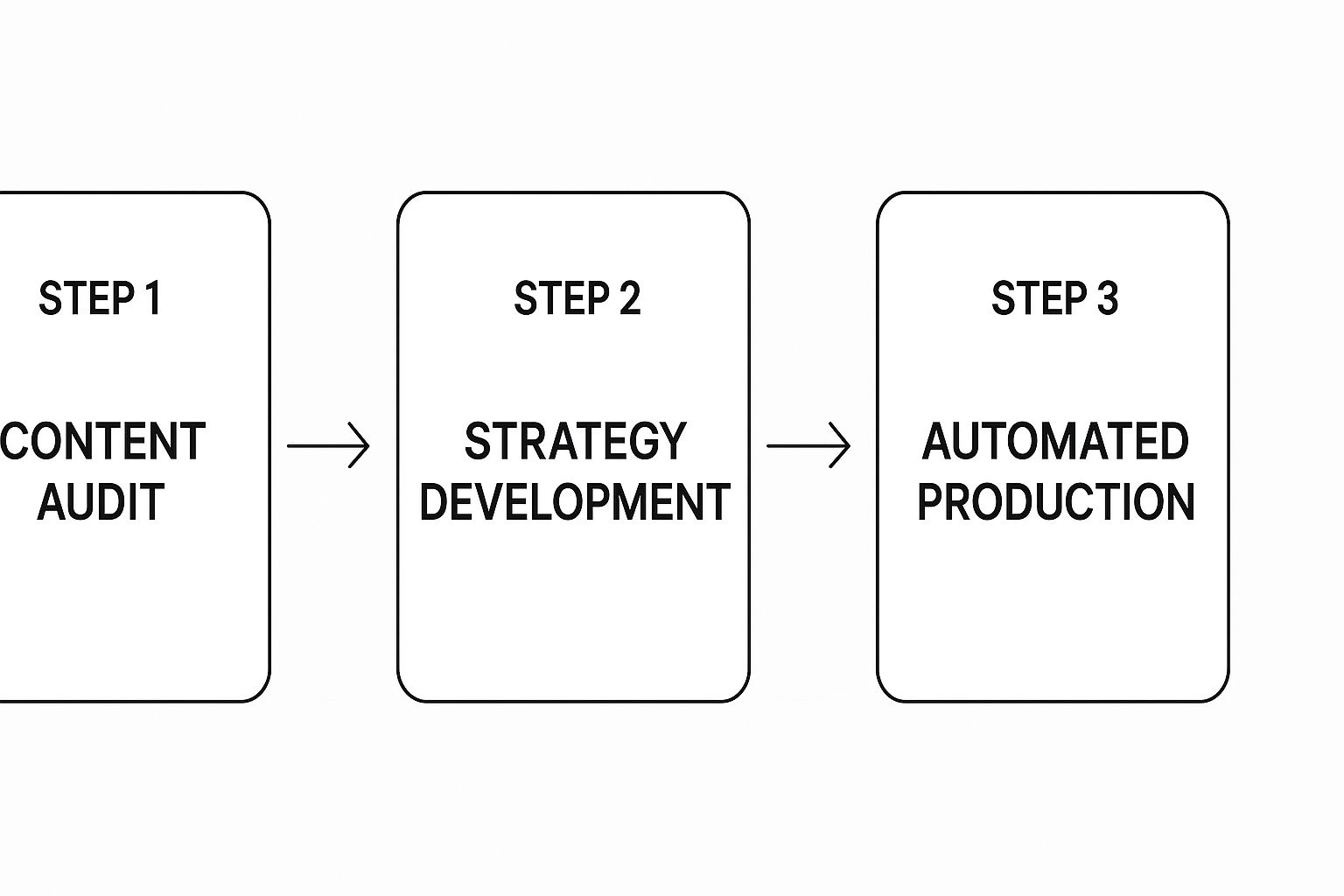
As you can see, a scalable operation always begins with an audit and a clear strategy before you can really get into a smooth production rhythm.
Establish Repeatable Workflows and SOPs
Standard Operating Procedures (SOPs) are the secret weapon of any team that scales successfully. They break down complex tasks into simple, step-by-step checklists that anyone on the team can follow.
Document everything. Your process for keyword research, how you create a content brief, the steps for drafting and editing, and your pre-publishing SEO checklist should all be written down.
Having these workflows defined eliminates bottlenecks and ensures nothing gets missed.
It also makes bringing on new team members a breeze. This focus on process is essential; a Content Marketing Institute report found that 66.5% of marketers struggle to allocate their resources effectively.
This tells you that scaling isn’t just about a bigger budget—it’s about having smarter systems in place.
Using Technology to Speed Up Production

Trying to scale your content marketing without the right tools is like trying to build a house with nothing but a screwdriver. It’s painfully slow, incredibly inefficient, and the final product just won’t be solid.
To really ramp up production, you need a smart tech stack that handles the repetitive stuff and lets your team’s creativity shine.
This isn’t about replacing people with robots. It’s about giving your talented team the leverage they need to focus on strategy and creative work instead of getting bogged down in administrative tasks.
Get Your House in Order with Project Management Tools
First things first: you have to get organized. If you try to scale without a central place to manage everything, you’re practically begging for chaos—missed deadlines, lost files, and those dreaded “just following up” email chains.
This is where project management platforms like Asana, Trello, or Monday.com become non-negotiable. They create a single source of truth for your entire content operation.
Your documented workflow suddenly becomes a series of clear, trackable tasks that everyone can see.
- Who does what? Assign briefs, drafts, and reviews to specific people with hard deadlines. No more ambiguity.
- Where are we at? A quick glance at the board shows you the exact status of every single piece of content.
- Keep it all together. All feedback, files, and conversations live in one spot. Say goodbye to hunting through email threads.
When you systematize your process inside a tool, you build a well-oiled production line. It frees up so much mental energy that was previously wasted just trying to figure out what was next on the list.
Use Content Intelligence to Dominate SEO

Churning out more content is pointless if nobody ever finds it. This is where content intelligence and SEO tools become your secret weapon, ensuring every article you publish is built to rank right from the get-go.
Platforms like SurferSEO, Clearscope, or Semrush give you the data-driven blueprint you need, taking all the guesswork out of optimization.
They analyze what’s already working for your target keywords and hand you a clear, actionable roadmap.
My Favorite Pro-Tip: Don’t just use these tools for the final edit. Make them part of your briefing process from the very beginning.
Drop the report link directly into the content brief. This empowers your writers to optimize as they write, which dramatically cuts down on the back-and-forth editing needed before you can hit publish.
This approach ensures that as you increase your output, you’re also increasing performance.
You start directly connecting your scaling efforts to real business goals, like more organic traffic and better leads. You’re not just making more stuff; you’re making smarter stuff.
Bring in Automation and AI—The Right Way
Automation is the real engine behind scaled content production. By taking over the repetitive, low-value tasks, you free up your team to focus on the high-impact work that actually moves the needle.
If you want to go deeper on this, it’s worth understanding what content automation is and how it fits into a modern strategy.
AI is a huge part of this, but you have to use it responsibly. It’s phenomenal for getting the ball rolling, but it should never, ever replace a skilled human’s final judgment.
How to Use AI Intelligently
| AI Task | Actionable Application | Human Oversight |
|---|---|---|
| Brainstorming | Ask it to generate 50 blog post titles or different angles on a single topic. | A human strategist cherry-picks the best, most brand-aligned ideas to move forward with. |
| Outlining | Have it create a structured outline based on the top SERP results for your keyword. | An editor refines the flow, injects unique insights, and makes sure it tells a compelling story. |
| First Drafts | Use it to generate a rough “zero draft” to break through writer’s block and get words on the page. | A skilled writer completely rewrites the draft, infusing it with brand voice, expertise, and real storytelling. |
The trick is to think of AI as an incredibly fast research assistant, not a writer. It can gather all the raw materials for you in seconds, but you still need a human craftsman to build something great.
When used this way, AI can slash the time it takes to get from an idea to a finished piece, making it an essential part of your scaling toolkit.
Growing Your Content Team Strategically
Let’s be real: simply throwing more people at your content problem isn’t a scaling strategy. It’s a recipe for chaos.
As you ramp up content production, you need a smart plan for growing your team that won’t break your budget or your internal processes.

The key is adding the right people at the right time. This isn’t just about hiring more writers.
You’re facing a strategic choice between bringing on full-time employees, tapping into the flexibility of freelancers, or partnering with a dedicated agency.
Each path has its own set of trade-offs, and the right one for you depends entirely on where you are in your growth journey.
Choosing Your Team Expansion Model
Figuring out how to grow your team is one of the biggest decisions you’ll make when scaling your content engine.
This choice directly impacts your budget, your ability to pivot quickly, and the depth of expertise you can call upon.
Here’s a practical breakdown to help you weigh the options:
| Team Model | Best For | Pros | Cons |
|---|---|---|---|
| In-House Hires | Companies with solid processes and a need for deep brand knowledge. | Deep brand and cultural immersion. Full control over priorities. | Higher fixed costs and a much slower hiring process. Requires significant management. |
| Freelancers | Businesses needing specialized skills for projects or flexible capacity. | Access to a huge talent pool of experts. Pay-as-you-go flexibility. | Requires strong onboarding and project management. Brand consistency can be a challenge. |
| Agency Partner | Teams that need a complete strategy and execution team from day one. | Immediate access to a full suite of experts. Proven processes and built-in scalability. | Higher overall cost. Less direct control over individual contributors. |
Remember, this isn’t a permanent decision. I’ve seen many companies find success with a hybrid model.
They maintain a core in-house team for strategy and brand consistency while relying on a trusted network of freelancers to handle specialized projects and manage overflow.
Your Critical First Hires
When you are ready to expand, don’t just hire another writer. Think bigger.
Adding specialists in key roles can multiply the effectiveness of your entire team. Two roles are absolutely crucial for maintaining quality as you scale up.
- A Dedicated Editor: This person is your quality gatekeeper. They do so much more than fix typos—they’re the guardian of your brand voice, a fact-checker, and the final check to ensure every single piece of content aligns with your strategy. A great editor frees up everyone else to focus on what they do best.
- A Content Strategist: If you’re still running the strategy yourself, this is your next hire. This person owns the content calendar, dives deep into keyword research, analyzes performance data, and makes sure your content is actually driving business results, not just making noise.
These two hires create the structure and oversight you need to prevent quality from tanking as your content velocity increases.
Expert Insight: Hiring an editor before you hire another writer is one of the smartest scaling moves you can make.
I’ve seen it time and again: one fantastic editor can elevate the work of five average writers, ensuring a level of brand consistency and quality you’d never get otherwise.
Onboarding Freelancers for Success
Working with freelancers is an amazing way to scale flexibly, but it only works if you have a rock-solid onboarding process. You can’t afford to waste hours re-explaining your brand with every new project.
The solution? Create a “freelancer welcome kit” that gets them up to speed fast.
This kit should include:
- Brand and Voice Guidelines: Give them clear “do this, not that” examples.
- Ideal Customer Personas: Help them get inside the head of who they’re writing for.
- Content Style Guide: Lay out the rules for formatting, linking, and submitting work.
- Examples of Your Best Work: Show them exactly what “great” looks like for your brand.
A tight onboarding process turns freelancers from temporary help into true extensions of your team. This investment in process is vital, especially as content marketing budgets continue to climb.
One recent report found that 11.4% of marketers plan to spend over $45,000 per month on content, a massive jump from just 4.1% the previous year.
You can read more about these content marketing trends to see just how critical strategic spending has become.
Squeeze Every Drop of Value from Your Content

Scaling your content marketing isn’t always about creating more, more, more. The real magic happens when you get more mileage out of what you’ve already created.
It’s about being smart and strategic, turning one great piece of content into a whole ecosystem of assets that meet your audience wherever they are.
This isn’t just about reposting links. It’s about transforming a single, well-researched blog post from a lone island into the heart of a content mainland, feeding your marketing channels for weeks or even months.
Turn One Big Idea into a Multi-Channel Campaign
The secret to effective repurposing is deconstruction. You start with a “pillar” piece—something substantial like an in-depth guide, a webinar, or a detailed case study—and you break it down into bite-sized, platform-specific micro-content.
This is how you multiply your impact without actually multiplying your workload.
Let’s say you just published a 2,000-word beast of a blog post. Here’s how you can slice it and dice it:
- YouTube Video: Pull out the main talking points and turn them into a script for a quick 5-minute video. Each major heading in the post can be a new segment.
- Email Mini-Series: Extract the most valuable takeaways and drip them out as a three-part email nurture sequence. Each email can tackle one core idea from the original article.
- Social Media Carousel: Is there a list or a step-by-step process in your post? Perfect. Convert that into a visually slick carousel for LinkedIn or Instagram.
- Shareable Infographic: Grab the most compelling data and stats from the post and work with a designer (or use a tool) to create a sharp infographic. It’s a magnet for shares on Pinterest and Twitter.
This approach ensures you’re not just spamming links but actually delivering value in the format people prefer on each channel.
To really get into the nuts and bolts, our guide on content repurposing strategies has a ton of other ideas.
Put Some Fuel on the Fire with Paid Distribution
Organic reach is great, but if you want to truly scale, you need to put a budget behind your top performers.
Paid distribution gets your best content in front of fresh, highly-targeted audiences who might never have found you otherwise. It’s about identifying what’s already working and pouring gasoline on it.
This is a massive growth lever.
A huge part of scaling content marketing is ditching the “publish and pray” approach for a “promote and profit” strategy. Find your top 10% of content and invest in getting it seen by the right eyeballs.
This strategy is only getting more important. With the slow death of third-party cookies, marketers are looking for reliable ways to reach people.
In fact, 25% are turning to targeted social media ads as a primary growth channel. With the global social ad market expected to grow by 12% this year, the opportunity is massive.
You can discover more insights about these marketing trends at Typeface.ai.
Build an Evergreen Distribution Machine
Once you’ve got your repurposed assets, the job isn’t done. The final piece of the puzzle is building a system that keeps your best content circulating.
Don’t let a great piece of content die after its first week in the sun. To really stretch its lifespan, you need to explore all the different ways to repurpose content across social channels.
This diagram really shows how content marketing is a cycle, where creation is just the beginning.
See how “distribution and marketing” is a continuous loop? That’s what you want to build: an engine that keeps pushing your evergreen content out there, driving traffic and leads long after you hit publish.
This is where automation is your best friend. Use a scheduling tool to automatically reshare your best-performing blog posts every few months.
This simple tactic keeps your hard work in front of new followers without you having to lift a finger, effectively turning your content library into a traffic machine that runs on its own.
Diversifying Your Content for a Wider Reach

If your entire content strategy is built on blog posts, you’re trying to build a house with only a hammer. It works, sure, but you’re missing out on a whole lot of potential.
To truly scale your marketing efforts, you need to meet people where they are, and that means offering content in the formats they actually want to consume.
Diversifying your content isn’t just about appeasing different preferences. It’s a strategic play to tap into new audiences, open up fresh SEO opportunities, and find entirely new ways to distribute your message.
When you move beyond just text, your whole content engine becomes stronger and more adaptable.
Get Started with Video—Without a Hollywood Budget
Starting a video series can sound daunting. Visions of expensive cameras, lighting rigs, and a full production crew can stop you in your tracks.
But here’s the reality: you can start making impactful videos with the tools you probably already own.
Your smartphone, a decent microphone, and some basic editing software are all you really need to get the ball rolling.
The goal isn’t to create a cinematic masterpiece; it’s to deliver genuine value to your audience. Think of it as a new medium for the expertise you’re already sharing on your blog.
My Favorite Tip: Look at your analytics. Your best-performing blog posts are a goldmine for video ideas. Take an article that already gets a ton of traffic and repurpose its key points into a short, punchy video script.
This takes the guesswork out of the equation because you already know the topic resonates with people.
This simple approach makes video marketing far more accessible, letting you tap into its massive potential without a huge upfront investment.
Build Authority with True Thought Leadership
While video is fantastic for grabbing attention, thought leadership is what builds deep, unshakable trust. This isn’t about chasing keywords; it’s about positioning your brand as the undeniable expert in your field.
This is where you share unique perspectives, original data, and the insights you’ve earned the hard way.
This kind of content is, by its very nature, incredibly difficult for competitors to copy. That’s its power.
Here are a few formats that work well for establishing authority:
- Original Research Reports: Survey your email list or analyze your own customer data to uncover trends no one else is talking about.
- Expert-Led Webinars: Bring together a panel of industry leaders to tackle a thorny issue and offer real solutions.
- Bold Opinion Pieces: Take a clear stance on a hot topic in your industry and back it up with sound logic and evidence.
This shift toward quality and deep expertise is a huge part of scaling content marketing today. It’s no surprise that 52% of marketers are planning to spend more on thought leadership.
The trend is clear: authority is just as important as volume.
Tap into Audio with a Podcast
Podcasts have found a special place in our routines, keeping us company on our commutes, at the gym, or while we’re making dinner.
It’s an incredibly intimate format that lets you build a real connection with your audience, one voice to another.
And getting a podcast off the ground is easier than you might think. Just like with video, repurposing is your friend. An interview-style blog post can become a great podcast episode.
A webinar recording can be stripped of its video and released as an audio-only masterclass. It’s an efficient way to add another layer to your content mix.
The industry is leaning heavily into these richer formats. Looking ahead, 61% of marketers say they plan to increase their video budget, making it the top investment priority.
When you combine that with the growing focus on thought leadership, it’s obvious that scaling content successfully now means moving into more engaging and authoritative territory.
You can see more of these content marketing statistics to understand how the smartest brands are planning their growth.
Figuring Out What’s Working to Fuel Your Growth

If you can’t prove your content is making a difference, good luck getting the resources to scale it.
This is the exact spot where so many content programs stall out—not because the ideas are bad, but because there’s no hard proof of success.
To really grow, you have to look beyond simple vanity metrics like page views and start focusing on the numbers that actually matter to the people signing the checks.
This is how you get bigger budgets. It’s how you prove the real-world value of your content and shift the conversation from content being a “cost” to it being a powerful engine for business growth.
Focus on Metrics That Actually Move the Needle
To get the green light for more resources, you have to speak the language of business impact. Traffic is a nice start, but it doesn’t tell you the full story.
The real question you need to answer is, what is all that traffic actually doing for the business?
This means shifting your attention to metrics that tie directly to revenue and bringing in new customers. That’s how you demonstrate a tangible return on investment.
Here are the KPIs I always keep a close eye on:
- Lead Quality: Are the leads your content is generating any good? You need to work hand-in-hand with the sales team to see how many of those leads eventually become sales-qualified leads (SQLs).
- Pipeline Influence: How many deals currently in your sales pipeline were touched by your content at some point? Dig into your CRM and find out which blog posts, webinars, or guides prospects looked at before they became a real opportunity.
- Customer Acquisition Cost (CAC): Keep a close watch on the CAC from your content efforts compared to other channels. A well-oiled content machine should actually help lower your overall acquisition costs over time.
These are the numbers that get executives to listen and approve bigger budgets. For a much deeper dive, check out our guide on how to measure content performance.
Build Simple, Actionable Dashboards
Forget those overwhelming dashboards with 50 different metrics. Honestly, simpler is almost always better.
I recommend building a clean, straightforward dashboard in a tool like Google Analytics that tracks only your most critical KPIs.
This dashboard should give you a clear, immediate snapshot of what’s working and what’s falling flat.
It’s not just a reporting tool for your boss; it’s a practical guide for you and your team to make smarter decisions every single week. It tells you where to double down and what’s not worth the effort.
My Two Cents: Think of your performance dashboard as your strategic compass. It should guide every future content decision you make, pointing you toward the topics, formats, and channels that deliver the best results so you can invest your resources wisely.
Use Your Data to Make Smarter Bets
Once you have a clear view of your performance, you can stop guessing and start making data-informed decisions. One of the most impactful things you can do is run regular content audits.
Set aside time each quarter to go through your entire content library and sort everything into two buckets:
- Your High-Performers: These are your all-stars. The plan here is simple: update them with fresh information, repurpose them into new formats (like an infographic or video), and promote them all over again.
- The Underperformers: This is the content that’s gathering dust with little to no traffic or engagement. You have to decide whether to prune it (delete and redirect the URL), give it a major rewrite, or combine it with another piece.
This keeps your content library lean, mean, and effective. It also gives you solid ground to stand on when you want to put money behind paid distribution.
For example, if you see an organic post absolutely crushing it, you can confidently put an ad budget behind it to amplify its reach.
Knowing that the average CTR for Google Ads is 3.17% for search and 0.46% for display gives you a solid benchmark to measure your own paid efforts against. You can discover more insights about marketing benchmarks on Typeface.ai.
Turn Your Content System into a Real Growth Engine
Scaling content marketing gets a lot easier when you’re not starting from a blank page every time.
With Pinterest GPTs, you can turn one strong idea into dozens of on-brand Pin titles, hooks, and angles in just a few clicks—so your team stays focused on strategy instead of struggling with first drafts.
Drop in your blog topic or URL, let the AI suggest scroll-stopping headlines and keyword-rich descriptions, then plug the winners straight into your content calendar.
It’s a simple, free way to keep your pipeline full and your best pieces working harder across Pinterest.
No budget, no complex setup—just faster, smarter content creation that supports everything you’ve just built in your content marketing system.
Common Questions About Scaling Content

Once you start to seriously ramp up your content marketing, the questions start flying. It’s totally normal.
Moving from a handful of articles to a full-blown content machine unearths a whole new set of challenges and growing pains.
Let’s dig into some of the most common questions I hear from marketers who are right in the middle of scaling up.
The idea here is to give you some clear, no-nonsense answers to the hurdles you’re likely to face. These are the practical insights that will help you sidestep the typical pitfalls that can derail your momentum.
How Do I Keep Content Quality High When Production Increases?
This is the big one, and for good reason. It’s so easy to let standards slide when the pressure is on to publish more, more, more. The secret isn’t just working harder; it’s about building a smarter, more robust system.
Your best defense against declining quality comes down to a few core assets:
- A Detailed Style Guide: This is non-negotiable. Your guide needs to cover everything from brand voice and tone to specific formatting rules and grammar quirks. It becomes the single source of truth for every writer and editor, creating that all-important consistency.
- Structured Content Briefs: Don’t ever just throw a topic at a writer. A solid brief is a roadmap to success, including the target keyword, a clear audience persona, key talking points, internal link suggestions, and even a few examples of what a great finished piece looks like.
- A Dedicated Editor: As I’ve said before, a skilled editor is the single best investment you can make for quality control. They’re your gatekeeper, making sure nothing goes live until it hits your brand’s standards.
Pro Tip: Stop thinking of your editor as just a proofreader. Bring them into the process early.
Getting their eyes on an outline or a first draft can prevent hours of painful rewrites down the line, making the entire workflow way more efficient.
What Is the Best Way to Manage a Team of Freelancers?
When you scale, managing a team of remote freelancers effectively becomes mission-critical.
The real trick is to treat them like an extension of your in-house team, not just gig workers. This all boils down to clear communication and solid processes.
First things first, create a central hub for all your freelancer resources. This can be as simple as a shared Google Drive folder or a dedicated space in your project management tool like Asana or Trello.
Think of this as their “welcome kit,” and stock it with everything a new writer needs to nail their first assignment:
- Your brand and voice guidelines.
- In-depth customer personas.
- Links to some of your best-performing content.
- A clear, step-by-step guide to your submission and revision process.
Putting in this work upfront saves you an incredible amount of time answering the same onboarding questions over and over.
It empowers freelancers to get up to speed fast and start producing on-brand content right out of the gate.
By building strong systems to tackle these common challenges, you can scale your content operations with confidence, all without sacrificing the quality that got you here in the first place.