To get real, lasting traffic to your website without spending a dime, you need to concentrate on three things: making sure your site is technically sound, creating killer content, and actually talking to people.
Get these right, and you’ll build a solid foundation that pulls in visitors naturally, rather than just chasing short-term wins.
Building a Foundation for Lasting Traffic

Before you jump into promoting your website, you’ve got to get your house in order first. Think of it like this: you wouldn’t throw a party in a messy, hard-to-navigate house, right? The same goes for your website.
A great user experience is absolutely non-negotiable if you want people to stick around.
This all starts with the nuts and bolts of your site—its technical health and design. A website that’s fast and looks good on a phone isn’t a luxury anymore; it’s a flat-out requirement.
Slow loading times are the number one reason people bounce, often before they even see what you have to offer.
To get started, it’s helpful to see how these foundational elements work together.
Core Pillars of Free Website Promotion
This table breaks down the three fundamental areas to focus on for effective, no-cost website promotion.
It outlines the primary goal for each pillar and the key activities you’ll need to undertake.
| Pillar | Primary Goal | Key Activities |
|---|---|---|
| Technical Readiness | Ensure the site is fast, secure, and easy for both users and search engines to navigate. | Optimize site speed, implement mobile-first design, secure with HTTPS, and create a logical site structure. |
| Compelling Content | Create high-quality, valuable content that answers audience questions and builds authority. | Conduct keyword research, write in-depth articles, produce engaging visuals, and establish a content calendar. |
| Community Engagement | Build relationships with your audience and industry peers to generate organic buzz and traffic. | Participate in online forums, engage on social media, collaborate with other creators, and encourage user-generated content. |
Focusing on these three areas ensures your promotional efforts are built on a solid, sustainable base.
Ensure a Seamless User Experience
A clean, intuitive design is all about helping visitors find what they’re looking for without getting frustrated.
Your navigation should make sense, and your content needs to be readable on any screen, big or small. Mobile is especially huge, as that’s where a massive chunk of your audience is coming from.
A seamless user experience directly impacts how long visitors stay on your site, which sends positive signals to search engines like Google.
By focusing on site speed and mobile-friendliness, you’re not just pleasing users—you’re laying the groundwork for better search rankings.
Creating this experience is more than just making things look pretty. It’s about structuring your articles, guides, and pages to give people the answers they need, fast.
If you’re wondering where to begin, our guide on how to develop a content strategy is a great starting point for aligning your content with what your users are actually searching for.
The Critical Role of SEO from Day One
Search Engine Optimization (SEO) is the engine that drives free, long-term traffic. It’s how you make sure search engines can find, understand, and rank your site.
Without a solid SEO foundation, even the most amazing promotional campaign will fall on deaf ears.
Here’s a sobering statistic: a staggering 97% of websites get zero organic traffic from Google. That tells you just how important good SEO is.
And since the first page of Google captures nearly 88% of all clicks, getting there is the only way to attract visitors without opening your wallet.
A great first step is to simply let the search engines know you exist.
You can learn how to submit your website to search engines for free to get the ball rolling and make sure you’re on their radar.
Mastering SEO to Attract Organic Visitors

When it comes to getting a steady stream of free, relevant visitors to your site, Search Engine Optimization (SEO) is hands-down the most powerful strategy out there.
It’s not about tech wizardry or complicated jargon; at its core, good SEO is just about understanding what your audience is searching for and making it dead simple for them to find you.
Think of it as building a long-term asset that works for you 24/7.
It all starts with knowing the exact words and phrases your potential customers are typing into Google. This is keyword research, and it’s the foundation of everything.
Luckily, you don’t need to shell out cash for expensive software to get started.
Free tools like Google Keyword Planner are a great starting point, but don’t overlook the simple “People also ask” section right in the Google search results. It’s a goldmine.
Once you know what people are asking, you can create content that gives them the answers, positioning yourself as the go-to resource.
Optimizing Your On-Page Elements
After you’ve got your keywords, the next job is to weave them naturally into your website. This is what we call on-page SEO—it’s all about sending clear signals to search engines about what each page is about.
Here are the most important spots to focus on:
- Title Tags: This is your headline in the search results. Make it compelling and include your main keyword.
- Meta Descriptions: That little blurb of text under the title. It doesn’t directly impact rankings, but a good one makes people want to click.
- Header Tags (H1, H2, H3): These break up your content for human readers and tell search engines about your page’s structure. Your H1 is your main page title, H2s are major sub-points, and so on.
- URL Slugs: The bit of the URL that comes after the “.com/”. Keep it short, sweet, and descriptive, and pop your keyword in there.
It’s just like organizing a book. The title tag is the book’s cover, the H1 is the chapter title, and the H2s are the subheadings within that chapter. It just makes everything easier to understand.
Ultimately, on-page SEO is about creating a great user experience. When you write clear, helpful content that’s easy to navigate, search engines notice and reward you for it.
For a more detailed look at getting your site to rank, check out our guide on how to increase website traffic organically.
The Power of Internal Linking
Here’s a simple tactic that’s incredibly powerful: linking from one page on your website to another relevant page. It’s called internal linking, and it’s a game-changer.
For one, it helps your visitors discover more of your content, keeping them on your site longer.
It also helps search engines understand how your pages are related and spreads “link equity” (think of it as ranking power) throughout your site.
Got a blog post that’s doing really well? Linking from it to a newer, related post can give that new page a nice little boost in the rankings.
Tapping into Community Platforms for SEO
Your SEO work doesn’t have to stop at your own domain. Online communities are a fantastic way to build authority and drive traffic back to your site, all for free.
Platforms like Quora and Reddit are basically giant Q&A search engines.
Find questions related to your expertise, provide genuinely helpful answers, and then—only where it makes sense—add a link back to a resource on your site that gives more detail.
The golden rule here is to add value first and promote second. No one likes a link-spammer.
These platforms are also popping up more and more in Google’s search results.
In fact, you can turn Reddit threads into evergreen SEO by becoming a trusted voice in relevant conversations.
It’s a smart way to get in front of active, engaged audiences without spending a dime.
Create Content People Actually Want to Share

Good SEO brings people to your website, but it’s fantastic content that makes them stick around, explore, and tell their friends.
If you really want to know how to promote a website for free, the secret is to create stuff so genuinely useful that your audience does the marketing for you.
Forget the generic advice to just “start a blog.” Let’s get specific and focus on building assets that solve real problems for real people.
The aim is to make your site the go-to resource in your niche—the kind people bookmark and share instinctively.
Brainstorm Topics That Genuinely Resonate
The best content ideas don’t just appear out of thin air; they come from listening.
Your audience is constantly dropping clues about what they need to know through the questions they ask online.
Your job is to find those questions and provide the best answers out there.
A simple yet incredibly effective method is to hang out where your audience does. Dive into communities on Quora, Reddit, or industry-specific forums.
Look for the same questions popping up again and again, common frustrations, and popular discussions. Each one is a golden opportunity for a new piece of content.
When you source topics directly from your audience’s conversations, you practically guarantee relevance. You’re not guessing what they want anymore; you’re giving them exactly what they’re asking for.
Another smart move is to see what’s already working for your competitors. Use free tools to check out their most popular articles. Don’t just copy them. Ask yourself: how can I make this 10x better?
Maybe you can go into more depth, include better real-world examples, or present the information in a more engaging way. This immediately sets your content apart.
Develop Different Types of Shareable Content
A solid content plan needs more than just blog posts. Different formats click with different people and serve different needs.
Mixing it up makes your site more interesting and boosts the chances of your work getting shared across all kinds of platforms.
Try creating a mix of these high-value content types:
- In-Depth “How-To” Guides: These are the big, comprehensive pieces that walk someone through solving a specific problem. They become foundational content that people come back to, earning you valuable backlinks and social shares over time.
- Insightful Case Studies: Nothing builds trust like showing your work. A detailed case study proves your expertise and offers social proof, making it a powerful tool for winning over potential customers.
- Original Research or Data Roundups: You don’t need a massive budget for this. Even a simple survey or a well-curated compilation of industry stats can become a unique asset that others will want to cite and link to.
- Resource Lists or “Ultimate” Guides: Everyone loves a good shortcut. Curating the best tools, articles, or resources on a topic saves your audience a ton of time. These often become go-to references in a niche.
Design Simple Graphics to Boost Engagement
You don’t have to be a graphic designer to make your content look great. Giant walls of text are a huge turn-off and can send visitors running.
Simple graphics break things up, highlight key points, and make your content way more shareable, especially on visual platforms like Pinterest.
Free tools like Canva have made this incredibly easy. You can grab their pre-made templates and create professional-looking visuals in just a few minutes.
Here’s a quick way to get started:
- Pinpoint Key Takeaways: Pull out a compelling statistic, a powerful quote, or a crucial step from your article.
- Pick a Simple Template: In Canva, search for a template that fits where you plan to share it (e.g., “Pinterest Pin” or “Instagram Post”).
- Customize it: Add your text, switch the colors to match your brand, and find a relevant icon or photo.
- Embed it in your post: Drop the graphic right into your article to add visual flair and a ready-made shareable asset.
By creating these little visual nuggets, you give your readers something easy to pin, tweet, or post. It’s a small effort that can seriously amplify your reach.
And once you have a great piece of content, there are endless ways to slice it and dice it into new formats.
For more on that, check out our guide on how to repurpose content for maximum impact.
Using Social Media and Online Communities for Growth

Forget just broadcasting your latest blog post into the void. Social media is where you can build real relationships that draw people to your website, and the best part is, it doesn’t have to cost a dime.
The secret is to stop thinking like you’re just pushing a product and start acting like a genuinely helpful member of the community.
Your goal is to become a recognized, trusted voice in the places your ideal audience already hangs out.
This means showing up, participating in discussions, and answering questions without expecting anything in return.
When you provide value first, your social presence transforms from a simple billboard into a powerful engine for free website traffic.
Find and Engage Your Ideal Audience
First things first: you need to figure out where your people are. If you sell handmade jewelry, visual-heavy platforms like Pinterest and Instagram are no-brainers.
But if you’re a B2B consultant, the real conversations are happening over on LinkedIn. Don’t stretch yourself thin trying to be everywhere.
Pick one or two platforms and commit. Immerse yourself by joining relevant groups, following key figures in your niche, and just listening.
What are people always asking? What problems keep popping up? This is your roadmap for creating content that actually resonates.
- Forums and Niche Communities: Sites like Reddit and Quora are absolute goldmines. Find subreddits or topics related to your field and start offering thoughtful, detailed answers. A link to your site should feel like a natural next step for someone who wants more info, not a random plug.
- Facebook Groups: Look for active groups where your target audience congregates. Become a familiar face by sharing insights and chiming in on other members’ posts. Over time, you’ll earn the credibility to share your own content without it feeling spammy.
- LinkedIn Engagement: Don’t just post and ghost. Jump into discussions in professional groups or under relevant industry hashtags. You’d be surprised how much more effective a few insightful comments on other people’s posts can be.
Optimize Your Profiles for Clicks
Think of your social media bio as prime real estate. It’s one of the first things a potential follower sees, so it needs to do some heavy lifting.
Instead of just stating your job title, tell people exactly how you can help them and give them a clear next step.
Your bio should always point back to your website. This could be a link to your homepage, a super popular blog post, or even a dedicated landing page offering a freebie.
Frame it as a compelling invitation that makes them want to click.
A well-crafted social media profile acts as a mini-landing page. It should quickly communicate your value and make it incredibly easy for an interested person to transition from follower to website visitor.
This is especially critical since we live in a mobile-first world. With about 60.9% of global website traffic coming from mobile devices, people are constantly discovering new brands on their phones.
When someone stumbles upon your profile, you have a very small window to grab their attention and guide them over to your site.
You can get a deeper look into mobile user behavior and its impact on marketing strategies.
Craft Posts That Build Authority
The social media content that performs best is the stuff that gives away value freely. Your posts should feel like mini-guides, quick-fire tips, or thought-provoking questions.
You’re essentially training your audience to see you as the go-to expert in your field.
So, instead of a boring “New Blog Post!” update, pull out a juicy statistic or a practical tip from the article itself.
Present it as a standalone piece of helpful content, and then casually mention the link for anyone who wants to learn more.
Let’s look at how two different approaches play out:
| Post Style | Description | Impact |
|---|---|---|
| The “Link Drop” | Just a headline and a link. That’s it. | Gets very little engagement and is often seen as pure self-promotion. |
| The “Value First” | Shares a useful tip from the article, asks a question, and then offers the link for more context. | Drives high engagement, builds trust, and positions you as a helpful resource. |
This “value-first” strategy naturally encourages likes, comments, and shares. Those signals tell the platform’s algorithm that your content is top-notch, boosting its visibility.
That means more eyeballs on your posts, more people learning from you, and ultimately, more clicks through to your website.
Building Direct Connections with Email and Outreach
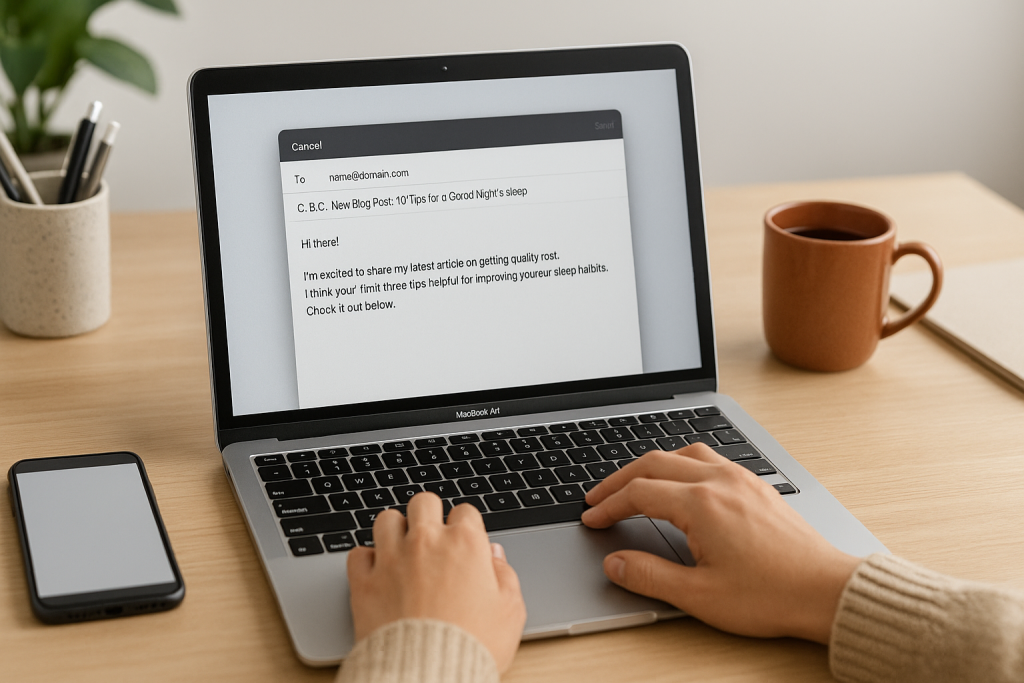
Forget waiting for algorithms to favor you. One of the most reliable ways to promote your website is by creating a direct line to your audience through email and strategic outreach.
This is about owning your traffic source and building real relationships, not just chasing clicks.
When you have someone’s email address, you have a personal invitation to their inbox—a space far less crowded than a social media feed.
Similarly, thoughtful outreach gets your name and work in front of entirely new communities.
Launch Your Email List for Free
An email list is one of the most valuable assets you can build. It’s an audience you control, completely independent of Google’s or Facebook’s ever-changing rules. And the best part? You can get started for $0.
Plenty of great services like Mailchimp and Brevo offer robust free plans that are more than enough to get you going. They handle the tech so you can focus on growing your list.
Here’s a simple game plan to get started:
- Pick a Free Provider: Sign up for a free plan. They all offer easy-to-use signup forms and basic email templates.
- Create a Simple Opt-In Form: Don’t ask for a life story—just an email address. A clean, simple form is all you need. Place it where people will see it: your sidebar, footer, or after your blog posts.
- Offer a Real Reason to Join: People are protective of their inboxes. Give them a compelling reason to subscribe. It doesn’t have to be a 50-page ebook. A simple promise like, “Get my best marketing tip every Tuesday,” is often enough.
What to Send Your Subscribers
Once people subscribe, you have to deliver. The goal is to send emails people actually want to open. Think value, not just sales pitches.
Your email list is a community, not just a broadcast channel. Treat your subscribers like insiders by giving them content that feels exclusive and valuable. This builds trust and transforms casual readers into loyal fans.
A weekly or bi-weekly newsletter is a fantastic format. You can round up your latest articles, share a cool resource you’ve discovered, or offer a quick tip that isn’t on your website.
Consistency and genuine helpfulness are what keep people subscribed.
The Art of Manual Outreach
Okay, let’s talk about reaching beyond your own audience. Manual outreach is about connecting with other creators, bloggers, and site owners in your space.
This isn’t about blasting out hundreds of generic emails begging for links. It’s about building partnerships.
The main prize here is often a guest posting opportunity. One guest post on a respected, high-traffic website can send more relevant visitors your way than a month’s worth of social media updates. It’s a massive credibility booster.
This image really drives home the difference between only writing for your own site versus guest blogging for others.
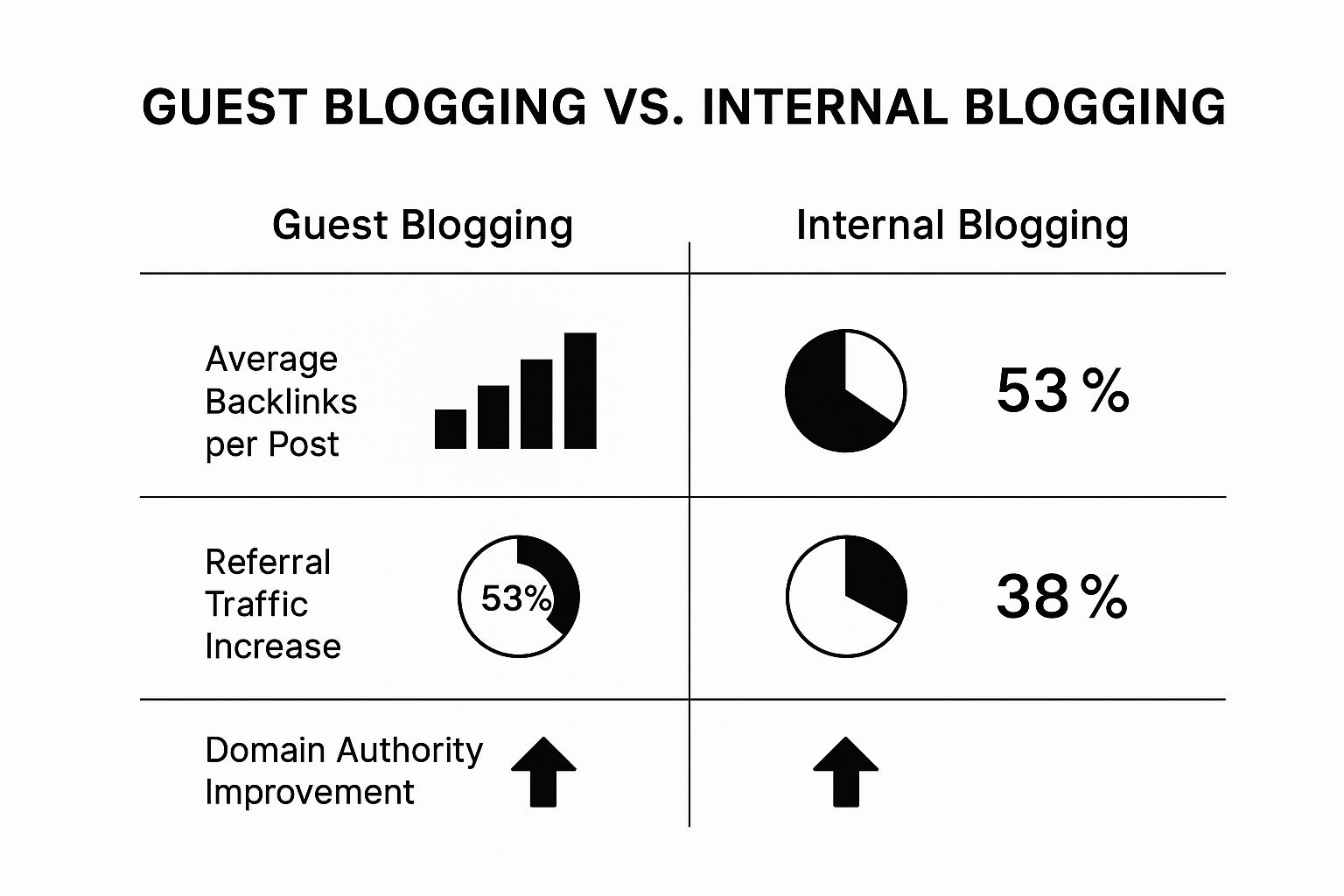
As you can see, the impact on backlinks, referral traffic, and overall domain authority from guest blogging is undeniable.
Crafting an Outreach Email That Actually Gets Read
Most outreach emails are terrible. They’re generic, self-serving, and get deleted on sight. Yours needs to be different.
Here’s a simple, non-spammy formula that works wonders:
- Start with a Genuine Compliment: Mention a specific article they wrote or a project they launched. Show you’ve done your homework. “I loved your recent post on X, especially the part about Y” works a lot better than “Dear Sir/Madam.”
- Introduce Yourself (Quickly): One sentence. That’s all you need to say who you are and what your site is about.
- Pitch a Win-Win Idea: This is the most important part. Don’t ask for a favor; offer them something valuable. Propose 2-3 specific guest post ideas that would be a perfect fit for their audience, not just yours.
- Show, Don’t Just Tell: Include a link to one of your best-written articles. This proves you can deliver quality content.
- Keep It Short and Sweet: Respect their time. Make your email scannable and easy to reply to.
By focusing on providing value first, you change the entire dynamic from a cold ask to a warm partnership proposal.
This approach is a cornerstone of how to promote a website for free and builds the kind of industry connections that will serve you for years to come.
To help you decide where to focus your energy, here’s a quick comparison of the free promotional channels we’ve discussed.
Comparison of Free Promotion Channels
This table breaks down the typical effort and reward for some of the most popular free promotion methods.
| Channel | Time Investment | Long-Term Impact | Key Skills Required |
|---|---|---|---|
| On-Page SEO | Medium (upfront), Low (ongoing) | High | Keyword research, content writing |
| Content Marketing | High (ongoing) | High | Writing, creativity, consistency |
| Email Marketing | Medium (ongoing) | High | Copywriting, community building |
| Guest Blogging | High (per post) | Medium to High | Writing, networking, outreach |
| Social Media | Medium to High (ongoing) | Low to Medium | Content creation, community management |
| Online Communities | Medium (ongoing) | Low to Medium | Genuine participation, helpfulness |
As you can see, channels like SEO and email marketing require a significant investment upfront but tend to deliver the most sustainable, long-term results.
Social media and community engagement, on the other hand, can provide quicker wins but often require constant effort to maintain momentum.
Turn Every Blog Post Into Dozens of Pinterest-Ready Pins
Getting your website in front of new people doesn’t have to mean spending more money—it usually means getting more mileage out of the content you already have.
Pinterest is one of the best free channels for that, but writing endless Pin titles, descriptions and hooks by hand can eat up your entire week.
Pinterest GPTs does the heavy lifting for you. Drop in your blog post topic or URL and get scroll-stopping Pin ideas, keyword-rich titles and descriptions tailored to your niche.
Use them to quickly create multiple fresh Pins for the same article, each targeting different angles and search terms.
Pair those AI-generated ideas with your existing designs or templates, and suddenly you’ve turned one article into a whole set of promotion-ready Pins—without paying for ads or spending hours writing copy from scratch.
Answering Your Questions About Free Website Promotion
Jumping into free website promotion is exciting, but let’s be real—it brings up a lot of questions. I’ve been there. Here are some honest answers to the things people usually ask me.
How Long Until I Actually See Results?
This is the million-dollar question, isn’t it? The straight answer is: it depends. Free promotion isn’t like flipping a switch on a paid ad campaign. You’re building something that lasts.
Think of it this way: SEO and content marketing are long-term investments. You’re building a foundation, brick by brick.
It can easily take three to six months before you start seeing a steady stream of organic traffic. Patience isn’t just a virtue here; it’s a requirement.
But some things are faster. If you get active in the right online communities or a popular social media account gives you a shout-out, you could see a traffic spike in a matter of days. These are great for a quick boost, but they won’t have the lasting power of a high-ranking article.
I Have No Time. What Should I Focus On?
When you’re stretched thin, you have to be ruthless with your time. The key is to stop trying to do everything.
I always tell people to lean on the 80/20 rule. Figure out the 20% of tasks that will deliver 80% of your traffic, and hammer away at those.
- For Long-Term Growth: If you can only do one thing, write one fantastic, in-depth “pillar” article each month. Optimize it for search, make it the best resource on the topic, and it will pay you back for years.
- For Quick Wins: Find one or two online forums or social media groups where your audience lives. Spend a few hours a week just being helpful. Answer questions, offer advice, and become a trusted name.
The single biggest mistake I see is people spreading themselves too thin. It’s far better to master one or two channels than to be mediocre at ten. Focus is your superpower.
What Are the Biggest Mistakes I Should Avoid?
You’re going to make some mistakes, and that’s okay. It’s part of the process. But if you can sidestep these common blunders, you’ll be way ahead of the game.
Here are the tripwires I see people hit most often:
- Giving Up Too Soon: Seriously, this is the big one. Content and SEO are a slow burn. So many people quit just before their efforts are about to gain traction. Stick with it.
- Flying Blind: Not looking at your analytics is like trying to navigate a maze with a blindfold on. Install Google Analytics (it’s free!) and pay attention to what’s working.
- Shameless Self-Promotion: When you join a community, your first job is to add value. If you just drop links to your site, you’ll be ignored at best and banned at worst. Help first, promote later.
- Skipping Basic On-Page SEO: You could write a masterpiece, but if you don’t nail the fundamentals like title tags, headers, and meta descriptions, search engines will never show it to anyone. This is non-negotiable.
Avoiding these classic mistakes will save you a ton of frustration and put you on the path to real, sustainable growth—all without spending a dime.