
To figure out your social media ROI, you need a clear plan. It all boils down to setting the right goals, tracking what matters, and then running the numbers with a simple formula: (Profit – Investment) / Investment x 100.
This turns all those likes, shares, and comments into a number that actually means something to your business.
Setting Social Media Goals That Drive Business Value

Before you ever open a spreadsheet, you have to know what you’re aiming for. The first step in measuring social media ROI has nothing to do with formulas—it’s about defining what success actually looks like for you.
If you don’t have clear, business-focused goals, you’re just chasing vanity metrics like likes and follows that won’t convince anyone who matters.
The key is to draw a straight line from every social media action to a tangible business outcome.
This means ditching vague goals like “increase engagement” and instead setting specific objectives that fit into the company’s bigger picture.
What those goals are will depend entirely on how your business makes money.
Tying Objectives to Business Models
For an e-commerce brand, the primary goal is often to drive sales directly from social media. Think Instagram Shopping tags or a Facebook product catalog.
Here, the ROI calculation is pretty straightforward because their social objectives are all about conversion rates and return on ad spend (ROAS). Every post and ad is designed to lead someone to a product page.
A B2B SaaS company, on the other hand, is playing a different game. Their focus is usually on generating qualified leads for the sales team. Their social media goals might look more like this:
- Driving sign-ups for a product demo from a LinkedIn campaign.
- Getting people to download a gated whitepaper promoted on Twitter.
- Building a dedicated community of potential customers in a niche Facebook Group.
For them, the value isn’t an immediate purchase but the creation of a sales-qualified lead (SQL), which has its own assigned monetary value.
Getting this distinction right is absolutely critical for an accurate ROI calculation.
Key Takeaway: Meaningful social media ROI starts with goals that directly support how you make money. If you can’t connect your social activity to a business result like a sale or a lead, you can’t measure its true return.
Overcoming the Measurement Gap
Aligning your social efforts with business outcomes is more important than ever. There’s often a huge disconnect between what executives expect and what marketers feel they can deliver.
The 2025 Sprout Social Index found that 65% of leaders want to see a direct line between social media and business goals, yet only 30% of marketers are confident in their ability to measure social media ROI.
You can explore more findings about this social media ROI gap.
This gap is exactly why starting with well-defined, measurable goals is a must. When you establish a clear objective from the start—like “generate 50 MQLs from our LinkedIn content this quarter”—you create a clear framework for what success looks like.
This doesn’t just make the ROI calculation easier down the line; it gives you the confidence to justify your social media budget and strategy to leadership.
Choosing Social Media Metrics You Can Actually Use

Once you have your business goals locked in, the real work begins: picking the key performance indicators (KPIs) that prove you’re actually hitting those targets.
This is a classic stumbling block for marketers. It’s easy to get overwhelmed by the sheer volume of data, but the secret isn’t to track everything. It’s about finding the handful of metrics that matter.
Let’s be honest, vanity metrics like follower counts and post likes are tempting. They offer a quick ego boost, but they rarely paint the full picture of your impact on the business.
To get to the truth, you have to connect your KPIs directly to the outcomes you defined earlier.
Matching Metrics to Your Goals
So, how do you do that? Simple. You work backward from the goal.
If your big objective is to boost brand awareness, you need metrics that show you how far and wide your message is spreading.
Think of it like this: you’re trying to measure the size of the audience you’re building and how much attention you’re capturing.
For that, you’ll want to keep an eye on:
- Reach: This is the total number of unique people who saw your content. It answers the fundamental question, “How many individuals did our post actually get in front of?”
- Impressions: This tells you the total number of times your content was shown to users. It’s a great way to gauge the overall visibility of your posts, even if the same person saw it multiple times.
- Share of Voice (SoV): This is a killer competitive metric. It pits your brand’s mentions against your competitors’, showing you how much of the online conversation in your industry you truly own.
On the other hand, if your goal is lead generation, the focus gets much sharper. You’re no longer just looking for eyeballs; you’re tracking specific actions that guide a potential customer from a social post into your sales pipeline.
Your go-to metrics here will be:
- Click-Through Rate (CTR): The percentage of people who not only saw your post but were compelled enough to click your link. A strong CTR is a great sign that your copy and creative are hitting the mark.
- Conversion Rate: This is the ultimate test. Of the people who clicked through from social media, what percentage actually completed the desired action, like signing up for a webinar or downloading an ebook?
- Cost Per Lead (CPL): This one is pure business. It’s the total ad spend on a campaign divided by the number of leads it brought in. CPL tells you exactly how efficient your social media efforts are at generating new business opportunities.
Pro Tip: Just tracking clicks isn’t enough. To get truly reliable data, you need to be able to trace a website conversion or a final sale all the way back to the specific Instagram post or LinkedIn ad that started it all. That’s where UTM parameters come in.
The Power of UTM Parameters
What are UTM parameters? They’re basically little tracking codes you add to the end of a URL.
When someone clicks that link, the tags send detailed information straight to your analytics platform, like Google Analytics.
This lets you see precisely which social channel, campaign, or even individual post sent that visitor your way.
Without UTMs, your analytics might just show a big, messy blob of “social referral” traffic. You’ll know people came from social media, but you won’t have a clue what’s actually working.
You can learn more about how to measure content performance in detail, but the bottom line is this: using UTMs consistently creates a clean, clear attribution trail.
It’s the key to making your social media ROI calculations accurate and, more importantly, believable to your boss.
Here’s a quick-reference table to help you connect the dots between your goals and the metrics that will help you track them effectively.
Matching Social Media Goals to Key Metrics
| Business Goal | Primary Social Media Metric | Example KPI |
|---|---|---|
| Increase Brand Awareness | Reach & Impressions | 20% increase in organic post reach quarter-over-quarter. |
| Drive Website Traffic | Click-Through Rate (CTR) | Achieve an average CTR of 2.5% on all posts with links. |
| Generate New Leads | Conversion Rate | 50 new leads per month from social media forms. |
| Boost Community Engagement | Engagement Rate (comments, shares) | Maintain an average engagement rate of 4% or higher. |
| Improve Customer Loyalty | Response Time & Sentiment | Respond to 90% of customer inquiries within 1 hour. |
| Increase Sales/Revenue | Revenue from Social Referrals | Attribute $10,000 in sales to social media channels this quarter. |
This table isn’t exhaustive, but it provides a solid framework. Start here, and you’ll be well on your way to tracking what truly drives business results, not just what looks good on a report.
Calculating Your Social Media ROI The Right Way

You’ve set your goals and picked your metrics. Now for the moment of truth: running the numbers to figure out your ROI.
On paper, the social media ROI formula is simple: (Profit – Investment) / Investment x 100. This gives you a clean percentage that shows exactly what you’re getting back.
But the real trick, and where so many marketers get tripped up, is in how you define “Profit” and “Investment.” Get those wrong, and your final number is meaningless.
What Are You Really Investing?
To get an honest look at your ROI, you have to account for every dollar and every hour spent. It’s way more than just your ad budget.
Your true investment is the sum of all these moving parts:
- Ad Spend: This one’s easy—it’s what you pay platforms like Facebook, LinkedIn, or TikTok to run your campaigns.
- Content Creation: Think about the time your team spends brainstorming, writing copy, designing graphics, or filming videos. If you’re paying freelancers or an agency, their fees go right here.
- Software and Tools: Don’t forget your monthly subscriptions. That scheduling tool, the analytics platform, your design software—it all adds up.
- Team Hours: Calculate the portion of your social media manager’s salary (and anyone else involved) that’s dedicated to these tasks.
Skipping any of these will artificially inflate your ROI. A complete, honest accounting of your investment is the only way to get a number you can actually trust.
Putting a Price Tag on Your Wins
Now for the “Profit” side of the equation. This can feel a little abstract, but it’s where the real magic happens.
A direct sale from a social ad is straightforward, but what about all the other valuable actions? You need to assign them a monetary value.
One of the best ways I’ve found to do this is by calculating the Customer Lifetime Value (CLV).
Let’s say you know that, on average, a new customer is worth $500 to your business over their lifetime. If your latest social media campaign brought in 20 new customers, you didn’t just make a few sales—you generated $10,000 in long-term value.
This is how you connect social media activity directly to the health of the business.
This whole process follows a pretty logical flow: you set a goal, you pick a metric that reflects that goal, and then you track it relentlessly.
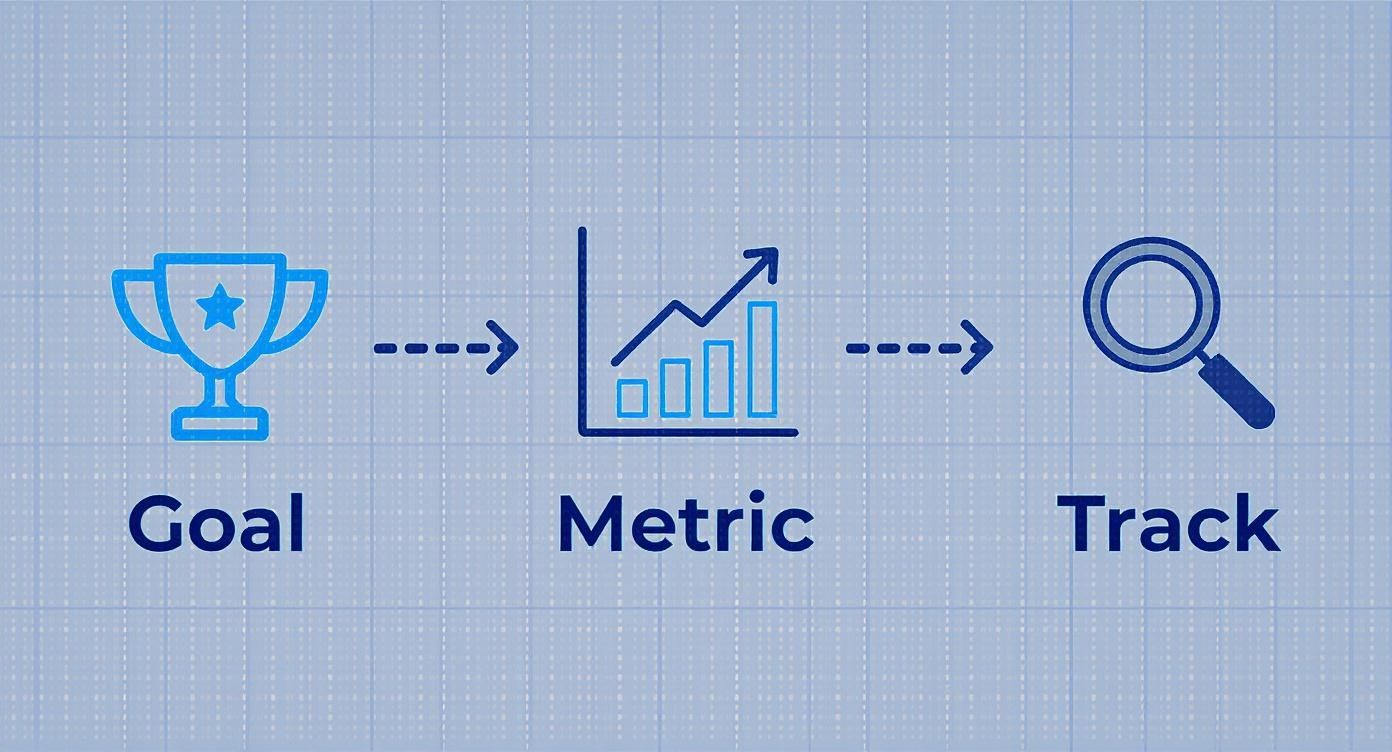
When you follow this path, every metric has a purpose, which makes your final ROI calculation that much more powerful.
Key Insight: Don’t get stuck measuring only the immediate sale. By calculating the value of a new lead or the lifetime value of a customer won through social, you can show a much bigger, more accurate impact on the company’s bottom line.
This detailed approach to calculating profit is what separates a good social media strategy from a great one.
For a deeper dive, check out our guide on how to measure marketing success for more ways to assign real value to your marketing efforts.
Getting this right is more important than ever. By 2025, the average ROI from paid social media advertising has jumped to $5.28 for every dollar spent—a 7.9% increase from the year before. The opportunity is massive if you know how to measure it.
If you want a wider lens on this topic, this article on measuring ROI, AI BI, and key metrics is a great resource. It covers crucial metrics that apply to almost any part of a business.
When you combine a comprehensive view of your investment with a clear value for your returns, you’ll be able to calculate a social media ROI that not only makes sense but also stands up to any scrutiny.
Using Analytics Tools for Smarter Measurement
If you’re still trying to calculate social media ROI with spreadsheets, I have to be honest: you’re making your life unnecessarily difficult. It’s a recipe for frustration and, frankly, a lot of guesswork.
To get the kind of accurate, actionable data that actually proves your value, you need the right tools.
They automate the heavy lifting and, most importantly, connect what you’re doing on social media to real business outcomes. Without them, you’re just flying blind.
The good news? You don’t have to break the bank to get started. Every major social platform has its own built-in analytics, and they’re a great place to begin.
- Meta Business Suite: This is your command center for Facebook and Instagram. It gives you a solid look at reach, engagement, and who your audience is.
- LinkedIn Analytics: For my fellow B2B marketers, this is gold. It provides incredibly detailed data on your content and follower demographics.
- Pinterest Analytics: Perfect for seeing which Pins are actually driving clicks and traffic, helping you double down on what works.
These native tools are fantastic for a quick health check on a specific platform. But they have a major downside: they operate in silos.
Trying to stitch together a comprehensive report from three different dashboards is a real headache.
Upgrading to Third-Party Platforms
This is exactly why dedicated, third-party analytics tools exist. Platforms like Sprout Social, Hootsuite, or HubSpot are game-changers. They pull all of your data from every network into one unified dashboard.
Suddenly, you have a bird’s-eye view of your entire strategy. You can instantly see which channels are pulling their weight and which ones are lagging behind.
These platforms go way beyond simple likes and shares, often integrating directly with your website analytics to connect social activity to leads and sales.
For a closer look at what’s out there, we’ve put together a guide on the 12 best social media automation tools to use in 2025.
Key Takeaway: The goal isn’t to collect tools; it’s to build a simple, powerful measurement system. You need a setup that clearly shows the return on your investment and tells you exactly how to get better results next month.
Connecting Social Data to the Customer Journey
Here’s the final piece of the puzzle, and it’s non-negotiable: integrating your social data with a robust web analytics platform like Google Analytics 4 (GA4).
This is where the magic happens. GA4 shows you what people do after they click a link in one of your posts.
By consistently using UTM parameters on your links, you can trace the entire customer journey. You’ll see which specific Instagram Story drove the most sign-ups or which LinkedIn article led to the most demo requests.
It bridges the gap between a “like” and a purchase, giving you the full, unvarnished story of your social media ROI.
If you’re looking to get even more granular, there are plenty of advanced measurement tools that can help you dig deeper into the data.
High-Impact Strategies to Boost Your Social ROI

Okay, so you’ve got the measurement basics down. Now for the fun part: finding strategies that really move the needle on your social media returns.
Think of these as force multipliers—tactics that don’t just inch your numbers up but deliver a significant punch.
Two of the most effective approaches I’ve seen in recent years are influencer marketing and social commerce.
Why do they work so well? They tap directly into how people actually behave online. Consumers today crave authentic recommendations from people they trust and want shopping to be as easy as possible.
Get these right, and you’re not just boosting metrics; you’re building real brand loyalty and driving sales you can actually see.
Tapping Into Influencer Marketing
Collaborating with the right creators is like getting a warm introduction to their entire community. The secret here is to look past vanity metrics like follower counts and focus on genuine brand alignment.
Find creators whose audience mirrors your ideal customer and whose personal brand vibes with yours.
It’s all about resonance, not just reach. I’ve seen micro-influencers with a tight-knit community of 10,000 followers drive more sales than a celebrity with a million disengaged ones.
Their endorsement feels less like an ad and more like a tip from a friend.
The data backs this up. The average ROI for influencer marketing is a staggering $5.78 for every dollar spent, blowing most traditional digital ads out of the water.
It makes sense when you learn that 61% of consumers trust creator endorsements. You can dig into more of these social media marketing statistics to see the full picture.
To get a clear picture of your ROI from these partnerships, give each influencer a unique UTM link and a special discount code.
This is the simplest, most effective way to track every click, conversion, and dollar they generate. No more guessing.
Making the Most of Social Commerce
Social commerce closes the gap between “I want that” and “I bought that.” By letting people shop directly on platforms like Instagram, TikTok, and Pinterest, you remove the friction that kills so many potential sales. You capture that impulse to buy the second it happens.
Tools like Instagram Shops and TikTok Shop essentially turn your social profile into a mini e-commerce site. It’s a seamless experience for the user and a goldmine of clean conversion data for you.
Calculating the ROI here is refreshingly straightforward. Every sale that happens through your in-app shop is tracked, giving you precise data on which posts are selling which products.
This lets you double down on what’s working, promote your top-sellers, and calculate your return with total confidence.
Connect Pinterest Keywords Directly to Your Social Media ROI
You’ve just seen how important it is to track what actually drives results, not just what looks good on the surface.
On Pinterest, that starts with showing up for the right searches, because the more relevant the search, the easier it is to link your Pins back to real clicks, leads, and revenue.
Post Paddle’s free Pinterest Keyword Research tool helps you stop guessing and start targeting the exact phrases your ideal audience is already using.
Enter your niche or offer, and you’ll uncover high-intent, long-tail keywords you can plug straight into your Pin titles, descriptions, and boards.
When you combine those keyword-optimized Pins with proper tracking (like UTM links and analytics), it becomes much clearer which Pinterest searches are driving traffic, sign-ups, and sales, not just impressions.
That makes your social media ROI reports more accurate and way more persuasive.
Answering the Tough Questions About Social Media ROI
Even with the best formulas and tools, some questions about social media ROI always seem to surface. These are usually the tricky, “what-if” scenarios that don’t fit neatly into a spreadsheet.
Let’s dig into a few of the most common ones I hear from marketers.
First up: “How often should I actually be doing this?” It’s a great question. You don’t want to get bogged down in constant reporting, but you can’t just set it and forget it.
I’ve found a quarterly deep-dive works best for a full ROI analysis. This gives your campaigns enough breathing room to actually generate meaningful data. For everything else, a monthly check-in on your core KPIs is perfect.
This rhythm lets you stay on top of performance and make smart, timely adjustments without getting lost in the weeds.
How Do You Put a Price on Brand Awareness?
This is the million-dollar question, isn’t it? How do you measure the ROI of something as abstract as “brand awareness”? You can’t always draw a straight line from a single impression to a sale, but you can assign a value to it.
The trick is to think about what that visibility would have cost you if you had to pay for it. This concept is often called Earned Media Value (EMV).
Here’s a practical way to figure it out:
- First, track your key awareness metrics—things like organic impressions and reach.
- Next, find the average Cost Per Mille (CPM) for paid ads in your niche. This is just the standard price for 1,000 impressions.
- Then, you simply multiply your organic impressions by that CPM rate.
Let’s say you generated 100,000 organic impressions last month, and the going CPM in your industry is $10.
That means you generated $1,000 in media value. It’s an estimate, of course, but it gives you a solid number to represent the value of your top-of-funnel efforts.
Key Takeaway: Measuring the ROI of brand awareness isn’t about direct sales. It’s about quantifying the value of the attention you earned for free—attention you otherwise would have paid for through ads.
So, What’s a “Good” Social Media ROI, Anyway?
Everyone wants to know what number to aim for. Is there a magic benchmark?
While it really depends on your industry and goals, a widely accepted rule of thumb is a 5:1 ratio. That means for every $1 you put in, you get $5 back in revenue. If you’re hitting that, you’re doing great.
But context is critical. An e-commerce store running a flash sale campaign on Instagram might see a massive, immediate return. On the other hand, a B2B software company using LinkedIn to build relationships with enterprise clients will have a much longer, more subtle ROI journey.
Ultimately, the most important benchmark is your own. Your goal should be to improve your ROI quarter over quarter. That’s the real indicator of a strategy that’s working.