
Figuring out how to measure the ROI of your social media efforts comes down to a simple, but not always easy, process.
You need to define clear goals, track actions that actually matter (like leads or sales), put a dollar value on them, and then weigh that against everything you spent to get there.
It’s all about tying your social media hustle directly to real business results, moving way past the old world of just counting likes and shares.
Moving Beyond Likes to Prove Real Business Value

Let’s be real: follower counts and likes don’t pay the bills. For too long, social media marketing got a pass by talking up “engagement” and “brand awareness”—nice ideas that were a nightmare to connect to the bottom line.
This fuzzy approach often left marketing teams scrambling to justify their budgets and prove their worth when the C-suite came asking questions.
That conversation has changed, big time.
Today, proving your value is non-negotiable. It’s no longer enough to just be on social media; you have to show how your activity is actually growing the business.
Measuring your return on investment is the only way to truly understand your impact and, more importantly, communicate it to the people who sign the checks.
Why Proving ROI Is a Top Priority
The pressure to justify every marketing dollar is more intense than ever. This isn’t just a hunch—it’s backed by data.
A HubSpot State of Marketing Report found that a whopping 77% of marketers feel that proving ROI is more important now than it was just a couple of years ago.
This shift forces us marketers to think like business owners. We have to connect every single post, campaign, and dollar spent to a tangible result.
When you can confidently calculate and present your social media ROI, you unlock some serious advantages:
- You Secure Your Budget: Nothing speaks louder than data. Showing a positive return is the best argument you can make for keeping or even increasing your marketing budget.
- You Sharpen Your Strategy: Knowing what works (and what’s a waste of time) lets you pour your resources into the platforms and tactics that deliver the goods.
- You Demonstrate Your Value: This is how you change the perception of marketing from a “cost center” to a “revenue driver,” proving it’s essential to the company’s success.
The real challenge isn’t just showing you’re busy; it’s about showing you’re making an impact. Calculating ROI turns your social media reports from a list of vanity metrics into a powerful story about business growth.
Of course, a great ROI starts with great engagement. If you need a refresher on building that foundation, our guide on how to improve social media engagement has some practical tips.
The Building Blocks of ROI Measurement
Before we jump into the formulas and tracking tools, let’s get the foundational pieces straight. Think of it like gathering your ingredients before you start cooking.
This table breaks down the key elements you need to have in place to measure ROI accurately.
Core Components of Social Media ROI Measurement
| Component | Description | Example |
|---|---|---|
| Clear Objectives | Defining specific, measurable business goals you want social media to achieve. | “Generate 50 qualified leads from LinkedIn this quarter.” |
| Key Metrics | The specific data points you’ll track to see if you’re hitting those objectives. | Clicks, form submissions, and cost-per-lead. |
| Monetary Value | Assigning a dollar value to conversions to quantify the “return” in your calculation. | “Each qualified lead is worth $150 to the business.” |
| Total Investment | Calculating all costs, including your team’s time, tools, and ad spend. | “$5,000 in ad spend + $2,000 in team hours.” |
Getting these four components right is the bedrock of any solid ROI calculation. With this framework, you’re ready to move from guessing your impact to proving it with confidence.
Start With a Clear Target: How to Set Objectives That Make Measurement Possible
Before you can get anywhere close to calculating your social media ROI, you have to answer a simple but crucial question: what are you actually trying to do?
It sounds obvious, but you’d be surprised how many campaigns kick off without a clear destination in mind.
Vague goals are the enemy of good measurement. Things like “get more engagement” or “build our brand” feel productive, but they’re impossible to hang a number on.
If you can’t measure it, you can’t prove its value. To really nail this down, your social media efforts need to be directly tied to tangible business outcomes, and that starts with well-defined objectives.
This is a cornerstone of effective social media campaigns.
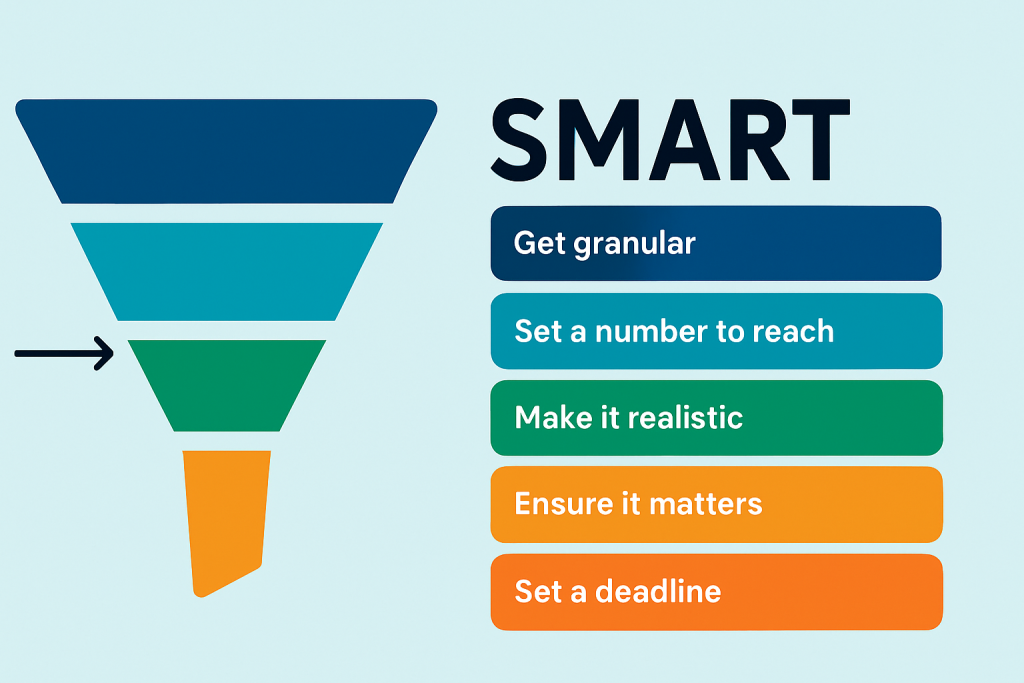
Don’t Just Set Goals, Make Them SMART
The best way I’ve found to get from a fuzzy idea to a concrete plan is by using the SMART framework. It’s a classic for a reason—it forces you to get specific and realistic about what you want to achieve.
Here’s a quick breakdown:
- Specific: Get granular. Instead of “more leads,” think “generate qualified leads from our new LinkedIn campaign.”
- Measurable: How will you know you’ve succeeded? You need a number. For example, “increase demo sign-ups by 20%.”
- Achievable: Be ambitious, but don’t set yourself up to fail. Your goals need to be within reach given your budget and resources.
- Relevant: Does this social goal actually help the company? If the business needs more revenue, your goal should be about driving sales or high-value leads.
- Time-bound: A goal without a deadline is just a dream. Put a date on it, like “increase website traffic from Pinterest by 15% within the next quarter.”
This isn’t just a checklist. Each element builds on the others to create an objective that is both powerful and practical.
Turning Vague Ideas Into Actionable Goals

Let’s walk through a real-world example. Say you’re a marketing manager at a B2B SaaS company.
A weak goal would be, “We want to use LinkedIn to get more customers.” It’s a start, but it’s not something you can build a strategy around.
Let’s run that idea through the SMART framework.
Specific: Generate high-quality leads for our new project management tool by promoting our latest case study on LinkedIn.
Measurable: Track case study downloads from a dedicated landing page. Our target is 100 marketing-qualified leads (MQLs).
Achievable: Last quarter’s campaign brought in 75 MQLs on a similar budget, so aiming for 100 is a stretch but doable.
Relevant: The sales team needs more demo bookings this quarter, and these MQLs will go straight into their pipeline.
Time-bound: We will hit this target of 100 MQLs by the end of Q2.
See the difference? We went from a vague wish to a concrete plan of action. This isn’t just a social media goal anymore; it’s a business objective that your social media activity is directly supporting.
Draw a Straight Line from Your Actions to Business Results
Ultimately, every single objective you set should create a clear link between a social media action—a post, a video, an ad—and a meaningful business outcome.
This is how you make sure every metric you track is actually telling a story about the impact you’re having.
Here are a few other ways this might look for different types of businesses:
- For an e-commerce brand: “Increase online sales from our Instagram Shop by 25% in Q3 by running a targeted ad campaign featuring user-generated content.”
- For a local restaurant: “Drive an additional 50 table bookings per month through a Facebook campaign promoting our new seasonal menu.”
- For a mobile app: “Achieve 5,000 new app downloads from our TikTok influencer collaboration within the first two weeks of the campaign launch.”
When you define your goals this way, you’re setting the foundation for an honest and powerful ROI calculation.
You’ve already decided what “return” looks like before spending a dime, which makes every step that follows much clearer and far more valuable.
Tracking the Social Media Metrics That Actually Matter

With your objectives locked in, it’s time to pick the right metrics to see if you’re actually hitting them. The thing about social media is you can measure everything, but most of it is just noise.
Chasing vanity metrics like follower counts or raw impressions feels productive, but it’s a lot like driving without a map—you’re moving, but you have no idea if you’re getting any closer to your destination.
To get a real, accurate picture of your ROI, you need to zero in on key performance indicators (KPIs) that tie directly back to your business goals.
Let’s break down the most impactful metrics by organizing them around the three core objectives: awareness, engagement, and conversion.
Metrics For Brand Awareness
Brand awareness is all about getting your name out there and in front of the right people.
It might feel less tangible than a sale, but you can absolutely track specific numbers to see how effective your efforts are and even assign a value to it.
- Reach: This is the total number of unique people who saw your content. Think of it as the primary indicator of how far and wide your message is spreading.
- Impressions: This is the total number of times your content was displayed, even if it was shown to the same person multiple times. A sky-high impression count with a low reach can be a red flag, often signaling your content is just being served over and over to a small, captive audience.
- Share of Voice (SOV): This one is about context. It measures how often your brand gets mentioned online compared to your competitors. A higher SOV means you’re dominating the conversation in your industry.
These metrics represent the very first step in the customer journey.
Once you understand your reach, you can start to assign a financial value to it by calculating its “earned media value”—what you would have paid to get that same level of exposure through ads.
Metrics For Meaningful Engagement
Engagement is where your audience stops being passive viewers and starts getting involved. These actions are a huge signal of genuine interest and a fantastic indicator of brand health and loyalty.
But just counting “likes” isn’t going to cut it. You have to look at the actions that show your content truly resonated with people.
Here are the engagement KPIs that really matter:
- Comments: A comment takes way more effort than a like. It shows a higher level of interest and often kicks off a valuable conversation.
- Shares: When someone shares your content, they’re giving your brand a personal endorsement to their entire network. It’s a powerful, modern form of word-of-mouth marketing.
- Saves: On platforms like Instagram and Pinterest, a save is a massive vote of confidence. It means a user found your content so valuable they want to come back to it later.
These aren’t just numbers on a dashboard; they represent a real investment of time and attention from your audience.
Tracking them helps you figure out what content connects, which is critical for refining your strategy over time.
If you want to go a level deeper, you can learn more about https://www.postpaddle.com/blog/how-to-measure-content-performance across all your channels.
Metrics For Driving Conversions
Okay, this is where the rubber meets the road. Conversion metrics are the actions that directly impact your bottom line, successfully moving people from a social media platform over to your own business properties.
The ultimate goal of measuring ROI is to connect social media activity to revenue. Conversion metrics provide the clearest and most direct path to making that connection.
Key conversion metrics to watch:
- Click-Through Rate (CTR): This is the percentage of people who saw your post and actually clicked on the link. A strong CTR tells you that your content and call-to-action were compelling enough to make someone act.
- Lead Form Completions: For any B2B or service-based business, this is a gold-standard metric. Tracking how many users fill out a contact or demo request form from a social campaign is a direct measure of your lead generation success.
- Sales Revenue: Thanks to tools like the Meta Pixel or UTM parameters, you can track sales that originate directly from your social media efforts. This gives you a crystal-clear revenue figure to plug into your ROI formula.
Of course, social media is just one piece of the puzzle. It’s always a good idea to consider other important marketing KPIs to track to get the full picture of your marketing performance.
The table below shows how you can map specific metrics directly to your high-level business goals, making the connection to ROI much clearer.
Mapping Metrics to Business Objectives
| Business Objective | Primary Metrics | How It Connects to ROI |
|---|---|---|
| Increase Brand Awareness | Reach, Impressions, Share of Voice | Builds top-of-funnel audience and can be valued as “earned media,” reducing future ad spend. |
| Boost Community Engagement | Comments, Shares, Likes, Saves | Indicates brand loyalty and audience health, leading to higher customer lifetime value (LTV). |
| Generate High-Quality Leads | Lead Form Fills, Link Clicks (CTR), Gated Content Downloads | Directly fills the sales pipeline with prospects who have a calculable lead value. |
| Drive Direct Sales | E-commerce Sales, Conversion Rate, Add-to-Carts | Provides a clear, direct revenue figure that can be attributed back to specific social campaigns. |
| Improve Customer Support | Response Time, Resolution Rate, Sentiment Score | Reduces support costs and increases customer retention, which directly boosts LTV and profitability. |
By aligning your tracking this way, you ensure that every number you report on tells a story about its contribution to the bottom line.
The Crucial Step: Assigning Monetary Value
Tracking metrics is only half the battle. To calculate a true ROI, you have to assign a dollar value to your conversions.
This is the single most important step that transforms abstract data points into the concrete financial figures your leadership team needs to see.
Let’s walk through a quick example of calculating the value of a lead for a software company.
- Based on historical data, 1 out of every 10 leads becomes a paying customer.
- The average customer’s lifetime value (LTV) is $1,500.
- With that information, we know the value of a single lead is $150 ($1,500 / 10).
Now, if your latest social media campaign generated 50 leads, you can confidently report that it produced $7,500 in business value (50 leads x$ 150/lead).
This figure becomes the “Return” in your ROI calculation, making your measurement both meaningful and defensible.
Calculating Your Social Media ROI with Core Formulas
Alright, let’s get down to the brass tacks—the actual math. This is where you connect all the data you’ve been tracking to a clear, defensible number that shows the real value of your work.
While there are a bunch of ways to slice and dice your data, it all starts with one core formula.
The classic, go-to formula is actually pretty simple: ROI (%) = [(Return – Investment) / Investment] × 100. It’s been the standard for a reason.
For example, if you run a campaign that costs $1,000 but brings in $5,000 in revenue, you’re looking at a 400% ROI.
It’s a clean, powerful way to show that your efforts are profitable. As analytics get smarter, our ability to make this number even more accurate just keeps getting better.
For more perspectives, you can find some great ROI calculation methods on eclincher.com.
At its heart, this formula gives you a straightforward percentage. It tells you exactly how much you earned for every dollar you put in.
A positive number? You’re making money. A negative one? It’s time to rethink the strategy.
This simple process flow chart breaks down how all the pieces come together for your final ROI calculation.
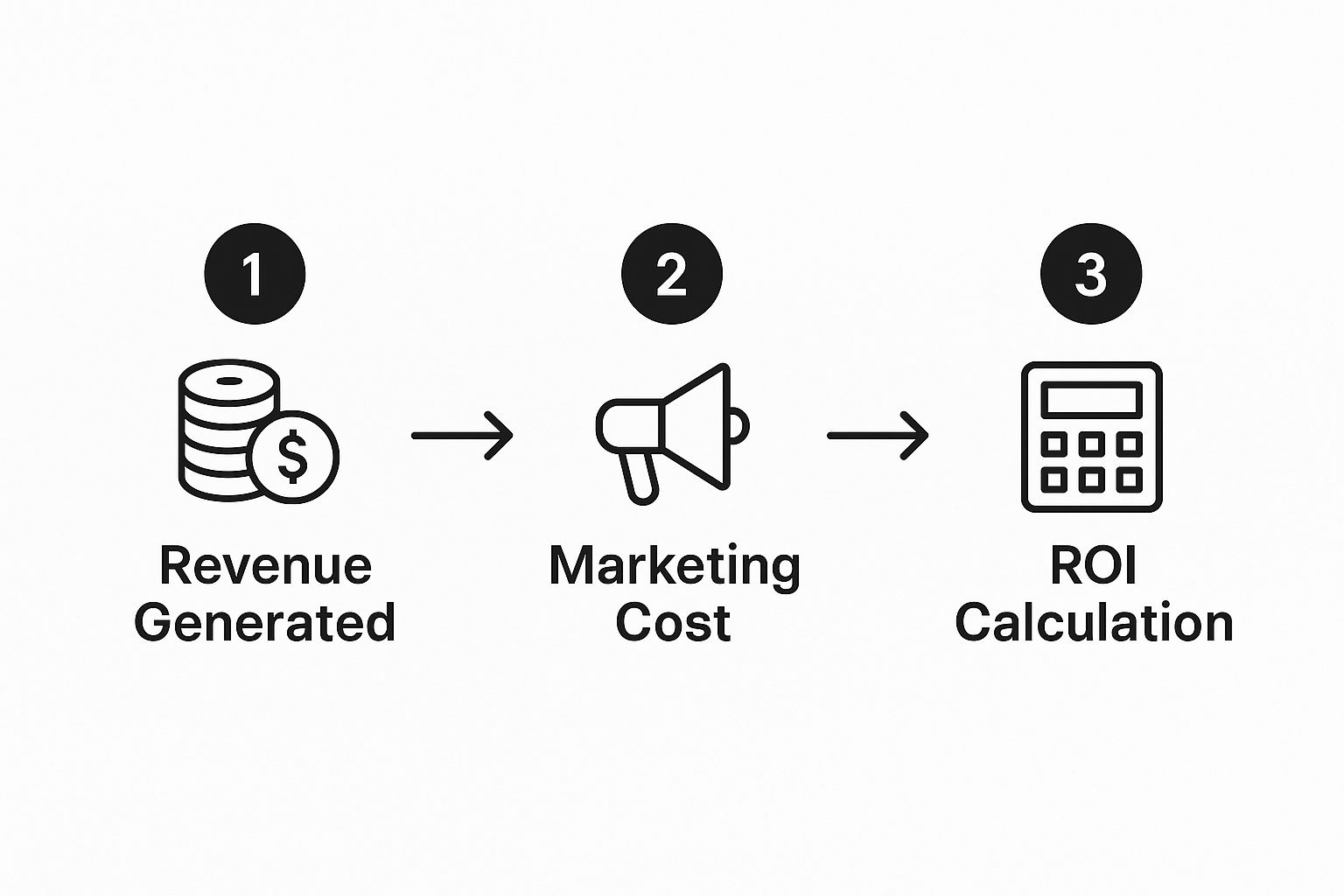
As you can see, the calculation boils down to subtracting your total marketing costs from the revenue generated to find your net profit, then comparing that profit to what you originally spent.
Defining Your Total Investment
One of the biggest mistakes I see people make is undercounting their investment. To get a true ROI, you have to account for everything. Not just the obvious ad spend.
Your real investment includes more than you think:
- Ad Spend: This is the easy one—the direct cost of running your paid social ads on platforms like Facebook, Instagram, or LinkedIn.
- Content Creation Costs: Did you hire a photographer or pay for stock video clips? Those are direct campaign expenses.
- Software and Tools: A portion of your social media management tool subscription, whether it’s Sprout Social or Hootsuite, should be chalked up to the campaign.
- Team Hours: This is the cost almost everyone forgets. Your team’s time is your most valuable asset. Figure out the hourly rate for each person involved and multiply it by the hours they dedicated to the campaign.
Adding all these up gives you the true ‘Investment’ figure for your formula. It stops you from accidentally inflating your ROI and gives you a number you can actually stand behind.
Calculating Your Return with Customer Lifetime Value
Now for the ‘Return’ side of the equation. This can be a bit more nuanced. Sure, direct sales are simple to track, but the real impact of a new customer often goes far beyond that first purchase.
This is where Customer Lifetime Value (LTV) becomes a total game-changer for your ROI calculations.
LTV is the total revenue you can reasonably expect from a single customer over the entire course of their relationship with your brand.
By plugging LTV into your ROI calculation, you paint a far more accurate and compelling picture of social media’s long-term value.
You’re not just measuring a one-off sale; you’re measuring the acquisition of a loyal, repeat customer.
When you frame it this way, you capture the full financial impact of your social media efforts. Trust me, that’s a much stronger story to tell your boss or client.
A Real-World Facebook Campaign Example
Let’s walk through a practical scenario to see how this all works. Imagine an e-commerce brand that sells handmade leather goods. They decide to run a Facebook campaign to promote a new wallet.
The Investment:
First, we need to tally up all the costs for their month-long campaign.
- Facebook Ad Spend: $2,000
- Video Production: $500 (hired a local videographer)
- Social Media Manager’s Time: $600 (20 hours at a$ 30/hour blended rate)
- Scheduling Tool Subscription: $50 (pro-rated monthly cost)
That gives us a total campaign investment of $3,150. This is our ‘Investment’ number.
The Return:
Using their Facebook Pixel and UTM parameters, the brand can track sales that came directly from the ads.
- Direct Sales Attributed to Campaign: $9,000
- Average LTV of a New Customer: $350
- Number of New Customers Acquired: 30
The immediate return from direct sales is $9,000. But to get the full picture, let’s factor in the LTV of those 30 new customers. That gives us a total projected return of $10,500 (30 customers x $350 LTV).
The Final ROI Calculation:
Now, we just plug our numbers into the formula:
ROI = [($10,500 Return -$ 3,150 Investment) / $3,150 Investment] x 100
ROI = ($7,350 /$ 3,150) x 100
ROI = 233%
With this calculation, the marketing manager can confidently report that for every dollar they put into the campaign, the business generated $2.33 in long-term value. Now that is a powerful, data-backed success story.
Using Analytics Tools for Smarter ROI Tracking

If you’re trying to track every click, conversion, and dollar spent on social media by hand, you’re setting yourself up for a world of pain.
You’ll get buried in spreadsheets and, worse, you’ll miss the story the data is trying to tell you. To really nail your social media ROI, you need the right tools to do the heavy lifting and connect the dots between your actions and your results.
The good news is, you’ve already got some powerful analytics baked right into the platforms you use every day.
Native tools like Meta Business Suite, LinkedIn Analytics, or TikTok Analytics are the perfect place to start. They serve up direct, unfiltered data on core metrics like reach, engagement rates, and audience demographics.
This is your ground zero for understanding campaign performance.
Digging Deeper with Third-Party Platforms
While those native tools are great, they can feel a bit like looking at the world through a keyhole—you only see one platform at a time.
To get the full picture of your ROI across every channel, you’ll need to bring in some third-party platforms.
Tools like Sprout Social or Hootsuite are designed to pull all your data into one central dashboard.
Suddenly, you can see how your Instagram efforts stack up against your LinkedIn campaigns, which is a game-changer when you’re deciding where to put your money.
Many of these platforms are also excellent choices if you’re in the market for social media scheduling software that comes with powerful analytics built-in.
These tools offer some pretty slick features that make ROI tracking much less of a headache:
- Customizable Reports: You can build dashboards that zero in on the exact conversion and revenue metrics your boss or client actually cares about.
- Automated Tagging: Automatically tag posts, campaigns, and even inbound messages to track performance without lifting a finger.
- Competitive Analysis: Get a real sense of how your share of voice and engagement compare to the competition.
Connecting Social Activity to Website Conversions
Now for the real magic: linking what happens on social media to what happens on your website. This is where Google Analytics becomes your absolute best friend.
The secret to making this connection work is a consistent, disciplined use of UTM parameters.
UTM parameters are just simple tags you tack onto the end of a URL. They act like little breadcrumbs, telling Google Analytics exactly where a visitor came from.
For instance, you can create a specific link for that new LinkedIn ad that tracks its source (LinkedIn), medium (paid social), and campaign name (Q4_Promo).
Here’s a snapshot of what that looks like inside Google Analytics, showing where your traffic is coming from.
This view lets you see exactly which social channels are driving the most traffic and, more importantly, the most conversions on your site.
Once you set up conversion goals in Google Analytics—like a completed purchase or a lead form submission—you can draw a straight line from a specific tweet or ad all the way to revenue.
This makes your ROI calculation not just a good estimate, but a hard, provable number.
When we talk about ROI, it’s impossible to ignore the impact of influencer partnerships. The data is pretty staggering: influencer marketing can generate an average return of $5.78 for every$ 1 spent.
That’s almost a six-fold ROI. This is exactly why it’s so critical to track the engagement and referral traffic from these campaigns. You can see more stats on influencer ROI at avaansmedia.com.
At the end of the day, using a smart mix of native, third-party, and web analytics tools turns ROI measurement from a guessing game into a data-driven science.
It gives you the power to not only prove your value but also to make smarter, more profitable decisions for your social media strategy going forward.
Ready to turn your social media numbers into real revenue, not just nice-looking dashboards?
If Pinterest is part of your marketing mix, your next smart move is to plug keyword data directly into your ROI strategy.
Our free Pinterest Keyword Research tool shows you exactly which topics are trending, which keywords are growing, and where the highest-intent opportunities are hiding.
That means you’re not just posting more content—you’re investing in content that’s far more likely to drive clicks, leads, and sales.
Use it to plan campaigns around proven demand, focus your ad spend on keywords that actually convert, and walk into your next report with hard data behind every result.
Open the free Pinterest Keyword Research tool in your browser now, drop in a few of your core topics, and start building social campaigns that you can confidently tie back to real ROI.
Answering Your Toughest Social Media ROI Questions

Even with a solid game plan, trying to measure the ROI from your social media efforts can stir up some tricky questions.
Let’s cut through the noise and tackle some of the most common challenges I see people face. Here are direct, actionable answers to get you unstuck and moving forward.
How Can I Measure the ROI of Brand Awareness Campaigns?
I get it. Measuring the return on a brand awareness campaign can feel like trying to nail Jell-O to a wall. But it’s not impossible. The trick is to stop looking for direct sales and start focusing on metrics that signal real value.
Instead of hunting for immediate purchases, look for growth in other key areas. Did your website traffic from social media jump during the campaign? Are more people punching your brand name directly into Google?
You can easily check this in Google Search Console by looking for a rise in branded search queries. It’s also smart to monitor your share of voice—are you getting mentioned more than your competitors?
If you need to put a dollar figure on it, your best bet is to calculate Earned Media Value (EMV).
Earned Media Value is what you would have paid to get the same level of reach and engagement if you’d run it as a paid ad.
For example, if your organic campaign reached 200,000 people and your average CPM (cost per thousand impressions) is $10, your campaign effectively generated $2,000 in media value. That $2,000 becomes the “Return” in your ROI calculation, giving you a solid number to work with.
What Is a Good Social Media ROI to Aim For?
This is the million-dollar question, isn’t it? But the honest, experienced answer is: there’s no single magic number. What’s considered a “good” ROI depends entirely on your industry, profit margins, and the specific goals of your campaign.
A high-volume, low-margin e-commerce brand is going to have a completely different target than a B2B service with a long sales cycle.
That said, many marketers consider a 5:1 ratio (a 400% ROI) a solid benchmark. This means for every $1 you spend, you generate$ 5 in revenue. It’s a ratio that generally ensures you’re clearing a healthy profit after factoring in all your other business costs.
My best advice? Stop chasing industry averages. The smartest move is to establish your own baseline. Run your first few campaigns, calculate your ROI, and then make it your team’s mission to consistently beat your own numbers. The real goal should always be profitability and steady, incremental improvement.
How Do I Account for the Long-Term Value of a Customer?
This is a big one. Focusing only on that first purchase is a classic mistake that dramatically undervalues your social media work. If you want to capture the true, lasting impact of your efforts, you have to bring Customer Lifetime Value (LTV) into the equation.
Think about it: a customer you found through a social campaign might make a small initial purchase. But their real value is tied up in all the repeat business they’ll give you down the road. Plugging LTV into your ROI calculation gives you a far more realistic—and compelling—picture of how profitable your social channels really are.
Calculating LTV isn’t too complicated, but you’ll need a few key pieces of data:
- Average Purchase Value: The typical amount a customer spends in one go.
- Purchase Frequency: How often a customer buys from you in a year.
- Customer Lifespan: The average number of years a customer sticks with you.
Let’s use a subscription box company as an example. Say a customer spends $40 per month, buys 12 times a year, and typically stays for three years. Their LTV is a whopping $1,440 ($40 x 12 x 3).
When you acquire that customer through a social campaign, $1,440 is the “Return” you should be using in your ROI formula. It changes the entire conversation.