Knowing how to pinpoint your target audience isn’t just another marketing checkbox, it’s the bedrock of your entire business.
Get this right, and everything from your product features to your brand’s voice just clicks into place.
Without it? You’re basically throwing your message into the wind and hoping the right person stumbles upon it.
Why Knowing Your Audience Is Everything

If you try to be everything to everyone, you’ll end up being nothing to anyone. It’s a classic mistake.
Generic messaging gets ignored because it doesn’t speak to a specific person’s problems or desires.
This is how you end up with a drained ad budget, dismal conversion rates, and a brand that nobody remembers.
The goal isn’t just to get any customers. It’s to find the right ones—the people who have a problem that you are perfectly built to solve.
It’s about swapping a wide, flimsy net for a targeted, high-strength one. You stop chasing surface-level numbers and start building a real community around what you do.
The Real Costs of Targeting the Wrong People
Skipping your audience research isn’t just a missed opportunity; it has real, tangible costs.
You’ll pour cash into ad campaigns that flop, build product features nobody wants, and create content that completely misses the mark.
It’s a costly domino effect, and it all starts with marketing to a faceless crowd instead of a clearly defined person.
This isn’t just a theory. The path from poor targeting to poor results is a straight line.
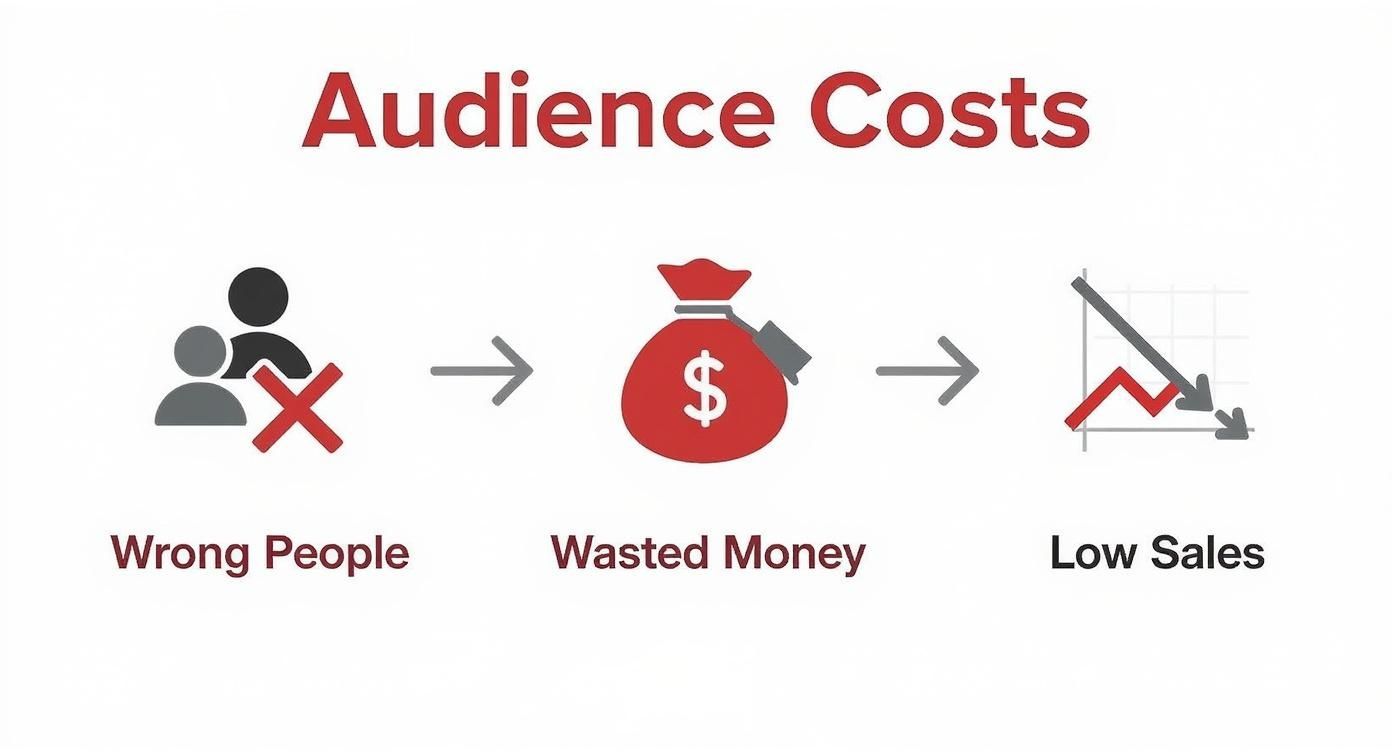
When your marketing doesn’t connect, you’re not just losing money; you’re losing momentum.
A sharp focus on the right audience is how you can increase website traffic organically and make every dollar in your budget count.
Keeping an Eye on Broader Demographic Shifts
Beyond your immediate customer profile, you need to understand the bigger picture. Major demographic shifts are reshaping the entire market.
For instance, the World Health Organization projects that by 2025, there will be 1.2 billion people over the age of 60.
That’s a massive and often overlooked market with very specific needs.
At the same time, Millennials and Gen Z are set to make up nearly 60% of the global workforce. Their buying power and digital-first mindset are impossible to ignore.
Smart businesses are figuring out how to cater to both a booming senior population and the younger generations that now dominate the economic landscape.
The most successful brands don’t just find an audience; they understand them so deeply that their products feel like an intuitive solution to a problem the customer has been struggling with for years.
Gathering Your Raw Audience Data

Alright, this is where the fun begins. We’re moving from theory to practice, digging into the actual data that will become the bedrock of your audience personas.
The aim here isn’t just to collect information from one place, but to blend different sources to get a complete, well-rounded view of your ideal customer.
The most logical place to start? Your existing customer base. These are people who have already bought into what you’re doing.
A quick look into your CRM or sales data can reveal a ton of patterns right away.
Are you noticing common job titles, similar company sizes, or recurring problems they came to you to solve?
Mining Your Digital Footprint
Your own website and social media channels are sitting on a treasure trove of quantitative data. Think of Google Analytics as your first stop.
In just a few clicks, you can see the age ranges, gender breakdown, and geographic locations of the people who are already finding and engaging with your content.
Then, layer on your social media analytics. Every platform has its own built-in dashboard that shows you the demographics of your followers.
You’ll get a clear picture of who is interacting with your posts, what topics get the most traction, and when your audience is most likely to be online.
This kind of demographic analysis is fundamental.
For example, if you’re targeting Instagram, you should know that the 18-24 (31.7%) and 25-34 (30.6%) age groups dominate the platform, making up over 62% of its user base.
And geographically, its biggest markets are India (362.9 million users), the U.S. (169.65 million), and Brazil (134.6 million).
Knowing this helps you decide if your audience is even there in the first place.
Key Takeaway: The data itself is just one part of the equation. You have to ask why it looks the way it does.
A sudden spike in traffic from Germany could mean a new market is opening up. High engagement on a particular blog post tells you exactly what kind of content your audience craves.
Once you have this baseline, you can start connecting the dots between who your audience is and how your content performs.
To get a handle on this, you’ll need a solid process for https://www.postpaddle.com/blog/how-to-measure-content-performance.
Adding the Human Element with Qualitative Data
Numbers tell you what is happening, but they rarely tell you why. That’s where qualitative data comes in.
It helps you uncover the motivations, frustrations, and real-world goals that drive your audience’s decisions.
If you’re new to this, learning how to conduct user research is a non-negotiable skill.
To help you get started, I’ve put together a quick-reference table that breaks down some of the most reliable primary data sources.
It compares each one, explains its primary use, and highlights the specific insights you can pull to better understand your audience.
Primary Data Sources for Audience Research
| Data Source | Type | Key Insights Gathered |
|---|---|---|
| CRM/Sales Data | Quantitative | Identifies common demographics (job title, industry, company size) and purchase history among existing customers. |
| Website Analytics | Quantitative | Reveals audience age, gender, location, and the content they engage with most. Tracks how they find your site. |
| Social Media Analytics | Quantitative | Provides follower demographics, engagement rates on specific topics, and peak activity times. |
| Customer Surveys | Qualitative | Uncovers challenges, goals, motivations, and what other solutions they have considered. |
| One-on-One Interviews | Qualitative | Gathers detailed stories, context, and the “why” behind purchasing decisions in the customer’s own words. |
| Social Listening | Qualitative | Captures unfiltered language, pain points, and questions people are asking in public forums and communities. |
As you can see, a mix of these sources gives you a much richer picture than any single one could on its own.
Now, let’s look at a few practical ways to gather that crucial qualitative feedback.
Here are a few methods I’ve found to be incredibly effective:
- Customer Surveys: Use a tool like SurveyMonkey or a simple Google Form. But don’t just ask about demographics. Ask about their biggest headaches, what they’re trying to achieve, and what other tools they’ve tried (and why they didn’t work).
- One-on-One Interviews: Nothing beats a real conversation. Schedule 15-20 minute calls with some of your best customers and ask open-ended questions like, “Can you walk me through the moment you knew you needed a solution for this problem?” You’ll uncover amazing, story-rich details you’d never get from a form.
- Social Listening: Become a fly on the wall. Spend time in Reddit communities, Quora threads, or Facebook groups where your audience hangs out. Pay close attention to the exact language they use to describe their problems—these are the words you should be using in your copy.
Analyzing Competitors and Market Gaps
You don’t have to create your audience profile in a vacuum. The truth is, your ideal customers are already out there, interacting with other brands in your industry.
Looking at your competitors is one of the smartest shortcuts you can take. It’s not about copying them; it’s about learning from their wins and mistakes to find your own sweet spot.
This isn’t just about making a list of their products. You need to reverse-engineer who they’re trying to talk to.
A solid analysis will help you spot your direct competitors (the ones offering a nearly identical solution) and your indirect competitors (those solving the same problem, but in a different way).
To really get the full picture, I’d recommend using a structured B2B competitor analysis framework.
Peeking into Your Competitor’s Playbook
Start by digging into their marketing. How do they talk? Who are they talking to? The language they use, the topics on their blog, and even the photos they choose are all clues.
A competitor posting memes on social media is clearly after a different crowd than one publishing dense white papers on LinkedIn.
These details show you who they’re successfully pulling in, which gives you a great starting point.
- Social Media Deep Dive: Go read the comments on their social posts. What are people asking? What are they complaining about? This is unfiltered, raw feedback, and it’s pure gold.
- Content and SEO Audit: Fire up a tool like Ahrefs or Semrush and see which keywords they’re ranking for. This tells you exactly what problems their audience is trying to solve online.
- Customer Review Mining: Check out review sites like G2 or Capterra. Pay close attention to the exact words customers use to describe their frustrations and what they love.
Uncovering Opportunities with Social Listening
Beyond just spying on your direct rivals, social listening is your secret weapon for understanding the bigger conversation.
This means keeping an eye on social platforms, forums like Reddit, and Q&A sites like Quora for any mention of your industry, competitors, or key problems.
It’s how you tap into what people really think and find needs that aren’t being met.
This isn’t just a niche tactic anymore. The global social media listening market is expected to jump from $9.61 billion in 2025 to a whopping$ 18.43 billion by 2030.
That kind of money tells you just how crucial this has become for businesses that want to stay ahead.
By tuning into the conversations your competitors are ignoring, you find the gaps. These are the pockets of people that nobody is speaking to directly. That’s your opening.
For instance, maybe you notice all your competitors are squarely focused on enterprise clients with huge budgets.
Through social listening, you might discover a vibrant community of small business owners who are desperate for a simpler, more affordable tool.
That’s your market gap. By building your brand to serve them, you sidestep a brutal head-to-head fight and start building a loyal following in a space you can actually own.
Building Personas That Feel Real

All that research you’ve done? It’s just a pile of numbers and notes until you give it a human face.
This is where you bring your data to life by building buyer personas—fictional, but realistic, profiles of your ideal customers.
The goal here isn’t to fill out a bland template; it’s to create a character your whole team can actually picture and understand.
A great persona is so much more than a name and a job title. It’s a living story that guides your messaging, content, and even your product roadmap.
When you nail it, you stop guessing what your audience wants and start knowing what they need. You’re no longer creating for a faceless crowd but for a specific person.
From Data Points to a Human Story
Start by sifting through your research and looking for patterns. Do certain job titles keep popping up? Are people mentioning the same frustrations over and over?
As you comb through survey answers and interview transcripts, a few distinct “types” of people will naturally start to take shape.
This is your first real clue to identifying who your audience is on a deeper level.
Resist the urge to create a dozen different personas right out of the gate.
Start with just one or two that represent your most important customer segments.
You can always build more later. Focus on depth, not breadth.
A truly useful persona needs a mix of demographic and psychographic details:
- Demographics: This is the basic stuff—age, job title, company size, and general location. It helps set the stage.
- Goals & Motivations: What’s this person trying to achieve in their role? What’s the bigger-picture driver behind their work?
- Challenges & Pain Points: What’s getting in their way? What problems are keeping them up at night? This is where you’ll find your biggest opportunities.
- Watering Holes: Where do they go for information? Think blogs, social media platforms, influencers, and online communities. This tells you where to find them.
Pro Tip: Give your persona a name and find a stock photo that feels right. It sounds simple, but this step is huge.
It instantly makes the persona more memorable and turns “Segment B” into “Marketing Manager Michelle,” someone your team can actually talk about.
Putting It All Together: A Sample Persona
Let’s make this tangible. Imagine we run a company that sells a project management tool built for small creative agencies.
After doing our homework, we’ve zeroed in on a key customer type.
Here’s a snapshot of “Creative Director Chris”:
| Persona Element | Details for “Creative Director Chris” |
|---|---|
| Background | 34 years old, works at a 15-person design agency in a major city. Manages a team of 5 designers. |
| Goals | Deliver amazing creative work on time and under budget, all without burning out his team. He wants to spend less time chasing down updates and more time actually leading creative direction. |
| Challenges | He’s constantly juggling multiple projects with tight deadlines. Client feedback is a chaotic mess of emails and Slack messages. He has almost no visibility into who’s working on what or if they have the bandwidth for a new project. |
| Watering Holes | Reads The Creative Bloq and Awwwards. Follows well-known creative directors on LinkedIn. Active in a few private Slack groups for agency owners. |
| Key Quote | “I feel like I’m constantly chasing status updates instead of leading my team creatively.” |
Suddenly, “Creative Director Chris” isn’t just a collection of data points. He’s a real person with real problems.
Now, the marketing team knows exactly who they’re talking to.
They can write blog posts about streamlining client feedback or create ads that hit on the pain of administrative overload, making sure every single piece of content connects.
Testing and Refining Your Audience Profile
Getting your persona down on paper is a huge first step, but let’s be honest—it’s still just a well-researched guess.
The real magic happens when you put that profile to the test in the wild.
This is the validation phase, where you find out if you’ve really nailed your target audience or if it’s time to head back to the drawing board.

Think of it less like a final exam and more like a series of small, controlled experiments. You don’t need to blow your budget to start testing; you just have to be smart about it.
The entire goal is simply to see if your theoretical customer acts the way you expect them to.
Run Small-Scale Validation Campaigns
One of the quickest ways to see if you’re on the right track is to run small, highly targeted ad campaigns.
Platforms like Facebook and LinkedIn are perfect for this because they let you build hyper-specific audiences based on the exact demographics, job titles, and interests you’ve mapped out in your persona.
Let’s say your persona is “Creative Director Chris.” You can literally build a campaign that only targets users with that job title working in creative fields.
- Test different angles: Don’t just run one ad. Create a few variations to see what message sticks. Does Chris click on an ad that promises efficiency (“Stop Wasting Time on Admin”) or one that speaks to his passion (“Unleash Your Team’s Best Ideas”)?
- Watch the engagement: Clicks are great, but look deeper. Are people from the right companies commenting? Are the right job titles sharing your post? High-quality engagement from your ideal profile is a huge win.
- A/B test your landing pages: Send that ad traffic to two different landing pages. One page might focus on solving a pain point you identified, while the other highlights a key benefit. Tracking which one converts better gives you concrete proof of what messaging actually works.
The point of these initial tests isn’t necessarily to drive a ton of sales. The real prize here is data.
Every click, comment, and conversion is a vote, telling you whether your persona is on the money.
Get Feedback from Your Front Lines
Your sales and customer service teams are sitting on a goldmine of audience intel. They’re on the phone with potential and current customers all day, every day.
They hear the unfiltered objections, the “dumb” questions, and the real-world problems that spreadsheets and analytics can never fully capture.
Make a point to regularly connect with these teams. Pull up your persona and ask them point-blank: “Does this sound like the people you talk to?”
Their gut-check feedback is invaluable and will quickly expose any gaps between your profile and the people actually buying your product.
Getting this right means knowing what signals to look for.
Aligning your teams on what to track is critical, and you can learn more about how to measure marketing success to get everyone on the same page.
Ultimately, figuring out your audience is never a “one and done” job. It’s a living process—a constant cycle of building, testing, learning, and tweaking.
As your market and customers evolve, your understanding of them needs to evolve right along with them.
Make Your Audience Research Work Harder on Pinterest
Figuring out who your ideal customer is is only half the job. The next step is speaking their language in places where they actively go looking for ideas and Pinterest is one of those places.
Once you know their goals, pain points, and daily context, the real question becomes: what exactly are they typing into the search bar?
When you turn your personas and research into concrete keyword phrases, everything sharpens: board themes stop feeling random, Pin ideas come faster, and your content starts matching real searches instead of vague guesses.
That’s how you move from “we know our audience” to “our audience can actually find us.”
My free Pinterest Keyword Research tool helps you make that jump. You plug in topics based on your audience profiles, and it surfaces real search phrases you can use in your board names, Pin titles, and descriptions.
It’s a simple way to translate all the work you’ve done on personas into keywords that drive discovery and growth.
Ready to turn what you know about your audience into words they actually search for?
Common Questions About Finding Your Audience
Even with the best roadmap, you’re bound to hit a few bumps when trying to nail down your target audience.
Let’s walk through some of the strategic hurdles that trip people up the most and give you some clear, practical ways to get past them.
These are the questions that often get businesses stuck, but thankfully, the answers are usually more straightforward than they seem.
What If My Audience Seems Too Broad?
This is a classic one, especially when you’re just starting out. It’s easy to think, “Hey, pretty much anyone could use my product!”
And while that might feel true, trying to market to “everyone” is a surefire way to connect with no one. The real secret is to start with a focused niche and then expand.
For example, instead of targeting all small business owners, what if you started with just the owners of local, brick-and-mortar coffee shops?
Or rather than going after all fitness enthusiasts, what if you zeroed in on new moms looking for simple at-home workout routines? Getting this specific is what makes your messaging cut through the noise.
When your audience feels like a giant, undefined blob, it’s a signal that you need to add another qualifying layer.
Dig back into your data and look for the most profitable, most engaged, or most overlooked segment within that massive group. That’s your true starting line.
Narrowing your focus doesn’t mean you’re shutting the door on other customers forever. It just means you’re building a solid foundation with a core group of die-hard fans first.
Once you’ve earned their loyalty, you can leverage that momentum to branch out into neighboring markets.
How Often Should I Update My Personas?
Your audience personas aren’t meant to be framed and hung on the wall like a museum piece. They’re working tools.
Markets change, customer habits evolve, and your own business grows. A persona that felt spot-on two years ago could be wildly out of date today.
As a general guideline, you should formally sit down to review and refresh your personas at least once a year. That said, certain events should act as an immediate trigger for a check-in:
- A major market shift: Think about big economic changes, a pandemic, or a new technology that completely changes how people live and buy.
- A new product launch: When you roll out a new service or product, you might naturally start attracting a different type of customer.
- A dip in marketing performance: If your ads and emails suddenly stop landing like they used to, it’s a big red flag that your audience’s needs or priorities have shifted.
Treat your personas like living documents. You keep them alive and relevant by constantly gathering feedback and staying genuinely curious about what’s going on in your customers’ world.
How Do I Find an Audience for a Brand-New Product?
Launching something completely new, with no existing customer data to pull from, can feel like you’re navigating in the dark.
But you’re not starting from scratch. The strategy here is simply to look outward before you look inward.
First up, dive into competitor analysis. Who are your closest competitors going after? Scrutinize their messaging, dig into their social media followers, and read through their customer reviews.
This will help you build a “proto-persona”—a foundational, data-backed guess about who might be interested in a solution like yours.
From there, get into the trenches with social listening and forum research. Spend time on platforms like Reddit, Quora, or niche Facebook groups related to your industry.
Search for keywords around the problem your product solves and just listen. Pay close attention to the language people use, the frustrations they share, and the other solutions they’ve already tried.
This kind of raw, unfiltered feedback is gold for sketching out your initial audience profile before you’ve even made your first sale.