
It all boils down to a simple, four-part process.
Figuring out your goals and who you’re talking to, taking stock of what you already have, mapping out how you’ll create new stuff, and then measuring what actually works.
This isn’t just theory; it’s a repeatable system that turns random content ideas into a reliable way to find and keep customers.
Why a Documented Strategy Separates Thriving Brands from Noise

Let’s be real for a second. The old saying “content is king” is pretty worn out.
Just making content for the sake of it is like yelling into a canyon and hoping someone, somewhere, hears you.
A written-down content strategy is your most valuable asset for real, sustainable growth. It gives every blog post, video, and pin a clear job to do.
Without a strategy, you’re just guessing. I’ve seen it a thousand times.
A small e-commerce shop posts slick product photos on Instagram one day, then a random how-to blog post the next.
The individual pieces might be fine, but there’s no story connecting them.
This “publish and pray” method burns through time and money, creates a jumbled brand message, and leaves you with an audience that never really gets what you’re about.
The True Cost of a Missing Strategy
The fallout from not having a plan is very real. You end up creating content that has nothing to do with your actual business goals.
You miss out on ranking for keywords that could bring in ready-to-buy customers. You fail to guide people from “just browsing” to “take my money.”
You’re essentially spending resources with no real expectation of a return.
A documented strategy forces you to get crystal clear on your objectives before you write a single word.
A content strategy isn’t just a plan for what you’ll publish; it’s a business asset that aligns your marketing efforts with core objectives, ensuring every article, video, and social post contributes to measurable growth.
A Framework for Purposeful Creation
When you put your plan on paper, you build a system.
You know exactly who you’re trying to reach, what problems you’re helping them solve, and how your content will lead them to a solution—ideally, your product.
That clarity is a game-changer. It gets your whole team on the same page, creating content where every piece supports the others.
It’s how you build a powerful, memorable brand experience. For a deep dive into building this foundation, this ultimate content marketing strategy guide is an incredible resource.
Here is a quick overview of the core components we’ll build together in this guide.
The Four Pillars of a Growth-Focused Content Strategy
| Pillar | What It Achieves | Key Action |
|---|---|---|
| Goals & Audience | Provides clear direction and purpose. | Define SMART goals and build detailed audience personas. |
| Content Audit | Identifies what works and what doesn’t. | Analyze existing content for gaps, wins, and opportunities. |
| Creation & Workflow | Establishes a system for consistent output. | Map out the entire process from ideation to promotion. |
| Measurement & KPIs | Proves ROI and informs future decisions. | Track key metrics to understand performance and iterate. |
The numbers don’t lie. As we head into 2025, a staggering 82% of companies are actively using content marketing.
More importantly, 76% of marketers say it’s a solid way to generate leads.
This isn’t a niche tactic anymore. A strategic approach is the bare minimum for staying competitive.
You can see more data on the effectiveness of content marketing on colorwhistle.com.
Nailing Your Audience and Sizing Up the Competition

The best content is never created in a vacuum. It’s a direct answer to a real person’s need, a solution to their problem, or a guide for their next step.
Before you even dream up a single topic, you have to get crystal clear on two things: who you’re talking to and who else is trying to get their attention.
This is where so many strategies fall flat. A lot of businesses cook up a generic “buyer persona”—something vague like “Marketing Mary, age 35-45″—and call it a day.
Honestly, that’s not going to cut it. To build a content strategy that actually connects and converts, you have to dig much deeper into the real-world motivations and pain points of your audience.
Going Beyond the Generic Persona
To really get inside your audience’s head, you need to listen in on the conversations they’re already having.
Generic personas are built on assumptions; real insights come from raw, unfiltered customer feedback.
Here are a few places I always look to gather this kind of intel:
- Social Listening: Forget just your brand mentions. I’m talking about lurking on Reddit, Quora, and niche industry forums. Pay close attention to the exact language people use to describe their frustrations. What questions keep popping up? What are they complaining about?
- Customer Surveys: Go beyond the standard satisfaction questions. Ask open-ended questions that get to the heart of their journey, like, “What was the biggest hurdle you faced before finding a solution like ours?” or “What’s one thing you wish you knew when you first started out?”
- Sales Call Notes: Your sales team is sitting on a goldmine. Their call transcripts and notes are packed with customer objections, goals, and the specific results people are desperately trying to achieve.
When you do this work, your understanding transforms from a flat caricature into a three-dimensional view of your ideal customer.
You’ll know their goals, their fears, and the exact words they type into Google when they’re looking for help.
The real goal isn’t just to know who your audience is. It’s to understand how they think. When you can articulate their problem better than they can, you instantly earn their trust.
Understanding broader market dynamics is also key, especially for specific content formats.
For instance, if you’re creating long-form written content, you can find some fantastic insights from the consumer book publishing market that can signal wider trends in how people consume and what they prefer.
Running a Competitive Analysis That Actually Helps

Once you’ve got a solid handle on your audience, it’s time to see what everyone else is doing.
The point here isn’t to copy your competitors. It’s to find the gaps they’ve missed. Your secret weapon for this is a content gap analysis.
A content gap analysis is just a methodical way of finding the valuable topics and keywords your audience is searching for, but your competitors aren’t covering well or at all.
Let’s say you run a SaaS company with project management software for creative agencies.
Your main competitors probably have blogs filled with broad articles on “time management” or “team productivity.” That’s pretty standard stuff.
But through your deep-dive audience research, you discovered that your ideal customers are tearing their hair out over managing client feedback and scope creep, specifically on video projects.
Now that is a specific pain point.
Finding and Owning Your Niche
This is your opening. By running a content gap analysis, you can pinpoint the keywords and topics that live inside this underserved niche.
Instead of adding another generic productivity post to the internet, you can create something that directly solves this very specific problem.
Here’s what that looks like in practice:
- Dig for Specific Keywords: Use an SEO tool to look for long-tail keywords like “how to manage video project feedback,” “client approval workflow for video,” or “preventing scope creep in creative projects.”
- Analyze What Ranks: Go search for those terms yourself. What you’ll likely find is that the top-ranking content is either too general or just doesn’t get the specific workflow of a creative agency.
- Create Something Better: Now’s your chance. You can build a definitive pillar page, a series of in-depth blog posts, or even a downloadable template that provides a genuine solution.
By zeroing in on this gap, you stop just creating content and start owning a conversation.
You become the go-to resource for a very specific, high-value audience—attracting qualified leads that your competitors are completely missing.
This targeted approach is the foundation of a content strategy that truly works.
Building a Sustainable Content Creation Engine

If you’re just posting content whenever you have a spare moment, you’re not building anything. You’re just… posting.
A real content engine doesn’t run on random acts of content. It runs on a clear, proactive roadmap.
Think of it as the difference between throwing seeds in the wind and planting a garden.
You’ll want to intentionally brainstorm topic clusters and pillar pages that directly serve your business goals.
- Content Pillars are the big-ticket themes that pull in your target audience.
- Topic Clusters are smaller, detailed posts that link back to your pillars, which is a huge boost for SEO.
- Internal Links are the threads that weave it all together, reinforcing your authority on a subject.
Mapping all this out from the start doesn’t just organize your content; it helps you figure out the best channels to promote it on.
So, where do you begin? Start by getting inside your audience’s head. What are their biggest problems and most urgent questions?
I once worked with a software firm that built its entire content strategy around three core areas: automations, templates, and troubleshooting.
That sharp focus helped them double their organic traffic in just three months.
Here’s how you can replicate that kind of success:
- Start by gathering keyword ideas. Look at your search data, but don’t forget to mine customer service emails and sales call notes for the exact language your audience uses.
- Take a peek at what your competitors are doing. Are there any topics they’ve overlooked or niches they haven’t covered in-depth? That’s your opening.
- Group your keywords into themed clusters that naturally revolve around your core services or products.
For every cluster, ask yourself: is the searcher looking for information, or are they ready to buy?
Tying each topic to a specific intent lets you create content that meets people exactly where they are in their journey.
Creating a Strategic Calendar
A good content calendar is so much more than a list of publish dates.
It’s your strategic roadmap, laying out formats, workflows, and promotion plans all in one place.
Before a new month begins, make sure you’ve defined the types of content you’ll create and who is responsible for each piece.
I’m a big fan of color-coding by channel—it gives you a quick visual of how you’re cross-promoting everything.
Here’s a simple content cadence that a small team could easily manage:
| Format | Frequency | Owner |
|---|---|---|
| Blog Post | Weekly | Writer |
| Short Video | Biweekly | Video Lead |
| Pinterest Pin | Daily | Social Manager |
Don’t just copy and paste this, though. Adapt it to your own team and goals.
A solo blogger, for example, might find it much more efficient to batch-write four blog posts in one day and then schedule all their Pinterest Pins in a single session.
Batching similar tasks is the secret to staying consistent without burning out.
It cuts down on the mental drain of constantly switching gears and helps you build momentum.
And don’t forget to pencil in holidays, product launches, and seasonal trends!
Budget-Friendly Video Tips
Speaking of content formats, video is an absolute powerhouse right now.
As we move through 2025, it’s delivering some of the best ROI and engagement you can get.
The numbers don’t lie: an incredible 91% of brands are using video, and 90% of them report a positive return on their investment. You can see more on this in this detailed research on video marketing.
Good news—you don’t need a Hollywood budget. Your smartphone, some natural light, and a simple editing app are all you need to get started.
Always add captions. It’s a small step that boosts accessibility and keeps people watching even with the sound off.
You can also get more mileage out of your work by chopping up longer videos into short, punchy clips for social media.
I’ve seen brands triple their engagement in under a month just by consistently posting high-frequency video bites.
This strategy keeps your feeds fresh and your audience hooked.
Just remember to link back to your full guides or pillar pages to drive that valuable, deeper traffic.
For a deeper dive into making this sustainable, check out our guide on how to scale content marketing with Post Paddle.
A solid system is what saves you from the last-minute scramble. It frees you up to think about the big picture and analyze what’s actually working.
Reinforcing Your Pillar Pages
Think of pillar pages as the central hubs for your topic clusters.
They are the comprehensive, go-to resources that guide readers through a subject from top to bottom.
For example, a marketing pillar page might break down every single step of an automated Pinterest workflow, complete with long-form insights, data, and visuals.
This kind of depth signals serious expertise to search engines and builds a ton of trust with your audience.
- Link your individual cluster articles back to the main pillar page.
- Update your pillar content at least quarterly with new data, examples, or insights.
- Make your pillar pages easy to find by featuring them on your homepage or in your main navigation.
Auditing your pillar content regularly keeps it fresh and relevant. This approach not only solidifies your authority but also makes content updates far more manageable.
A Quick Case Study
We saw a cooking blogger start using Post Paddle to automate 200 Pins a month. Before, her days were a chaotic scramble to get content posted.
Afterward, she was planning her content calendar weeks in advance.
The result? Her traffic shot up by 150%, and she reclaimed 10 hours of her time every single week.
This is what happens when you have a defined engine in place—you get reliable, repeatable results.
Building a content engine transforms your scattered tasks into a strategic, well-oiled machine. It gets your team on the same page and fuels consistent, predictable growth.
Now it’s your turn. You don’t have to build the entire thing overnight.
Start small. Plan out just one topic cluster and schedule your posts for the next two weeks.
See what happens. Measure your performance, tweak your topics, and then gradually expand your engine.
In the long run, consistency always beats intensity. Your documented engine is the backbone of sustainable growth.
Put these tactics to work, and watch your quality content deliver returns that compound over time.
Use Smart Automation to Get Your Content Seen
You’ve poured your heart and soul into creating fantastic content. That’s a huge win, but it’s only half the battle.
Now, you need to get it in front of the right eyeballs, and you need to do it consistently. This is where smart automation completely changes the game.
It turns your content distribution from a manual, time-sucking chore into a lean, mean, traffic-driving machine.
Forget just posting your new blog article once and hoping for the best.
A real strategy involves making sure that content keeps working for you long after you’ve hit the publish button.
This is especially true for platforms that act more like search engines than social feeds.
Your Secret Weapon? Pinterest.
Let’s talk about a platform that’s criminally underrated: Pinterest. Too many people lump it in with other social sites, but its true power is that it’s a visual search engine.
People aren’t there to see what their friends ate for lunch; they’re actively looking for ideas, solutions, and things to buy.
Because it’s search-based, your content—your Pins—can drive traffic for months, sometimes even years. A tweet is gone in minutes.
An Instagram post has a lifespan of a few hours. A well-crafted Pin, on the other hand, is an evergreen asset that just keeps bringing new visitors to your website.
The real magic of Pinterest is its longevity. A single Pin can catch fire weeks after you post it, delivering a steady stream of highly targeted traffic. It’s an investment, not just a social update.
Thinking about your content this way requires a plan. A solid content calendar becomes the blueprint for this kind of automated, long-term promotion.
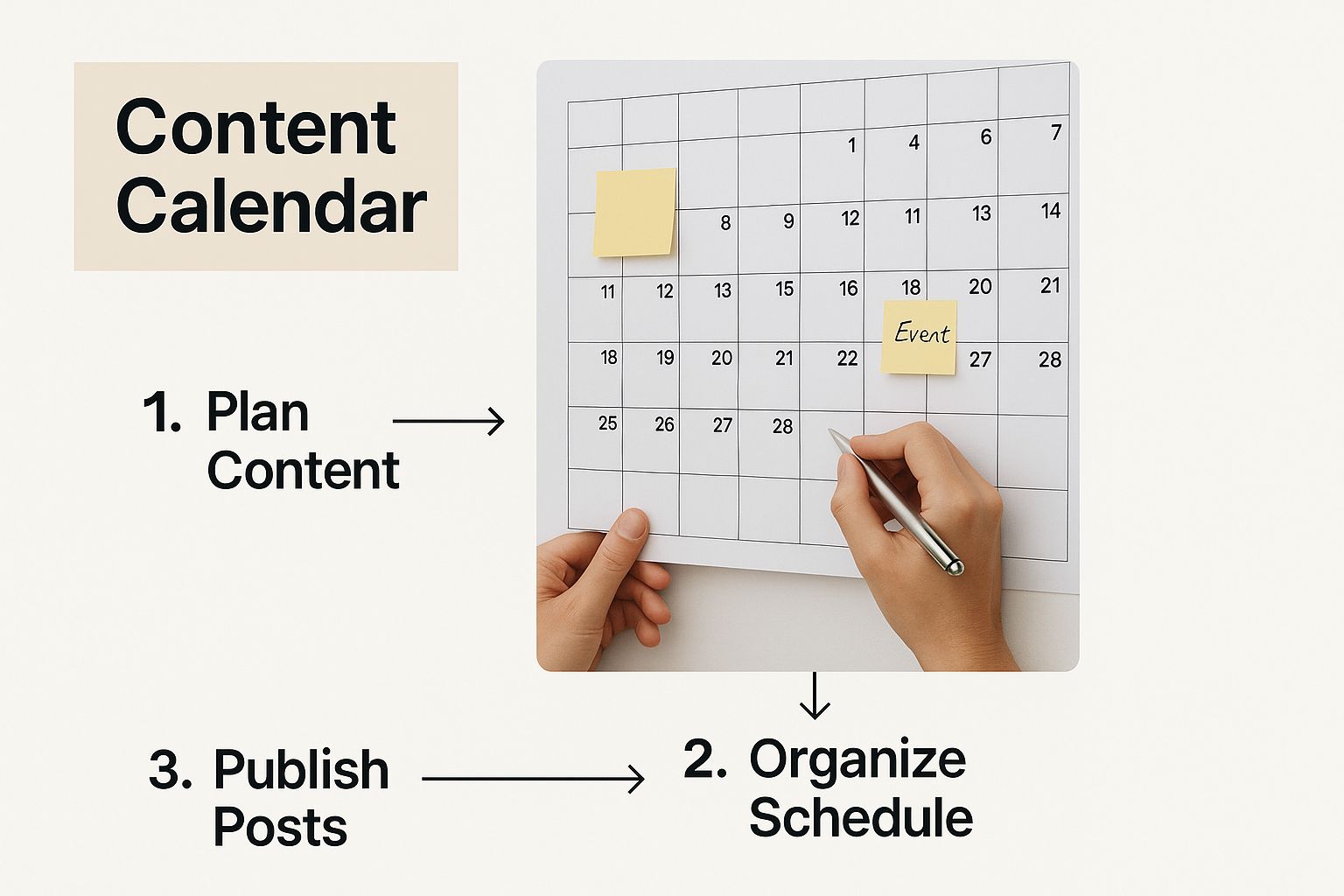
When you have a system, every piece of content gets a predefined promotion schedule, maximizing its reach without you having to do it all by hand.
How to Set Up an Automated Pinterest Workflow
Okay, let’s get down to brass tacks. Manually creating dozens of unique Pins for every single blog post is a one-way ticket to burnout.
This is where a tool like Post Paddle comes in to do the heavy lifting for you.
Let’s say you’re a food blogger with a brand new recipe. Here’s what an automated workflow looks like:
- The system grabs your content: The tool automatically pulls the new post’s URL, images, and text from your blog.
- It creates unique Pins: Using your pre-designed, on-brand templates, it generates multiple Pin variations. Think different text overlays, different images from the post, and unique, SEO-friendly descriptions for each one.
- It schedules everything smartly: Finally, these new Pins are automatically scheduled to your most relevant Pinterest boards over the next several days or weeks. This keeps your profile active without spamming your followers.
A process that used to take hours now takes a few minutes to set up. You build the system once, and it runs for every new piece of content you publish.
The Real-World Impact
So, does this stuff actually work? Absolutely. We helped a home decor blogger who was spending nearly 10 hours a week manually pinning everything.
After we set up an automated workflow for her using Post Paddle, she got that time down to less than an hour a week.
But it gets better. The results were staggering:
- Her outbound clicks from Pinterest to her blog shot up by 150% in just three months.
- Her monthly Pinterest views exploded by over 300%.
- She used all that reclaimed time to create more high-quality articles, which in turn fed the automation engine and created a powerful growth loop.
This isn’t a fluke. When you automate your distribution on a platform like Pinterest, you can maintain a high level of activity without sacrificing your sanity.
Every piece of content you create gets the visibility it deserves.
While Pinterest is an amazing place to start, you can apply these same principles across your channels by exploring different social media automation tools.
By making smart automation a core part of your strategy, you move from just creating content to strategically amplifying it.
That’s how you get a real return on your creative investment and build a reliable engine for traffic and growth.
Measuring What Matters and Optimizing for Growth

A content strategy isn’t something you create once and then shove in a drawer. Think of it as a living, breathing part of your marketing that needs regular check-ups and adjustments.
If you’re not measuring its performance, you’re essentially flying blind, making decisions based on gut feelings instead of what the data is telling you.
This is where the real growth happens. When you consistently track performance and make smart, data-informed tweaks, you create a powerful feedback loop.
Your results start to shape your strategy, ensuring you’re not just staying busy, but actually being productive.
Moving Beyond Vanity Metrics
It’s so easy to get caught up in “vanity metrics.” We’ve all been there—excited about a spike in social media likes or a surge in page views.
While those numbers can feel good, they often don’t tell the whole story.
A blog post might get thousands of views but generate zero leads, which makes it way less valuable than a post with only 100 views that converts 10% of its readers.
To really get a handle on your content’s impact, you have to focus on the Key Performance Indicators (KPIs) that are tied directly to your business goals.
Here’s what that looks like in practice:
- Growing Brand Awareness? Keep an eye on organic traffic growth, your keyword rankings for core topics, and whether more people are searching for your brand by name (branded search volume).
- Need More Leads? Your focus should be on conversion rates for your sign-up forms, the number of new email subscribers coming from your content, and how many marketing-qualified leads (MQLs) you’re generating.
- Trying to Boost Engagement? Look at metrics like time on page, the number of comments per post, and the click-through rate (CTR) on the links within your articles.
Shifting your focus to these kinds of actionable metrics gives you a much clearer picture of what’s actually working.
For a deeper dive into what you should be tracking, our guide on how to measure content performance breaks it all down.
Your Content Performance Dashboard
You don’t need some ridiculously expensive analytics suite to get started. A simple, well-configured dashboard in Google Analytics 4 (GA4) can tell you almost everything you need to know.
The trick is to set up a custom report that puts your most important KPIs in one place so you can spot trends at a glance.
I recommend starting with these three reports:
- Traffic Acquisition: This tells you which channels (Organic Search, Social, Direct, etc.) are bringing you the most valuable visitors.
- Pages and Screens: Here’s where you’ll find your rockstar blog posts and landing pages—the ones keeping users engaged and driving conversions.
- Conversions: This report tracks how many people are taking those key actions you care about, like filling out a form or downloading an ebook.
This data-first mindset is only becoming more critical. A huge trend we’re seeing is the rise of AI in content strategy, with over 80% of marketers globally now using AI tools. These tools rely on solid performance data to work their magic, making accurate measurement more crucial than ever.
The goal isn’t to track every single metric under the sun. It’s to track the right metrics—the ones that help you make smarter decisions about where to put your time and energy next.
The Power of the Content Audit
One of the most valuable things you can do to optimize your strategy is a content audit.
This is just a systematic review of all your existing content to figure out what to keep, what to update, and what to get rid of entirely.
Doing an audit every six to twelve months helps you:
- Spot Underperforming Content: Find those old posts that aren’t ranking or driving traffic and decide if they’re worth improving or if it’s time to say goodbye.
- Find “Quick Win” Updates: Pinpoint articles with outdated stats or info. A quick refresh can often give them a nice little SEO boost.
- Discover Repurposing Gold: Uncover your best-performing blog posts. Could that guide become a video? An infographic? A webinar?
This whole process keeps your content library from getting bloated and ensures it stays lean, relevant, and effective.
It’s all about focusing your efforts on the assets that actually deliver a return, which completes that feedback loop and drives sustainable, long-term growth.
Ready to Turn Your Content Strategy Into Steady Traffic?
If you want your articles and pins to work together instead of posting and hoping, the next step is dialing in the right keywords.
This free Pinterest keyword research tool shows you exactly what your audience is searching for, so you can plan content pillars, topics, and pins around real demand—not guesswork.
It’s ideal if you’re building a long-term content engine and want every post, pin, and page to support your growth goals.
Whether you’re starting from scratch or tightening up an existing strategy, this tool helps you spot high-intent ideas faster and organize them into a clear plan.
Common Content Strategy Questions Answered
Even the most buttoned-up content strategy will have you scratching your head at some point. That’s just part of the process.
Let’s walk through a few of the most common questions that come up once you start putting your plan into action.
One of the first things people ask is about publishing frequency. How often should you actually be posting?
The real answer is, it depends on what you can realistically handle without your quality tanking.
Consistency will always beat volume. If you can only manage one fantastic, deeply researched blog post a month, that’s infinitely better than churning out four half-baked articles just to say you published weekly.
Start with a schedule you can own, and you can always ramp things up later.
How Long Should a Blog Post Be?
Ah, the million-dollar question. You’ll hear a lot about how long-form content (think articles over 1,500 words) tends to do well with search engines, but there’s no magic number.
The right length is however long it takes to solve your reader’s problem completely.
A quick how-to guide might only need 800 words to get the job done. A massive, foundational guide on a complex topic? That could easily top 3,000 words.
Instead of getting hung up on word count, zero in on these things:
- User Intent: What is someone really trying to figure out when they type in that search query?
- Topic Depth: Did you cover all the angles? Have you answered the follow-up questions they’ll have?
- What’s Already Out There: Take a look at the top-ranking content for your keyword. What’s the average length and depth?
Your mission is to create the single best, most helpful resource on the internet for that topic. If you can do that in 500 words, great. If it takes 5,000, so be it. Just don’t add fluff for the sake of it.
The best content strategy isn’t set in stone. Think of it as a living framework that you adjust based on what the data and your audience are telling you. What works today might need a refresh in six months.
What Is the Best Content Format?
The “best” format is whichever one your audience actually prefers. While blog posts are the bread and butter of any good SEO strategy, you can’t stop there.
For example, video is huge—a staggering 91% of brands are using it as a key marketing tool because people just love to watch and engage.
Think about using a mix of formats to keep things interesting and show up in different places.
- Video: Awesome for showing people how to do something, demonstrating a product, or just putting a face to the name.
- Infographics: These are perfect for making complicated stats or processes easy to understand. They’re also incredibly shareable, especially on a visual platform like Pinterest.
- Checklists & Templates: Who doesn’t love a freebie? These provide instant value and are fantastic for getting people onto your email list.
Mixing up your content formats helps you appeal to different people and grabs their attention wherever they hang out online.
For more deep dives into these kinds of questions, you can find some great insights from the Clipbot blog that offer practical advice.