While many social media platforms have deprioritized them, hashtags on Pinterest remain a powerful tool for discoverability and reach.
Unlike other platforms where hashtags cater to fleeting trends, Pinterest hashtags function more like a permanent filing system, helping the platform categorize your content and serve it to users actively searching for specific ideas and inspiration.
Using the right combination of hashtags for Pinterest ensures your Pins appear in relevant search results, topic feeds, and the “More like this” section long after they are first published. This evergreen nature makes a strategic hashtag approach essential for driving sustained traffic and engagement.
This guide moves beyond generic advice to provide a comprehensive blueprint for your Pinterest strategy.
We will explore eight distinct types of hashtags, from broad category tags to hyper-specific long-tail phrases. You will learn not just what hashtags to use, but how and when to deploy them for maximum impact across different niches, from e-commerce to blogging.
Get ready to transform your Pins from simple images into targeted assets that connect directly with an audience ready to engage, save, and click.
8 Essential Hashtag Categories to Use on Pinterest
Hashtags on Pinterest work best when you use them with intention, not at random.
The eight categories below give you a simple framework for mixing reach, relevance, and intent—so every hashtag you add helps Pinterest understand your content, match it to the right searches, and put your Pins in front of people who are actually interested in what you offer.
1. Niche-Specific Hashtags

While broad hashtags might seem like the quickest way to get eyes on your content, niche-specific hashtags are the secret to attracting your ideal audience.
These are targeted keywords that drill down into a particular industry, interest, or aesthetic.
Think of them as the difference between shouting in a crowded stadium and having a meaningful conversation with an interested group.
Using niche-specific hashtags for Pinterest ensures your content reaches users who are actively searching for what you offer.
For example, a home decor blogger will see far better results using #minimalistbedroom than the overly saturated #homedecor. The former targets users with a specific intent, leading to higher engagement and a more qualified audience.
How to Find and Use Niche Hashtags
The key is to think like your target user. What specific terms would they search for?
- Research terminology: Dive deep into your field. If you’re in the sustainable fashion space, use tags like
#slowfashionmovementor#ethicalclothinginstead of just#fashion. - Analyze competitors: Look at the pins of successful creators in your niche. Note which specific hashtags they consistently use on their top-performing content.
- Blend the popular with the new: Mix moderately popular niche tags (e.g.,
#veganrecipeswhich has high volume) with emerging or more descriptive ones (e.g.,#veganmealprepsunday) to capture different segments of your audience.
Pro Tip: Aim for a sweet spot of 3 to 5 highly relevant niche hashtags per Pin. This provides Pinterest with enough context to categorize your content without appearing spammy or unfocused.
For a quick overview of how these hashtags perform, the following summary highlights their typical search volume and engagement potential.
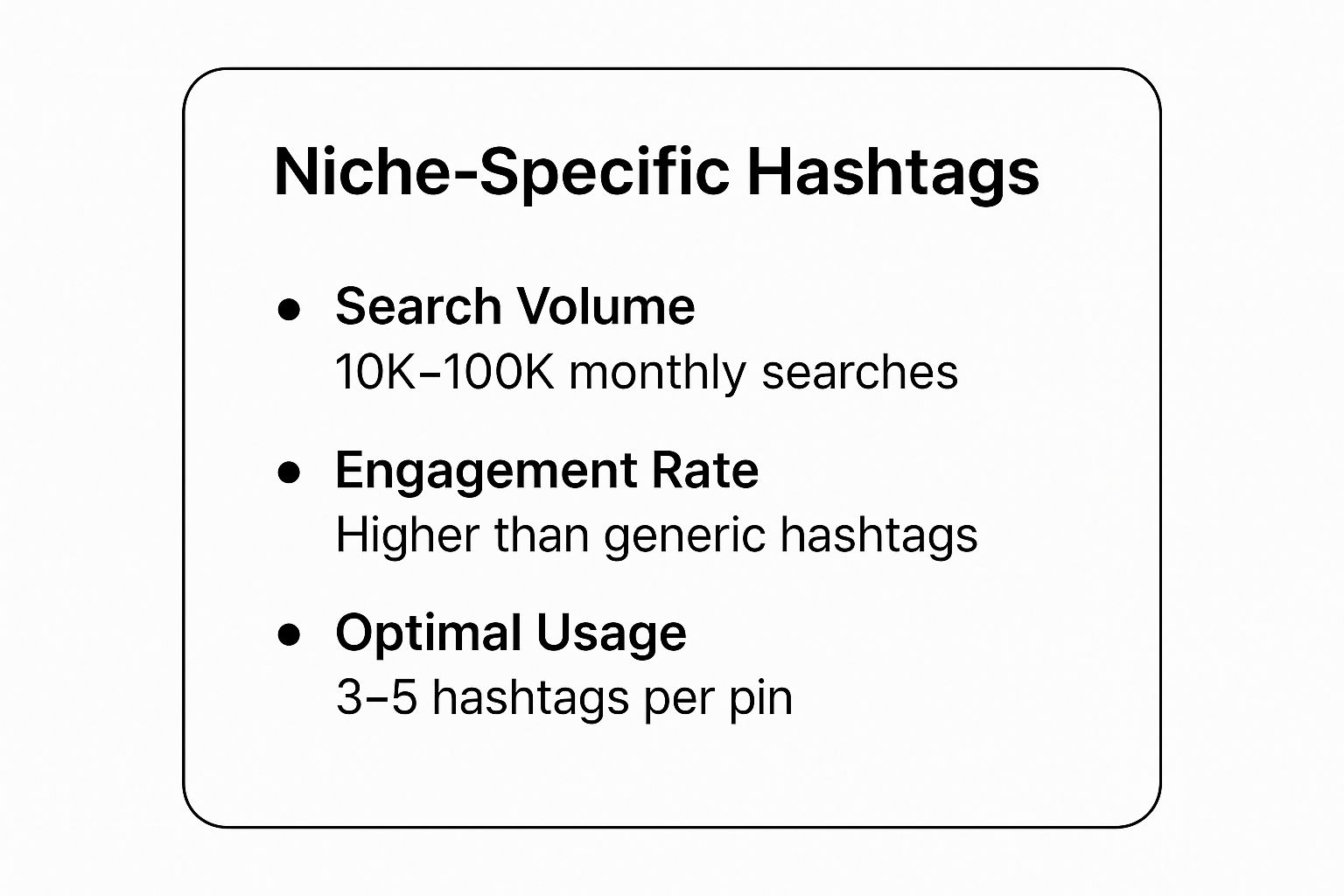
As the data shows, these hashtags occupy a strategic middle ground, offering substantial reach without the overwhelming competition of generic tags.
This balance makes them a powerful tool for building a dedicated following and driving meaningful traffic from users genuinely interested in your specific content.
2. Trending/Seasonal Hashtags
Timing is everything on Pinterest, and capitalizing on what’s currently popular can give your content a massive, timely boost.
Trending and seasonal hashtags tap into the collective consciousness of users, aligning your Pins with holidays, seasons, events, or viral topics that are already top-of-mind. This strategy allows you to ride a wave of high search volume and user interest.
Using trending hashtags for Pinterest connects your content directly to what users are looking for right now.
For instance, a food blogger sharing a pumpkin spice recipe in October would gain significant traction with #fallbaking or #halloweenrecipes.
These tags experience a predictable surge in search traffic during specific months, providing a short-term but powerful opportunity for visibility and engagement that can lead to explosive growth.
How to Find and Use Trending Hashtags
Success with this strategy depends on proactive planning and staying agile. You need to anticipate what users will be searching for and adapt quickly to new trends.
- Plan ahead: Pinners start searching for seasonal inspiration early. Begin creating and pinning content for major holidays like Christmas (
#christmasdecorating) or seasons like spring (#springcleaning) at least 45 to 60 days in advance. - Use Pinterest Trends: This native tool is your best friend for spotting what’s about to be popular. Monitor it regularly to identify emerging keywords and hashtags before they peak.
- Adapt quickly: Keep an eye on the “Today” tab on the Pinterest mobile app for daily viral trends. If a trend aligns with your niche, create relevant content quickly to capitalize on the buzz. You can learn more about building a timely strategy by using a Pinterest content calendar.
Pro Tip: Combine a broad seasonal hashtag like
#backtoschoolwith a more specific one like#dormroomideasor#kidslunchboxideas. This captures both the high-volume general interest and the more targeted, high-intent searches within that trend.
3. Broad/Generic Hashtags
While niche hashtags are for precision, broad or generic hashtags are all about maximizing reach. These are the high-volume, widely-used tags covering general topics with massive search interest on Pinterest.
Think of them as casting the widest net possible to get your content in front of a vast, diverse audience.
Using broad hashtags for Pinterest can give your Pins an initial visibility boost, exposing them to millions of users browsing general categories.
For example, a Pin showcasing a new smoothie recipe could benefit from the tag #recipe (over 30M monthly searches), while a room makeover might use #homedecor (over 25M monthly searches). The trade-off is intense competition, meaning your content must be exceptional to capture attention.
How to Find and Use Broad Hashtags
The key is to use these powerful hashtags strategically without getting lost in the noise.
- Identify top-level categories: Think about the most general category your content falls into. If you share DIY projects,
#diyis a prime choice. For fashion content,#fashionis the go-to. - Prioritize visual appeal: Use broad hashtags on your most visually stunning Pins. High-quality, eye-catching images or videos are essential to stand out among the millions of other Pins using the same tag.
- Combine with specifics: Never rely solely on broad tags. Always pair one or two broad hashtags with a set of niche and branded hashtags to provide context and attract a more qualified audience simultaneously. For instance, pair
#recipewith#veganpastarecipeand#easyweeknightmeals.
Pro Tip: Limit yourself to just one or two broad hashtags per Pin. Using too many can dilute your Pin’s relevance in the Pinterest algorithm and make it look spammy, hurting its overall distribution.
For a quick overview of how these hashtags perform, the following summary highlights their typical search volume and engagement potential.
| Hashtag | Monthly Searches (Est.) | Competition | Best For |
|---|---|---|---|
| #diy | 50M+ | Very High | High-quality tutorials, before-and-afters |
| #recipe | 30M+ | Very High | Visually appealing food and drink content |
| #homedecor | 25M+ | Very High | Inspiring room makeovers, decor ideas |
| #fashion | 20M+ | Very High | Eye-catching outfits, trend showcases |
As the data shows, these hashtags offer unparalleled reach, but success requires top-tier content that can compete at a high level.
They are best used as a supplement to a more targeted hashtag strategy, helping your best content reach its maximum potential audience.
4. Long-tail Hashtags

Long-tail hashtags are your precision tool for connecting with users on a mission.
These highly specific, multi-word phrases capture the exact intent behind a search, moving beyond broad categories into detailed user needs.
They operate on the principle of specificity, targeting smaller, more motivated audiences and resulting in significantly higher engagement and conversion rates because they face far less competition.
Using long-tail hashtags for Pinterest helps you align your content perfectly with a user’s specific problem or desire.
For instance, a creator in the home organization space will attract a much more engaged Pinner with #smallbathroomorganizationideas than with the generic #organization. The long-tail version targets someone actively looking for a solution, not just browsing for general inspiration.
Similarly, #budgetfriendlydiyhomedecor is more powerful than #diy.
How to Find and Use Long-tail Hashtags
The goal is to mirror the detailed language your ideal customer uses when searching.
- Use Pinterest search suggestions: Start typing a broad term into the Pinterest search bar and see what auto-populated phrases appear. These are real, popular long-tail searches.
- Think in full phrases: Instead of single keywords, think about the problems you solve or the solutions you offer. A food blogger might use
#easyhealthydinnerrecipesto attract busy families. - Test variations: Don’t be afraid to experiment with different long-tail combinations on your Pins. Track which ones drive the most clicks and saves to refine your strategy over time, such as testing
#workfromhomeofficesetupversus#homeofficeinspirationforwomen.
Pro Tip: Combine 2-3 specific long-tail hashtags with one or two broader niche tags. This strategy allows you to capture both the highly targeted searcher and the user exploring a wider interest category, maximizing your Pin’s visibility.
You can learn more about how to effectively use long-tail hashtags on postpaddle.com to drive better results.
While these hashtags have lower search volume individually, their collective impact on traffic and engagement is substantial, making them an essential part of any successful Pinterest marketing plan.
5. Brand/Community Hashtags
Brand or community hashtags are custom-created tags designed to build brand identity and foster a dedicated community around your content.
Unlike keyword-based hashtags, these are unique to your brand, influencer program, or a specific campaign. They act as a digital hub, collecting user-generated content (UGC) and creating a sense of belonging among your followers.
Using branded hashtags for Pinterest transforms your audience from passive viewers into active participants.
For instance, Anthropologie’s #JoyfullyMade encourages users to share their own creative and lifestyle moments, aligning them with the brand’s aesthetic.
This strategy not only builds loyalty but also provides a steady stream of authentic content you can re-pin and celebrate, amplifying your reach through your own community’s efforts.
How to Find and Use Brand/Community Hashtags
The goal is to create a tag that is both memorable and uniquely yours.
- Keep it simple and memorable: Your hashtag should be short, easy to spell, and directly related to your brand name or mission. Think of Coca-Cola’s iconic
#ShareACokeor Calvin Klein’s#MyCalvins. - Promote it everywhere: Include your branded hashtag in your Pinterest profile bio, on every relevant Pin description, and across your other social media channels to build recognition and encourage adoption.
- Incentivize participation: Encourage followers to use your hashtag by offering to feature their content on your boards. This recognition is a powerful motivator for creating and sharing user-generated content. Learn more about how this tactic can increase Pinterest engagement on PostPaddle.
Pro Tip: Combine your unique brand hashtag with 2-4 other relevant niche or broad hashtags. For example, a Pin featuring user content could use
#YourBrandHerealong with#homedecorinspoand#livingroomideasto reach both your loyal community and new potential followers.
6. Action/Intent Hashtags
Beyond describing what your Pin is, action or intent-based hashtags signal what your Pin helps a user do.
These powerful tags align with a user’s specific goal, whether they’re looking to learn a new skill, plan an event, or make a purchase. They capture users who are further along in their journey and ready to take the next step.
Using action-oriented hashtags for Pinterest taps directly into the platform’s core function as a discovery and planning engine.
For example, a DIY blogger sharing a furniture flip will connect with a more motivated audience using #howtoorganize or #stepbystepguide compared to a more passive tag. These hashtags promise a clear outcome, attracting users with high intent.
How to Find and Use Action/Intent Hashtags
The goal is to match your hashtag to the solution your Pin provides. What action will the user take after seeing your content?
- Match the hashtag to the action: If your Pin is a tutorial, use tags like
#howtomakeor#diytutorial. For product discovery, try#musthaveor#shopthelook. - Combine with descriptive tags: Pair an action hashtag with a topic hashtag for maximum impact. For instance, combine
#quickandeasywith#weeknightdinnerto target users looking for a fast meal solution. - Ensure your Pin delivers: Your content must fulfill the promise of the hashtag. If you use
#stepbystep, your Pin description or landing page must provide clear, sequential instructions.
Pro Tip: Test different action-oriented words to see what resonates with your audience. Phrases like
#getthelook,#planwithme, or#trythisathomecan significantly boost engagement by setting clear expectations and encouraging clicks.
These hashtags are especially effective for driving traffic to tutorials, blog posts, and product pages, as they prime the user for a specific follow-up action.
By framing your content around a user’s intent, you transform a passive view into an active engagement, leading to higher-quality traffic and more meaningful conversions.
7. Aesthetic/Style Hashtags

On a platform as visually driven as Pinterest, aesthetic and style hashtags are indispensable.
These tags go beyond describing what an object is and instead define its visual mood, design philosophy, or overall vibe.
They connect your content with users who are not just searching for an item, but for a specific look and feel that resonates with their personal taste.
Using aesthetic-focused hashtags for Pinterest helps your content land on the curated boards of users who value a cohesive visual identity.
A Pin showcasing a simple, uncluttered living room will perform exceptionally well with #minimalistdesign or #scandi because it taps into a well-defined and highly sought-after design movement.
Conversely, a vibrant, pattern-rich interior would find its audience through tags like #maximalist or #bohochic.
How to Find and Use Aesthetic Hashtags
Success with these hashtags depends on authenticity and consistency. Your visual content must genuinely embody the aesthetic you are tagging.
- Ensure a visual match: Your Pin’s imagery, from composition to color grading, must align perfectly with the aesthetic tag. Using
#darkacademiaon a bright, pastel-colored image will alienate users and hurt your Pin’s performance. - Study the aesthetic: Dive deep into the top-performing Pins for your target aesthetic. Analyze the colors, textures, and subjects that define it to ensure your content fits seamlessly.
- Combine with functional tags: Pair your style hashtags with descriptive ones for maximum impact. For example, combine
#cottagecorewith#gardeningtipsor#homemadebreadto attract both aesthetic-seekers and users with a specific functional need.
Pro Tip: Maintain consistency across your Pinterest profile. If your brand is built around a
#coastalgrandmotheraesthetic, ensure the majority of your Pins reflect this style to build a strong, recognizable visual brand that attracts loyal followers.
8. Location/Geographic Hashtags

For businesses with a physical presence or content tied to a specific place, location hashtags are non-negotiable.
These geographic identifiers connect your Pins to users searching for content relevant to a particular city, region, or destination.
This transforms Pinterest from a global platform into a powerful local discovery tool, driving foot traffic and local engagement.
Using location-based hashtags for Pinterest helps you tap into a highly motivated audience.
For instance, a local coffee shop in Austin will gain more traction with #AustinCoffeeShops than a generic tag like #coffee. The former targets users actively seeking local recommendations, resulting in higher-quality leads and greater potential for real-world conversions.
Similarly, a travel blogger can attract a targeted audience by using #TokyoTravel for their Japan guides.
How to Find and Use Location Hashtags
The goal is to connect with users in a specific geographical area. Think about how a local or a visitor would search for your offerings.
- Layer your locations: Combine broad and specific tags. A wedding photographer in Brooklyn could use
#NYCWeddingPhotographer,#BrooklynWedding, and even#DUMBOphotoshootto capture users at different stages of their search. - Research local trends: Pay attention to local events, festivals, or popular slang that could be used as a hashtag. A restaurant could leverage a tag like
#SXSWfoodieduring the South by Southwest festival. - Combine with niche tags: For maximum impact, pair your location tag with a niche-specific one. For example, a vintage furniture store in California should use
#CaliforniaVintageor#LosAngelesHomeDecorto narrow its audience effectively.
Pro Tip: Don’t forget hyper-local tags. Mentioning specific neighborhoods, parks, or well-known landmarks (e.g.,
#CentralParkPicnicor#VeniceBeachSkate) can attract a highly targeted audience looking for experiences in that exact spot.
These hashtags are especially powerful for service providers, brick-and-mortar stores, travel bloggers, and event promoters.
By grounding your content in a physical place, you create a direct path for local customers to find you, making your digital efforts translate into tangible, real-world results.
Hashtag Types Comparison for Pinterest
| Hashtag Type | Implementation Complexity 🔄 | Resource Requirements ⚡ | Expected Outcomes 📊 | Ideal Use Cases 💡 | Key Advantages ⭐ |
|---|---|---|---|---|---|
| Niche-Specific Hashtags | Moderate – requires deep niche knowledge | Moderate – research niche terminology | High engagement, better conversion | Targeted industries, communities | Higher conversion, less competition |
| Trending/Seasonal Hashtags | High – time-sensitive, requires monitoring | High – frequent adaptation, planning | Massive but short-lived reach | Holidays, seasonal events | Potential viral reach, boosts brand awareness |
| Broad/Generic Hashtags | Low – easy to implement | Low – minimal research needed | Maximum reach but lower engagement | Brand awareness, broad themes | Maximum visibility, high search volume |
| Long-tail Hashtags | Moderate – research specific phrases | Moderate – detailed keyword research | Higher conversion, lower volume | Precise user intent, specific queries | Easier ranking, better qualified traffic |
| Brand/Community Hashtags | High – requires brand building & promotion | High – continual promotion and engagement | Builds loyalty, slower initial growth | Brand campaigns, user-generated content | Complete narrative control, community growth |
| Action/Intent Hashtags | Moderate – requires user behavior insight | Moderate – content matched to intent | High commercial intent, better traffic | Tutorials, product recommendations | Drives conversions, aligns to user goals |
| Aesthetic/Style Hashtags | Moderate – consistent visual style needed | Moderate – content styling & curation | High engagement with style-focused audience | Fashion, home decor, lifestyle | Builds cohesive brand aesthetic, attracts niche |
| Location/Geographic Hashtags | Low to Moderate – focus on geographic terms | Low to Moderate – local trend research | Highly relevant local reach | Local businesses, travel, events | High local relevance, lower competition |
Putting It All Together: Your Action Plan for Hashtag Success

We’ve journeyed through the dynamic landscape of hashtags for Pinterest, exploring eight distinct categories that can transform your Pins from mere images into powerful traffic-driving assets.
From the precision of niche-specific tags to the broad appeal of general terms, and the community-building power of branded hashtags, you now have a comprehensive toolkit at your disposal.
The key is no longer just using hashtags, but using them with strategic intent.
The true power of this strategy lies not in choosing one type of hashtag over another, but in creating a sophisticated blend.
An effective Pin description harmonizes multiple hashtag categories into a cohesive, discoverable narrative.
It’s about creating a formula that works for your unique brand and audience, a balanced mix that tells the Pinterest algorithm exactly who needs to see your content.
Your Immediate Action Plan
To move from theory to tangible results, it’s time to put these concepts into practice.
Don’t let this information become passive knowledge. Instead, start implementing a structured approach today.
Here are your actionable next steps:
- Conduct a Hashtag Audit: Review your last 10-15 Pins. What types of hashtags did you use? Were they mostly broad, or did you incorporate long-tail and niche-specific tags? Identify gaps and opportunities based on the categories we’ve discussed.
- Develop Your “Hashtag Bank”: Create a simple document or spreadsheet. Dedicate a section to each of the eight hashtag types. Start populating it with relevant tags for your business. For example, list your top 5 brand hashtags, 10 niche-specific terms, and a handful of relevant aesthetic or seasonal tags you can rotate.
- Test and Measure Your Blends: For your next five Pins, consciously create a different hashtag blend for each. Try a Pin with a focus on long-tail and action hashtags. For another, lean into trending and aesthetic tags. Use your Pinterest Analytics to track which combinations deliver the best initial impressions and engagement.
- Refine Your Pin Templates: Incorporate your hashtag strategy directly into your content creation workflow. When you design a new Pin or write a description, refer to your hashtag bank. This makes the process systematic rather than an afterthought.
Key Takeaway: Mastering hashtags for Pinterest is an ongoing process of research, application, and refinement. Your goal is to build a repeatable system that consistently connects your content with the right Pinners at the exact moment they are searching for inspiration, solutions, or products.
By treating hashtags as a crucial piece of your SEO puzzle, you unlock a new level of discoverability.
You move beyond hoping for visibility and start engineering it. This deliberate approach is what separates struggling accounts from those that achieve sustained growth, drive meaningful website traffic, and build a loyal community on the platform.
Your journey to mastering hashtags for Pinterest starts now; take these strategies and build the momentum your brand deserves.
Ready to Stop Guessing Your Pinterest Hashtags?
You’ve just learned how powerful the right hashtags can be—now make them faster and easier to find.
Use PostPaddle’s FREE Pinterest Hashtag Generator to quickly come up with relevant hashtag ideas that match your Pin’s topic and audience, so every post is more discoverable without the guesswork.
Turn your strategy from “hope and see” into a simple, repeatable hashtag workflow you can use for every Pin.
FAQs
Why are hashtags important on Pinterest?
Hashtags help Pinterest understand what your Pin is about so it can surface it in relevant searches and feeds. When you use them strategically, they can increase your reach, saves, and clicks without needing extra design or ad spend.
How many hashtags should I use on a Pinterest Pin?
A small, focused set of highly relevant hashtags usually works best. Instead of stuffing your description, choose a handful that clearly match your Pin’s topic, audience, and the search intent you’re targeting.
What types of hashtags should I use on Pinterest?
A balanced mix of niche-specific, branded, product or service-based, audience-focused, seasonal, and trending hashtags tends to perform well. This combination helps you stay relevant while also tapping into broader discovery opportunities.
Should I use the same hashtags on every Pin?
It’s better to have a core group of hashtags you use often (such as your brand and niche) and then adjust the rest based on each Pin’s specific topic. This keeps your hashtag strategy consistent but still targeted.
How do I know if my Pinterest hashtags are working?
Monitor metrics like impressions, saves, and outbound clicks on Pins that use specific hashtag combinations. Over time, patterns will emerge—showing you which hashtag categories bring more visibility and engagement so you can refine your strategy.