Before you can even think about getting more followers on Pinterest, you have to get the foundation right.
Your profile is the very first thing people see, and it needs to act like a magnet for your ideal audience.
This is more than just filling out a few fields; it’s about building a strategic home base that screams value from the moment someone lands on it.
Honestly, a well-tuned profile is your single greatest asset for turning casual browsers into dedicated followers.
Build a Profile That Attracts Your Ideal Follower

Think of your Pinterest profile as your brand’s digital storefront.
It’s your first impression, and it can make or break someone’s decision to stick around or just scroll on by.
A generic, confusing profile gets ignored. But a sharp, strategic one? That stops people in their tracks and makes them want to see what you’re all about.
This is your shot to tell people who you are, who you’re here for, and what kind of amazing stuff you share.
Craft a Keyword-Rich Bio
Your bio is incredibly valuable SEO real estate. It needs to tell people and the Pinterest algorithm exactly what you do, using the kinds of words your audience is actually searching for.
So, instead of something vague like “Lover of all things creative,” get specific.
Try something like, “Your source for modern home decor inspiration, DIY project tutorials, and interior design tips for small spaces.”
See the difference? One is fluff; the other is a clear promise of value.
Choose a High-Quality Profile Picture
Your profile picture might seem small, but it’s a huge part of building trust.
If you’re a personal brand—a coach, creator, or blogger—use a clear, professional headshot. People connect with people.
For a business, your logo is the way to go, but make sure it’s high-resolution and instantly recognizable, even when it’s shrunk down into that little circle.
Avoid anything blurry or busy. A polished image shows you mean business.
Optimize and Organize Your Boards
Your boards are where you organize your expertise and make your content easy to find. Think of them as the aisles of your storefront. They need logical names that mirror what people are searching for.
For instance, don’t just create a board called “Food.” That’s way too broad.
Instead, break it down into specific, searchable topics like “Quick Weeknight Dinners,” “Healthy Vegan Recipes,” or “Holiday Baking Ideas.”
This does wonders for your Pinterest SEO and lets a new visitor immediately see the incredible value you offer.
Remember, the first step is always setting up your account for success. To unlock advanced features and analytics, you need a business account.
You can learn more about how to create a Pinterest business account in our detailed guide.
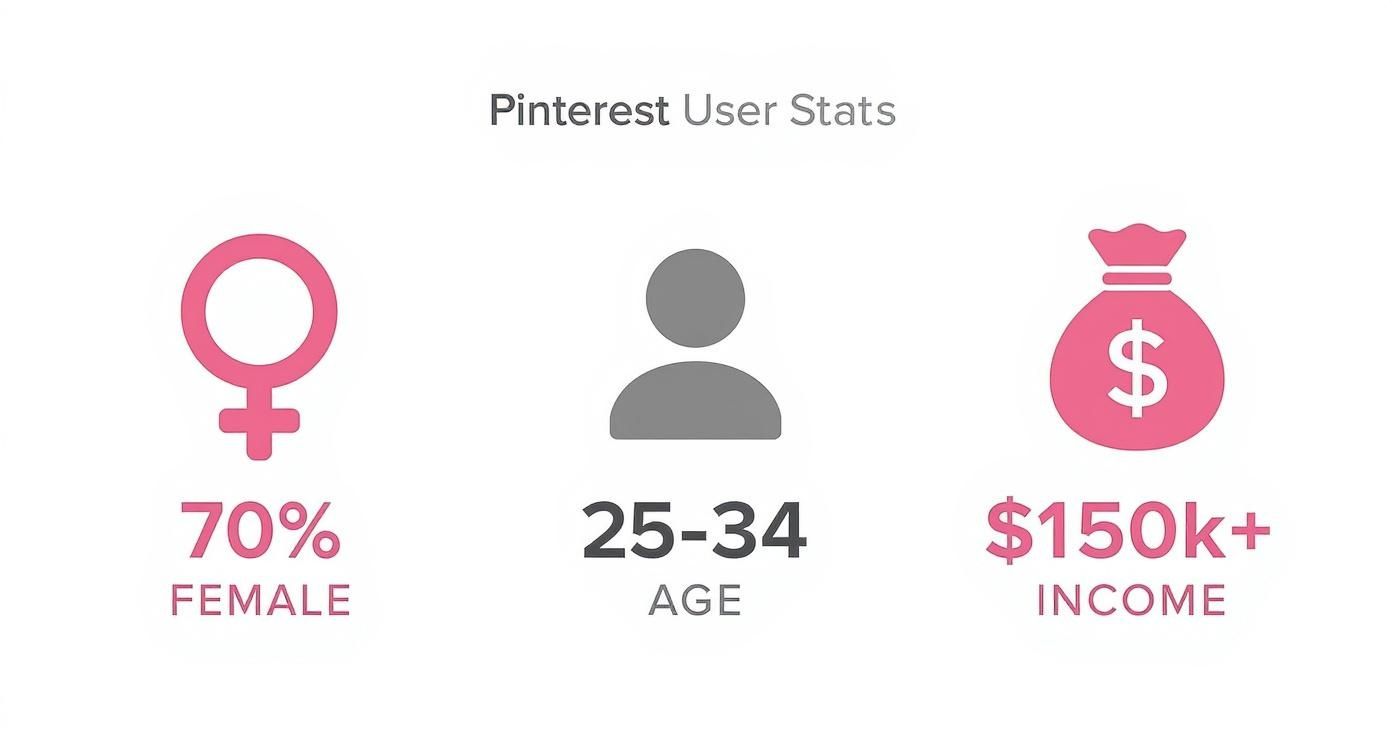
Knowing who you’re talking to is also a huge piece of the puzzle. Pinterest’s audience is unique—nearly 70% of users are female, with a massive segment of Millennial women.
It’s also incredibly popular with high-income households, which opens up powerful opportunities for certain brands.
Understand Why People Follow on Pinterest
First things first, let’s get inside the head of a Pinterest user. If you want to get more followers, you have to stop thinking about Pinterest like it’s Instagram or Facebook.
It’s not a social network; it’s a visual discovery engine. People aren’t there to see what you did last weekend. They’re there to plan, discover, and get inspired for their future.
The reason someone hits “Follow” on Pinterest is fundamentally different. It’s not about who you are; it’s about the consistent value you promise to deliver.
Think of it this way: when a user follows you, they’re subscribing to a future feed of ideas they genuinely want. Grasping this simple shift in mindset changes everything.
The Mindset of a Pinterest User
Imagine your Pinterest profile is a beautifully curated magazine. Each of your boards is a different section, and every single pin is an article or a great idea.
Someone follows you because they love the magazine’s whole vibe and trust that you’ll keep delivering content that speaks to them.
They’re mentally checking off boxes:
- “Will this account help me figure out my kitchen remodel?”
- “Can I count on this profile for new, healthy recipes every week?”
- “Does this creator share fashion tips I can actually wear in real life?”
Your entire strategy needs to be built around getting a resounding “YES!” to these kinds of questions.
That promise of future value is the secret sauce to gaining followers.
This infographic paints a clearer picture of who you’re actually trying to reach.
As you can see, we’re talking about an audience of planners and buyers. They’re on the platform with a goal, ready to take action.
Focus on Solutions and Inspiration
To really connect with this audience, your content has to be selfless.
It’s less about shouting about your brand and more about solving a problem or sparking an idea for your ideal follower.
Every pin needs to offer a real, tangible takeaway.
For instance, a home decor brand shouldn’t just spam pins of its products.
A much smarter move is to pin things like “clever layout ideas for a small living room” or “the best color palettes for a calming bedroom.”
Their products can then be subtly woven in as the perfect solution.
Key Takeaway: Followers are a byproduct of providing consistent, searchable value. People follow accounts they believe will make their lives easier, more beautiful, or more interesting down the road.
The opportunity here is massive and it’s only getting bigger. As of the first quarter of 2025, Pinterest hit a record 570 million monthly active users—that’s a 10% jump from the previous year.
With Gen Z now making up 42% of global users and a staggering 96% of top searches being unbranded, it’s clear people are actively looking for new creators and brands.
You can find more Pinterest user growth trends at thunderbit.com.
There’s a huge, engaged audience out there just waiting for you. Your job is to become their go-to source for inspiration.
Create Pins That Stop the Scroll and Earn Follows
Your Pins are the true workhorses of your Pinterest strategy. They’re what grab a user’s attention, solve an immediate problem, and convince them your profile is a goldmine of information worth following.
This is the moment a casual scroller decides to become a loyal fan.
Think of every single Pin as a tiny, powerful billboard for your brand.
It has to be visually stunning, instantly informative, and persuasive enough to make someone stop, click, save, and ultimately, hit that “Follow” button.
Designing for the Pinterest Feed
Pinterest is a fast-paced, vertical world. Your content is competing for eyeballs, so it absolutely has to stand out.
Let’s break down the design fundamentals that are non-negotiable if you’re serious about growth.
- Stick to the Golden Ratio: The sweet spot is a 2:3 aspect ratio. A canvas of 1000 x 1500 pixels is perfect. This vertical format simply takes up more screen real estate, making your Pin feel more substantial and harder to just scroll past.
- Use High-Quality Visuals: Nothing says “amateur” faster than a blurry or pixelated image. Always use crisp, clear, and vibrant photos or graphics that look professional and align with your brand’s aesthetic.
- Add Bold Text Overlays: People scroll fast. A bold, easy-to-read text overlay is your best tool for instantly communicating what your Pin offers. A headline like “5 Genius Small Kitchen Hacks” is far more compelling than a generic “Kitchen Ideas.”
These aren’t just arbitrary rules; they’re about making your value clear in a split second.
For a more detailed walkthrough, our complete guide on how to create a Pin for Pinterest has you covered.
Beyond the Visuals: The Strategy Behind Your Pins
A gorgeous Pin is only half the battle. The real magic that drives follower growth happens when you pair great design with smart strategy.
This means paying close attention to your Pin description and your call-to-action (CTA).
Your description is prime real estate for keywords. Think like your ideal follower: what terms are they typing into the search bar?
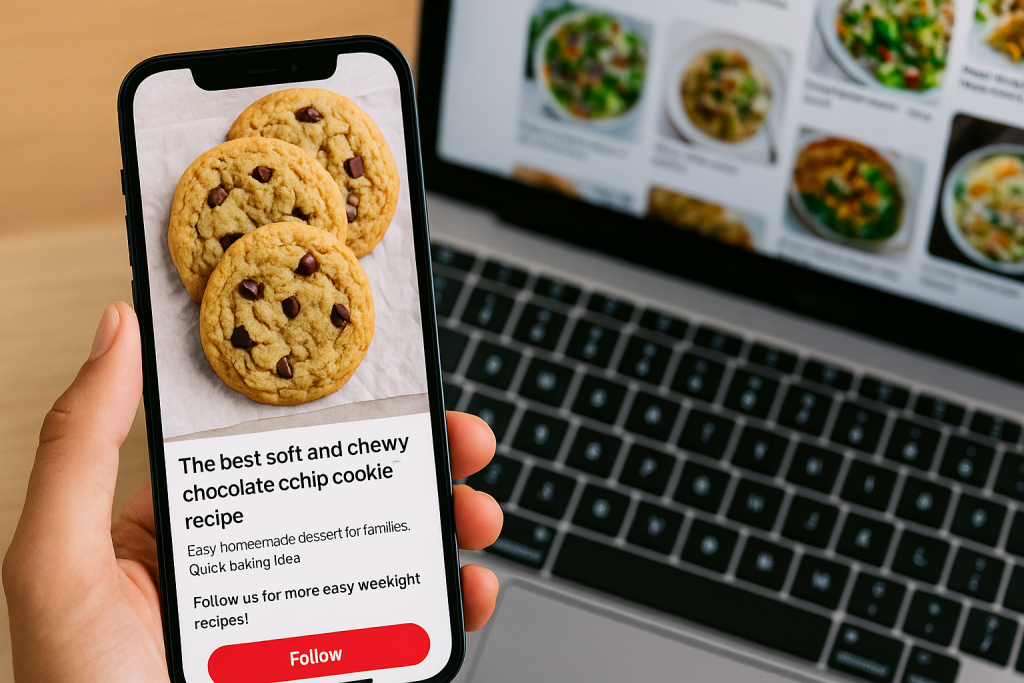
For a cookie recipe Pin, don’t just write “chocolate chip cookies.” Go deeper with something like, “The best soft and chewy chocolate chip cookie recipe. Easy homemade dessert for families. Quick baking idea.”
Your call-to-action is where you gently nudge them toward becoming a follower. Instead of just saying “Click the link,” try adding a simple phrase like, “Follow us for more easy weeknight recipes!” directly on your Pin image or at the end of your description.
This focus on engagement is critical. After all, a staggering 85% of weekly Pinterest users have made a purchase based on Pins they saw from brands.
By optimizing every part of your Pin, you’re not just sharing content; you’re building a relationship with a highly engaged audience and becoming a trusted source they want to hear from again and again.
To help you get it right every time, I’ve put together a quick checklist.
Effective Pin Design Checklist
Here’s a quick-reference guide to make sure every Pin you create is optimized for engagement and follower growth.
| Element | Best Practice | Why It Works |
|---|---|---|
| Dimensions | 1000 x 1500 pixels (2:3 aspect ratio) | Maximizes screen space on mobile devices and stands out in the feed. |
| Image/Video Quality | Use high-resolution, clear, and well-lit visuals. | Professional, high-quality visuals build trust and are more likely to be saved and clicked. |
| Text Overlay | Add a bold, easy-to-read headline that clearly states the Pin’s value. | Instantly communicates the topic and benefit to fast-scrolling users, encouraging them to stop and engage. |
| Branding | Subtly include your logo or website URL on every Pin. | Increases brand recognition and ensures you get credit as your Pin gets re-shared across the platform. |
| Call-to-Action (CTA) | Include a clear, gentle nudge, like “Save for later” or “Follow for more.” | Guides the user on what to do next, turning passive viewers into active followers and engagers. |
| Pin Description | Write a keyword-rich description (2-3 sentences) explaining what the Pin is about. | Helps your Pin get discovered in search results by both users and the Pinterest algorithm. |
Running through this checklist before you hit “publish” will dramatically improve your Pins’ performance and help you turn those views into dedicated followers.
Develop a Consistent Pinning Rhythm
When it comes to Pinterest, consistency is everything. It’s the engine that drives your growth.
If you pin sporadically—dumping a bunch of content one day and then going silent for a week—you’re sending confusing signals to the algorithm and leaving your followers hanging.
To really get followers on Pinterest, you need a steady, predictable rhythm. Think of your profile like a popular magazine subscription; your audience expects fresh content to land on their feed regularly.
If you disappear, they’ll lose interest and your momentum will flatline.
The goal is to create a workflow that you can actually stick with, one that keeps a constant stream of inspiration flowing to your audience.
Finding Your Ideal Pinning Frequency
There isn’t a single magic number for how many Pins you should post each day.
The sweet spot depends on your niche, how much content you can realistically create, and your audience’s behavior.
But here’s a rule of thumb I always follow: consistency beats quantity.
It is so much more effective to post 3-5 high-quality Pins every single day than it is to pin 20 Pins once a week.
Your daily mix should ideally include:
- Fresh Pins: This is your top priority. Fresh Pins are brand-new images or videos that link to your content. Pinterest’s algorithm absolutely loves fresh content, so make this a core part of your daily routine.
- Strategic Repins: You can give your best-performing older Pins a second wind by sharing them again to relevant boards. Just don’t overdo it. It’s a smart tactic for getting more mileage out of content you already know works well.
This balanced approach keeps the algorithm happy with new material while also maximizing the visibility of your proven winners.
The Power of Scheduling Your Pins
Trying to keep up with a daily pinning schedule manually is a recipe for burnout. I’ve been there. This is exactly where automation becomes your best friend.
A good scheduling tool lets you batch your work into focused blocks of time. You can knock out all your Pin creation in an hour or two, once a week.
Imagine creating and uploading all your Pins for the week in one go, setting them to publish at the best times, and then walking away.
It frees you from the daily grind and ensures your account stays perfectly active.
For a full walkthrough of how this works, check out our guide on how to schedule Pins on Pinterest.
A consistent pinning schedule does more than just keep your account active.
It trains the Pinterest algorithm to see your profile as a reliable and valuable source of information in your niche, leading to better visibility and a steadier flow of new followers.
Ultimately, building this rhythm is about creating a system that works for you. It transforms the chaotic chore of “posting on Pinterest” into a predictable, automated process.
That consistency builds trust with both the algorithm and your audience—the perfect foundation for long-term follower growth.
Tap Into the Community to Spark Growth

It’s easy to think of Pinterest as just a visual search engine, but that’s only half the story.
There’s a thriving community aspect that too many creators overlook, and it’s an absolute goldmine for growth.
Getting out there and actually engaging with people is a killer strategy for gaining followers. Why?
Because it tells both the Pinterest algorithm and other users that you’re an active, helpful member of your niche.
Simply pinning your content and hoping for the best is a slow, uphill battle. You’ve got to become part of the conversation.
When you start interacting, your profile gets seen by people who are already passionate about your topics, making them way more likely to check you out and hit that “Follow” button.
Find and Join Relevant Group Boards
Think of Group Boards as shared spaces where multiple creators can add their Pins.
Jumping into popular boards in your niche is one of the quickest ways to get your content in front of a big, ready-made audience you haven’t built yourself yet.
It’s a bit like guest posting on a major blog. You get immediate exposure to a whole new group of people who are already primed to love what you do.
Just make sure you hunt for active boards with solid engagement and clear rules for contributing.
Make Genuine Connections With Other Creators

Real interaction isn’t about broadcasting your own stuff—it’s a two-way street. When you take the time to build actual relationships, your visibility gets a serious boost.
Here are a few simple ways to start engaging:
- Follow other creators in your space: Find accounts that inspire you and fit your brand’s vibe. It keeps you on top of trends and often gets you a follow back from them and their audience.
- Leave comments that mean something: Ditch the generic “Great Pin!” and add real value. Ask a thoughtful question or share a related tip. A genuine comment stands out and makes people curious enough to click back to your profile.
- Reply to every single comment: If someone takes the time to comment on your Pin, always write back. It builds a real sense of community around your content and encourages more people to join the conversation.
This community-first approach is a cornerstone of sustainable growth. For a broader look at building a loyal audience, check out these powerful social media marketing strategies.
By actively participating in the Pinterest ecosystem, you transform your profile from a static content library into a dynamic hub of conversation and value.
This shift is what turns passive viewers into loyal followers who trust your expertise.
Remember, every comment you leave and every creator you follow is another chance to introduce your brand to someone new.
This hands-on approach builds momentum and shows potential followers that you’re a helpful, present resource worth connecting with for the long haul.
Turn Your Pins Into Follower Magnets
Getting more followers on Pinterest starts with better Pins. When your images, text, and layout are all done right, it’s much easier for the right people to find you and hit “Follow.”
To make this simple, you can use a free Pinterest Pin Checklist. It helps you review the basics before you publish, size, text overlay, keywords, branding, and call to action, so every Pin has a real chance to perform.
Use it while you batch new Pins for the week or when you update old content.
A quick check can be the difference between a Pin that gets ignored and one that earns saves, clicks, and new followers over time.
Common Questions About Growing a Pinterest Following
If you’re trying to figure out how to grow on Pinterest, it’s easy to get tripped up. So many creators hit the same roadblocks and ask the same questions.
Let’s tackle some of the most common points of confusion so you can get back to building momentum.
Feeling like your progress is crawling along at first is completely normal. Pinterest isn’t about quick wins; it’s a long game that rewards patience and consistency more than anything else.
1. Do Followers Even Matter on Pinterest?
This is the big one, and the answer isn’t a simple yes or no. Followers do matter, but they play a totally different role here compared to a platform like Instagram, where your reach is pretty much chained to your follower count.
Pinterest is, first and foremost, a visual search engine. This is great news because it means a brand-new account with just 10 followers can create a Pin that goes viral and reaches millions.
Your reach hinges far more on solid keyword strategy and high-quality content than on how many followers you have.
Key Insight: Your main goal should be driving traffic and getting saves. A Pin that consistently sends people to your website is infinitely more valuable than a few vanity followers.
The followers will show up naturally once you prove you’re a source of great, discoverable content.
I always tell people to think of it like this: your followers are the audience you’ve already won over, while search gives you access to an audience that’s actively looking for what you offer.
You need both, but you should start by focusing on showing up in search.
2. How Long Does It Realistically Take to See Growth?
If there’s one secret ingredient to Pinterest success, it’s patience. If you’ve only been pinning for a few weeks and you’re feeling discouraged, don’t sweat it. You’re not doing anything wrong—you’re just in what I call the “indexing phase.”
It usually takes a solid 3 to 6 months for the Pinterest algorithm to really start to understand your content, index it properly, and show it consistently in search results.
During those first few months, it can absolutely feel like you’re just pinning into the void. But every single keyword-optimized Pin you publish is a seed you’re planting for future traffic.
The biggest mistake you can make is giving up before your content has had time to sprout.
3. What Metrics Should I Focus On Besides Followers?
If you’re only staring at your follower count, you’re missing the real story of your account’s health.
To understand your actual performance and get a true measure of your potential to get followers on Pinterest, you need to keep a close eye on these numbers in your Pinterest Analytics:
- Outbound Clicks: This is the golden metric. It shows you how many times people clicked from your Pin straight to your website. For most businesses, this is the number that directly measures your return on investment.
- Saves: When someone saves your Pin to one of their boards, it’s a huge signal to the algorithm that your content is high-quality. More saves means Pinterest will show your Pin to more people.
- Impressions: This tells you how many times your Pins were on screen in someone’s feed or search results. It’s a fantastic top-level indicator of your overall visibility and lets you know if your keyword strategy is on the right track.
For a deeper dive, check out these essential social media management tips for Pinterest.
Getting a handle on these core metrics will help you double down on what’s working and cut what isn’t.