In the fast-paced world of digital marketing, creating high-quality content consistently is a monumental task.
What if you could multiply the value of every blog post, video, or webinar you produce? The answer lies in effective content repurposing.
This is not about simply reposting the same material everywhere; it’s a strategic approach to transforming a single asset into a multitude of formats tailored for different platforms and audiences.
For busy social media managers, bloggers, and e-commerce entrepreneurs, mastering content repurposing strategies is the key to maintaining a vibrant online presence, maximizing reach, and achieving a higher ROI on your content creation efforts without burning out.
This guide moves beyond generic advice to provide a detailed collection of actionable methods.
You will learn how to implement proven tactics, from cross-platform content atomization and format transformation to reviving historical posts and amplifying user-generated content.
We’ll provide specific steps and real-world scenarios to help you work smarter, not harder. Get ready to transform your content workflow and unlock the full potential of every piece you create.
9 Smart Content Repurposing Strategies for Marketers
Content repurposing is how you turn one strong idea into an entire ecosystem of content that works for you on every platform.
The nine smart strategies below will help you stretch each asset further, reach new audiences without burning out, and build a more scalable, data-backed content engine for your marketing.
1. Cross-Platform Content Atomization: The ‘Create Once, Distribute Forever’ Model

Content atomization is a powerful content repurposing strategy that involves deconstructing a large, foundational piece of content into smaller, standalone “atoms.”
You take one significant asset, like a webinar, research report, or in-depth guide, and break it down into dozens of smaller pieces.
Each atom is then customized for different platforms, ensuring the core message is adapted to the specific context and audience of each channel.
This approach maximizes the value of your initial content creation effort. Instead of a single touchpoint, you create a widespread, multi-channel campaign.
Key statistics become compelling tweets, insightful quotes are turned into eye-catching Instagram graphics, and complex concepts are simplified into LinkedIn carousels or short TikTok videos.
This method, famously championed by Gary Vaynerchuk, ensures your core message reaches the widest possible audience in their preferred format.
How Content Atomization Works
The process is a systematic workflow designed for maximum efficiency and reach. It begins by identifying the most potent elements within your cornerstone content, such as key takeaways, data points, or memorable quotes.
The infographic below illustrates the core three-step workflow of this content repurposing strategy.
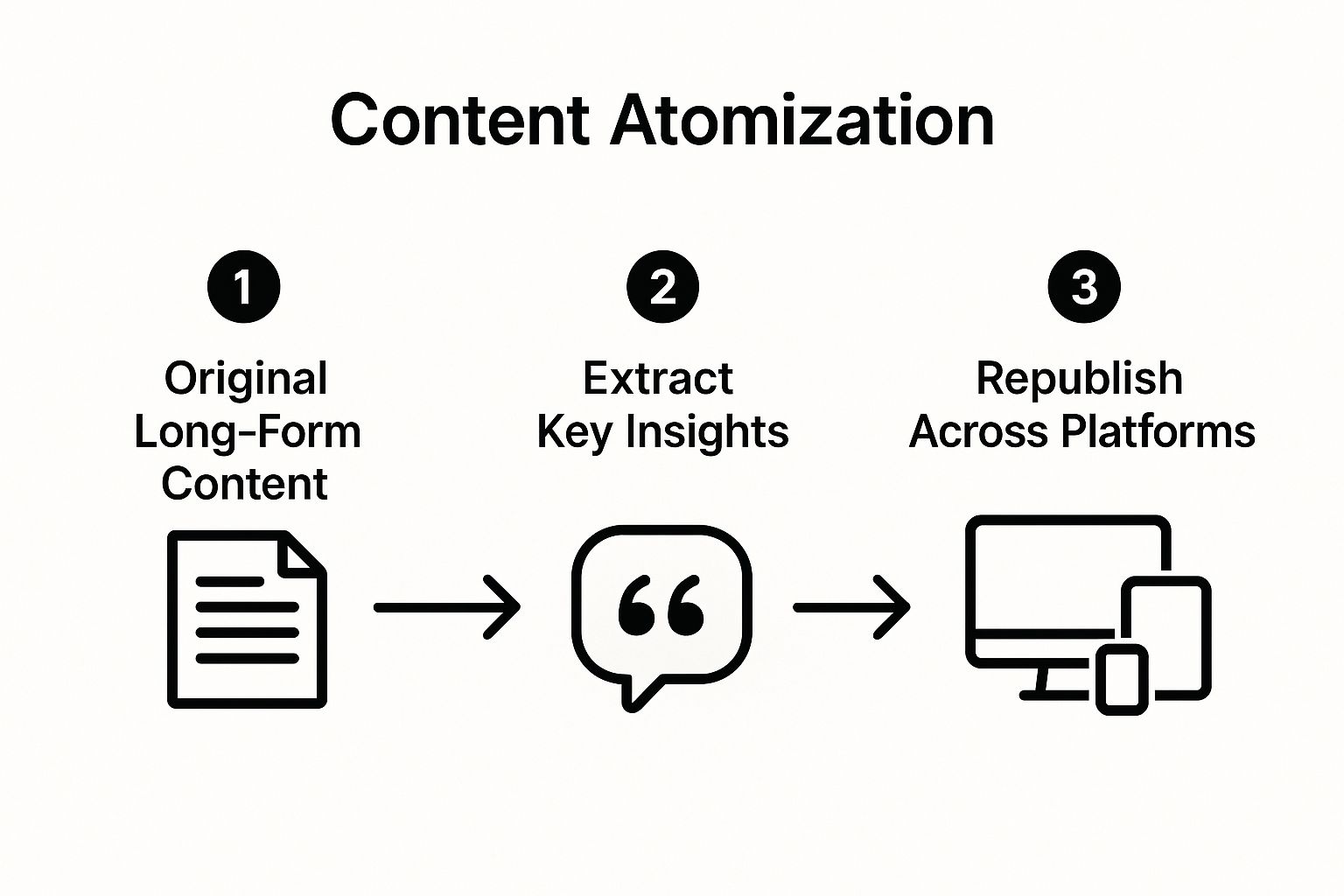
This simple yet effective flow allows a single content asset to fuel an entire multi-platform marketing calendar, solidifying brand presence and authority.
Actionable Tips for Implementation
- Create a Content Map: Before you start, visually map out how your primary content piece will be broken down. Plan which quotes, stats, and concepts will become which type of micro-content for each specific platform.
- Maintain Brand Consistency: Use consistent fonts, brand colors, and logos across all atomized assets. This ensures brand recognition, even when the content format changes drastically.
- Track Platform-Specific Metrics: Analyze the performance of each atom on its respective channel. This data will reveal which formats resonate best on platforms like Pinterest versus LinkedIn, allowing you to refine your future content repurposing strategies.
2. Format Transformation Strategy: From Text to Video, and Beyond

The Format Transformation Strategy is a cornerstone of effective content repurposing. It involves converting a piece of content from its original format into a completely new one, all while preserving the core information and value.
This approach capitalizes on the fact that different audience segments prefer consuming information in different ways.
By transforming a blog post into a video, or a podcast into an infographic, you make your valuable insights accessible to a much broader audience with diverse learning styles.
This strategy ensures that the investment made in creating high-quality, original content pays dividends across multiple channels.
For example, a data-rich research report can be transformed into an engaging webinar to capture leads, while a popular podcast interview can become a detailed blog post for SEO benefits.
Brands like Canva and Buffer excel at this, routinely turning blog tutorials into video walkthroughs and research findings into multi-format campaigns.
How Format Transformation Works
This process moves beyond simple copy-pasting; it requires thoughtfully re-imagining the content for a new medium. A successful transformation adapts the delivery and presentation to the strengths of the target format.
An engaging, conversational podcast script will look very different from the structured, skimmable blog post it was based on.
The video below from Tim Ferriss, a master of this technique, showcases how complex ideas discussed in long-form interviews can be adapted for different mediums.
Actionable Tips for Implementation
- Identify High-Performing Content: Start by analyzing your existing content. Pinpoint blog posts with high traffic, videos with great engagement, or podcasts with the most downloads as prime candidates for transformation.
- Invest in Reusable Templates: To streamline the process, create branded templates for different formats. Develop templates for YouTube video intros, infographic layouts, and presentation slides to maintain consistency and speed up production.
- Align Format with Content: Certain topics naturally lend themselves to specific formats. A step-by-step “how-to” guide is perfect for a video tutorial, while a data-heavy report is ideal for an infographic or a detailed slide deck.
- Don’t Be Afraid to Outsource: If you lack in-house expertise for a specific format like video editing or graphic design, consider hiring a specialist. The high-quality output will often provide a better ROI than a poorly executed internal attempt.
3. Seasonal Content Recycling: The Annual Refresh Model
Seasonal content recycling is one of the most reliable content repurposing strategies, focusing on updating and republishing evergreen content tied to specific times of the year.
This approach involves systematically reusing assets related to holidays, seasons, or annual events, recognizing that these topics regain relevance cyclically. By refreshing this content, you can capture a new audience and capitalize on recurring search interest.
This method avoids reinventing the wheel each year. Instead of creating brand-new campaigns for events like Black Friday or Mother’s Day, you can update last year’s successful posts with new visuals, data, and promotional offers.
Food bloggers, for instance, often republish Thanksgiving recipe collections with new photos and tips, while major retail brands like Target recycle holiday marketing concepts with a fresh creative twist, ensuring consistent traffic and engagement.
How Seasonal Content Recycling Works
The strategy is built on a proactive, calendar-driven workflow. It begins by auditing existing content to identify top-performing seasonal assets and scheduling them for a timely refresh and republishing.
This ensures your most valuable content is always ready to meet predictable audience demand.
The core idea is to add new value rather than simply reposting. This could mean updating statistics, swapping out old images for new ones, or adding a new section that reflects current trends.
This keeps the content fresh for both search engines and returning visitors.
Actionable Tips for Implementation
- Create a Content Recycling Calendar: Proactively map out holidays and seasons relevant to your audience. Identify existing posts to update for each event to build a predictable and efficient workflow. Planning with a seasonal content calendar is key to this strategy’s success.
- Always Add New Value: Never just republish. Update your content by adding new tips, refreshing outdated statistics, embedding a new video, or creating new graphics to justify the re-promotion.
- Refresh Headlines and Introductions: Tweak the title and opening paragraph to reflect the current year and any new angles. This signals to both readers and search engines that the content is current and relevant.
4. User-Generated Content Amplification: The Community-as-Creator Method

User-Generated Content (UGC) Amplification is a powerful strategy that transforms your audience from passive consumers into active co-creators.
This method involves encouraging, collecting, and repurposing content created by your customers, followers, and community members. It leverages authentic social proof by featuring real-world experiences, reviews, and creative submissions, building trust and engagement simultaneously.
This approach creates a self-sustaining content engine fueled by your most passionate advocates.
By turning customer photos, testimonials, and unboxing videos into marketing assets, you reduce the load on your internal teams and infuse your channels with credibility that branded content often struggles to achieve.
Brands like GoPro and Airbnb have built empires on this model, showcasing authentic user stories to inspire new customers. It’s one of the most effective content repurposing strategies for fostering community.
How User-Generated Content Amplification Works
The core of UGC Amplification is establishing a clear system for sourcing and showcasing community contributions.
You actively create opportunities, like a branded hashtag contest or a call for product reviews, and then integrate the best submissions into your marketing calendar. This not only provides you with a steady stream of content but also rewards and acknowledges your audience, strengthening their loyalty.
A prime example is Starbucks’ annual #RedCupContest, which generates thousands of festive customer photos each year.
Actionable Tips for Implementation
- Create Clear Guidelines: Establish a branded hashtag and provide simple instructions for submissions. Let your audience know exactly what kind of content you are looking for and how they can participate.
- Always Ask for Permission: Legally and ethically, you must secure explicit permission before repurposing a user’s content. A simple direct message asking for consent is often sufficient, but be sure to credit them in your post.
- Acknowledge Every Contributor: Engage with users who create content for your brand, even if you don’t feature them. A simple like, comment, or share shows appreciation and encourages future participation.
- Organize Your UGC: Develop a system, such as dedicated folders or a digital asset management tool, to tag, store, and easily access approved user content for future campaigns.
5. Content Series Development: From a Single Hit to a Recurring Success
Content series development is one of the most effective content repurposing strategies for building audience loyalty.
This approach involves taking a high-performing, standalone piece of content, such as a popular blog post or video, and expanding its core topic into a structured, multi-part series. Instead of a one-off engagement, you create a recurring content experience that keeps your audience coming back for more.
This strategy leverages proven interest in a subject to foster deeper exploration and build anticipation.
By turning a successful asset into an ongoing narrative, you transform fleeting attention into a sustained relationship.
Brands like Moz with its ‘Whiteboard Friday’ videos or HubSpot with its in-depth marketing guides use this method to establish themselves as go-to authorities on specific topics, creating a predictable and valuable content cadence that audiences can rely on.
How Content Series Development Works
The process begins by identifying a piece of content that has already demonstrated significant audience engagement, such as high traffic, shares, or comments.
This proven “winner” serves as the foundation for a planned sequence of related content.
Each installment delves deeper into a sub-topic, answers a new question, or explores a different angle of the original theme, creating a cohesive and comprehensive resource over time.
This methodical expansion not only maximizes the value of your initial research but also establishes a powerful content pillar.
It signals to both your audience and search engines that you have deep expertise in the subject, solidifying your brand’s authority and creating a predictable content schedule.
Actionable Tips for Implementation
- Start with Proven Performers: Analyze your analytics to identify individual content pieces that have already succeeded. Base your series on topics with a demonstrated track record of audience interest to minimize risk and maximize potential impact.
- Plan the Entire Arc: Before publishing the first part, map out the entire series. Outline the topic for each installment to ensure a logical flow and prevent content gaps or repetition down the line.
- Create Distinctive Series Branding: Use consistent branding elements like a unique name, logo, color scheme, or format for all content within the series. This helps audiences easily recognize and follow along with new installments.
- Monitor Engagement to Guide Direction: Pay close attention to the performance of each part. Use audience feedback and engagement metrics to make adjustments and ensure the series continues to deliver value and align with what your audience wants.
6. Historical Content Revival: Breathing New Life into Evergreen Assets

Historical content revival is one of the most efficient content repurposing strategies available.
It involves identifying high-performing older content, updating it with current information, and republishing it to capture a new audience. This method acknowledges that the value of well-crafted content is often timeless, and a strategic refresh can make it relevant and impactful once again.
This approach is particularly effective for foundational or evergreen topics that remain relevant but require periodic updates to statistics, examples, or industry context.
Instead of letting valuable assets gather dust in your archives, you can re-promote them to both new followers who missed them the first time and existing audiences who will appreciate the updated insights.
Companies like Buffer and Copyblogger have mastered this, regularly updating their classic posts to maintain their status as authoritative resources.
How Historical Content Revival Works
The process centers on a content audit to find “revival candidates” – posts with strong historical performance, such as high traffic, engagement, or backlink profiles.
Once identified, these pieces are refreshed to ensure they are accurate, modern, and comprehensive. The goal is not just to change the date but to genuinely enhance the content’s value for a contemporary audience.
This strategic republishing can significantly boost SEO by signaling to search engines that the content is fresh and relevant, while also providing your social media calendar with proven, high-quality material without starting from scratch.
Actionable Tips for Implementation
- Conduct a Content Audit: Use analytics tools to identify blog posts or articles with sustained traffic, high engagement, or a significant number of backlinks from 6-12 months ago or older. Prioritize these for revival.
- Update and Enhance: Refresh outdated statistics, replace old examples with current ones, and add new sections or insights that reflect recent industry changes. Check for and fix any broken links.
- Signal the Update: Change the headline to reflect the new information (e.g., adding “for [Current Year]”). Write a new introduction that explicitly states the content has been updated for freshness and accuracy.
- Promote Like New: Once republished, promote the updated content across all your channels as if it were a brand-new piece. This ensures it reaches the widest possible audience and maximizes the return on your revival effort.
7. Collaborative Content Multiplication
Collaborative Content Multiplication is a strategy that leverages partnerships to create and distribute content.
Instead of working in a silo, you team up with other creators, brands, or subject matter experts to produce a core piece of content.
This asset is then mutually repurposed and shared across all partners’ channels, instantly amplifying its reach and tapping into new, relevant audiences.
This approach transforms content creation from a solo effort into a joint venture.
A prime example is the Marketing School podcast with Neil Patel and Eric Siu, where each episode is promoted and repurposed across both of their extensive personal and business networks.
The result is a powerful feedback loop where combined authority and shared distribution channels generate significantly more impact than either could achieve alone.
This is one of the most effective content repurposing strategies for rapid audience growth.
How Collaborative Content Multiplication Works
The process centers on a mutually beneficial partnership where content is co-created and then distributed through a shared network. It begins with identifying a partner whose audience and expertise complement your own.
Together, you create a valuable asset, such as a joint webinar, an interview series, or a co-authored guide.
After creation, each party takes the content and adapts it for their specific channels.
The webinar recording becomes blog posts on both company websites, key quotes are turned into graphics for each partner’s Instagram feed, and discussion points are transformed into separate LinkedIn posts.
This multiplies the content’s lifespan and ensures it reaches diverse segments of your combined target market.
Actionable Tips for Implementation
- Establish Clear Agreements: Before creating anything, formalize an agreement that outlines content ownership, usage rights, and attribution requirements. This prevents future misunderstandings and ensures a smooth partnership.
- Choose Synergistic Partners: Select partners whose audience aligns with your target demographic but doesn’t directly compete. The goal is to provide complementary value, like a fitness apparel brand partnering with a nutritionist.
- Develop Co-Branded Templates: Create a set of shared templates for graphics, videos, and other assets. This ensures brand consistency across all repurposed content while clearly signaling the collaboration to both audiences.
- Plan a Cross-Promotional Calendar: Coordinate your content distribution schedules to maximize momentum. Staggering posts or launching them simultaneously as part of a unified campaign can create a much bigger splash.
8. Data-Driven Content Optimization: Turning Insights into Assets

Data-driven content optimization is a methodical repurposing strategy that moves beyond intuition and guesswork.
It involves using analytics and performance data to identify your most successful content elements, such as topics, formats, and headlines, and then systematically repurposing them. This approach transforms content creation into a strategic, repeatable process based on proven audience engagement and preferences.
This strategy ensures that your resources are invested in content that has already demonstrated its value.
For example, if a specific statistic in a blog post drives significant social media shares, that data point becomes a prime candidate for its own infographic. Similarly, a high-performing video segment can be clipped and promoted as a standalone short.
This is how platforms like BuzzFeed and Netflix turn audience data into viral content and tailored promotions.
How Data-Driven Optimization Works
The core of this method is a continuous feedback loop: create, measure, analyze, and repurpose.
By tracking metrics like engagement rate, click-through rate, and time on page, you can pinpoint the exact elements that resonate with your audience. These validated “winners” then become the foundation for new content assets, reducing risk and increasing the likelihood of success for future campaigns.
This is one of the most efficient content repurposing strategies for maximizing marketing ROI.
Actionable Tips for Implementation
- Establish Comprehensive Analytics: Set up tracking across all your platforms, from website analytics to social media insights. Define key performance indicators (KPIs) for each content type to measure success accurately.
- Create High-Performer Templates: Identify the structure and style of your best-performing content. Use these insights to create templates for future assets, ensuring you replicate the elements that lead to success.
- Conduct Regular Performance Audits: Schedule monthly or quarterly reviews to analyze your content data. Look for trends, outliers, and patterns that reveal what your audience wants more of.
- Balance Data with Creativity: While data provides direction, don’t let it stifle innovation. Use insights as a guide, not a rigid rulebook, leaving room for creative experimentation. To learn more about how data can refine your strategy, see these tips for Pinterest keyword research.
9. Educational Content Laddering: Building a Learning Journey
Educational content laddering is a sophisticated repurposing strategy that structures your content into a clear hierarchy, guiding audiences from beginner to advanced topics.
Instead of creating isolated educational assets, you build an interconnected learning path.
Each piece provides standalone value while simultaneously serving as a stepping stone to deeper, more comprehensive material, effectively turning individual tutorials into a complete curriculum.
This approach is highly effective for establishing authority and nurturing your audience over the long term.
It transforms a single blog post into a multi-level learning experience, where foundational concepts are repurposed into introductory social media posts, intermediate ideas become webinars, and advanced insights are compiled into a premium course or e-book.
Platforms like HubSpot Academy and Moz have mastered this, creating loyal audiences by providing a clear, structured path to expertise.
How Educational Content Laddering Works
This strategy organizes your expertise into a logical sequence that caters to different skill levels within your audience.
It begins by mapping out a topic from its most basic principles to its most complex applications, ensuring a seamless progression for the learner. You then create and repurpose content to fit each distinct level of that ladder.
A beginner might discover your brand through a short “What Is SEO?” video.
This video then links to an intermediate guide on “Keyword Research Basics,” which in turn promotes an advanced webinar on “Technical SEO for E-commerce.”
This is one of the most powerful content repurposing strategies for building long-term audience engagement and demonstrating undeniable expertise.
Actionable Tips for Implementation
- Assess Audience Skill Levels: Start by surveying your audience or analyzing engagement data to understand their current knowledge gaps. This will help you define the “rungs” of your educational ladder.
- Create Clear Learning Pathways: Explicitly link between content levels. Use clear calls to action like “Ready for the next step?” or “Mastered the basics? Try our advanced guide” to guide users upward.
- Maintain Consistent Branding: Use uniform branding, formatting, and instructional tone across all content in the ladder. This creates a cohesive and professional learning experience that builds trust.
- Regularly Update Content: Knowledge evolves. Periodically review and update all levels of your content ladder to ensure accuracy and relevance, reinforcing your position as a credible authority.
Content Repurposing Strategies Comparison
| Strategy | Implementation Complexity 🔄 | Resource Requirements ⚡ | Expected Outcomes 📊 | Ideal Use Cases 💡 | Key Advantages ⭐ |
|---|---|---|---|---|---|
| Cross-Platform Content Atomization | Medium – requires platform-specific optimization and content mapping | Moderate – content repurposing and scheduling tools needed | Increased reach and SEO; diverse audience engagement | Brands aiming for broad multi-channel presence | Maximizes content visibility with minimal effort |
| Format Transformation Strategy | Medium to High – needs multi-format creation skills | High – multiple production types and specialists | Greater accessibility; format diversity enhances lifespan | Content creators targeting varied learning styles | Extends content life and appeals to diverse preferences |
| Seasonal Content Recycling | Low to Medium – relies on calendar and updates | Low to Moderate – updating and scheduling content | Consistent traffic during key periods; SEO gains | Businesses with seasonal/promotional cycles | Reduces creation pressure using proven content |
| User-Generated Content Amplification | Medium – requires active community management | Low to Moderate – curating and organizing submissions | Authentic engagement; diversified perspectives | Brands with strong communities seeking authenticity | Cost-effective content creation with social proof |
| Content Series Development | High – demands planning and consistent publishing | Moderate – ongoing content creation commitment | Increased audience loyalty and authority | Thought leaders and educators building in-depth topics | Builds engagement momentum and topic expertise |
| Historical Content Revival | Low to Medium – auditing plus updating required | Low – mainly content updates and audits | Extended content ROI; new audience reach | Marketers leveraging evergreen successful content | Efficient resource use with proven past success |
| Collaborative Content Multiplication | Medium to High – coordination and agreements needed | Moderate – shared production and editing efforts | Expanded reach; diverse expertise | Partnerships and influencer collaborations | Broader audience access and shared credibility |
| Data-Driven Content Optimization | High – requires analytics setup and interpretation skills | Moderate to High – ongoing data analysis and content adjustment | Improved ROI and content effectiveness | Data-focused marketers optimizing engagement and conversions | Increases success likelihood via evidence-based decisions |
| Educational Content Laddering | High – complex planning and content structuring | High – creation of layered educational materials | Long-term audience development and authority | Educational platforms and B2B marketers training audiences | Builds expertise and nurtures audience growth |
Putting Your Content Repurposing Plan into Action

The journey through these nine comprehensive content repurposing strategies has hopefully illuminated a powerful truth: your best content deserves more than a single moment in the spotlight.
The era of “create, publish, and forget” is over.
Today, sustainable growth is driven by strategic amplification, transforming one-time efforts into a persistent, multi-channel presence that engages your audience at every turn.
We’ve moved far beyond simple cross-posting. You’ve seen how a single, high-performing asset can be methodically deconstructed through Content Atomization to fuel your entire social calendar.
You’ve learned how to shift perspectives with Format Transformation, turning a data-heavy blog post into a visually compelling infographic or a dynamic video.
This isn’t just about saving time; it’s about meeting your audience where they are, with content tailored to the platform they prefer.
From Theory to Tangible Results
The real value of these strategies emerges when they become an integrated part of your workflow.
By embracing Data-Driven Content Optimization, you stop guessing and start making informed decisions, reviving and refining content based on what your analytics prove your audience loves.
Similarly, Collaborative Content Multiplication and UGC Amplification demonstrate that your content ecosystem doesn’t have to be a solo effort. Involving partners and your community adds authenticity and exponentially expands your reach.
Remember the core benefits that underpin every one of these approaches:
- Enhanced ROI: Maximize the return on your initial content creation investment. Every new format or platform you adapt your content for increases its value.
- Improved Efficiency: Radically reduce the time spent on the content treadmill, freeing up resources for strategy, community engagement, and creative development.
- Expanded Reach: Introduce your core messages to new audience segments on different platforms, from the visual scrollers on Pinterest to the professional networkers on LinkedIn.
- Reinforced Authority: Consistently sharing valuable insights across multiple formats solidifies your brand’s position as a thought leader in your niche.
Your Actionable Next Steps
Feeling overwhelmed is a natural reaction to so many possibilities. The key is to start small and build momentum.
Don’t try to implement all nine strategies at once. Instead, choose one clear starting point.
- Identify a Winner: Dive into your analytics and find your single best-performing piece of cornerstone content from the last year. This could be a comprehensive blog post, a popular webinar, or an in-depth case study.
- Select One Strategy: Pick one strategy from this list that feels most achievable. A great starting point is Format Transformation.
- Execute and Measure: Turn that blog post into a 10-slide Instagram carousel, a concise Twitter thread, and three visually distinct Pins for Pinterest. Track the engagement on each and see what you learn.
By taking this focused, iterative approach, you’ll build the habits and workflows necessary to make these powerful content repurposing strategies a cornerstone of your marketing success.
You’ll stop simply creating content and start building a true content engine.
Ready to Turn Repurposed Content Into High-Performing Pins?
You’re already doing the hard work of squeezing more value from every piece of content—now make sure each Pin you create from it is actually publish-ready.
Use PostPaddle’s free Pinterest Pin Checklist as a quick final pass before you hit “post,” so you stay consistent, don’t skip simple but important steps, and give every repurposed Pin its best chance to drive clicks and saves.
FAQs
What does content repurposing mean for marketers?
Content repurposing means taking an existing piece of content—like a blog post, video, or webinar—and transforming it into new formats or versions. Instead of constantly creating from scratch, you reuse and adapt what already works to reach more people on more platforms.
Why is content repurposing so important in 2026?
Audiences are fragmented across channels, and attention is limited. Repurposing helps you show up consistently where your audience spends time, while getting more ROI from every content asset you create. It also lets you test formats and messages faster using ideas you already know resonate.
How do I know which content to repurpose first?
Start with proven winners: posts, videos, or emails that already get strong traffic, engagement, or conversions. These topics have validated demand, so turning them into additional formats (like carousels, shorts, or lead magnets) is usually a low-risk, high-reward move.
Won’t repurposing content make everything feel repetitive?
Not if you do it thoughtfully. Each format should highlight a different angle, level of depth, or slice of the original idea—such as turning a full guide into bite-sized social tips, a visual infographic, or an in-depth webinar. The core idea stays consistent, but the presentation feels fresh.
How can I systematize my content repurposing process?
Create a simple playbook: for each “pillar” piece of content, define the standard formats it should become (e.g., blog → 5 social posts → 1 email → 1 short video). Combine this with a content calendar and regular performance reviews so you’re always repurposing the assets that deliver the best results.