So, you want to grow your Pinterest following.
The core idea is pretty straightforward: consistently create beautiful, helpful Pins that are easy for people to find.
You’re essentially curating a visual answer-book for whatever your audience is searching for, whether that’s tonight’s dinner recipe or inspiration for a full kitchen remodel.
Why Your Pinterest Follower Count Is Still a Big Deal

Before we get into the nitty-gritty tactics, let’s talk about why this still matters. It’s easy to get cynical about follower counts, but on Pinterest, they work differently.
This isn’t like other social media feeds where your content disappears in a matter of hours. Pinterest is a search engine, which gives your content an incredibly long life.
A Pin you publish today could be driving traffic and making sales for you months, or even years, from now.
That’s why every single follower is a long-term asset. When you post something new, your followers see it first.
Their early saves and clicks are a huge signal to the Pinterest algorithm that your content is high-quality, which is what gets it shown to a much bigger audience in search results and home feeds.
It’s More Than Just a Number
Growing your following isn’t just about stroking your ego. It’s about building a ready-made audience that genuinely wants your ideas.
This community gives you that crucial first wave of engagement that tells the platform your content is worth showing to more people.
A solid follower count also acts as social proof. It builds authority and trust, making first-time visitors to your profile far more likely to hit that “Follow” button.
Think of it this way: a Pinterest follower isn’t just a number. It’s someone who has actively raised their hand and said, “Yes, I want to see what you post.”
This transforms your profile from a simple content board into a reliable traffic engine for your website or business.
Ultimately, growing your Pinterest following is about building a loyal community.
This is the audience that will consistently engage with your Pins, amplifying your reach and turning your Pinterest presence into a powerful, sustainable marketing channel.
It’s the difference between just posting content and building a real brand asset.
Building Your Follow-Worthy Pinterest Foundation
Before you even start thinking about advanced follower growth tactics, you have to nail the basics.
Your Pinterest profile is your digital handshake, it’s the first thing people see, and it needs to make them want to stick around.
A sloppy, confusing profile will send potential followers running, no matter how great your Pins are.
The absolute first move? If you haven’t already, switch to a free Pinterest Business account.
This isn’t optional for serious growth. It unlocks a whole suite of analytics tools that show you exactly what’s working, who’s seeing your content, and what they’re looking for.
Flying blind without this data is just a guessing game.
Crafting a Magnetic First Impression
With a Business account set up, your profile photo and bio are your two most powerful assets for making a connection. Your profile photo needs to be instantly recognizable.
If you’re a personal brand, use a clear, professional headshot. If you’re a company, your logo is perfect.
Just make sure it’s crisp and clean, with no distracting backgrounds
Your bio is precious real estate. You get just 160 characters to tell people who you are, what you do, and why they should care. This is a prime spot for SEO, so think about the keywords your ideal follower would use.
A food blogger shouldn’t just say, “I like making food.” Instead, something like this works much better: Easy weeknight dinner recipes and healthy meal prep ideas for busy families.
Follow for simple, delicious meal inspiration!” It’s specific, packed with value, and tells visitors exactly what they’ll get by following you.
A well-branded profile is the cornerstone of attracting followers. It’s all about blending visual appeal with smart keyword use to turn casual visitors into a dedicated audience.
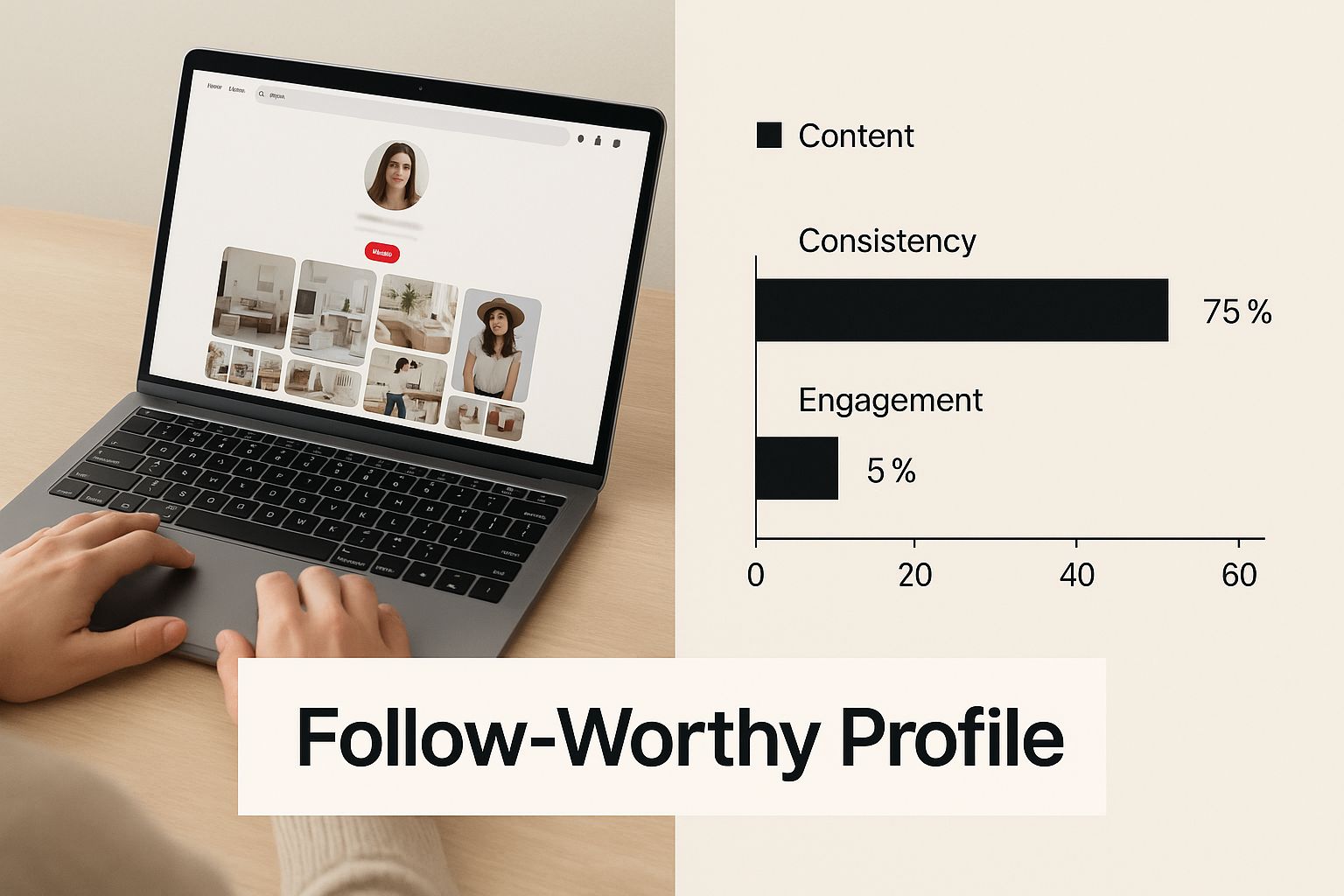
To make this easier, I’ve put together a quick checklist to run through your own profile. Think of it as a pre-flight check before you really start pushing for growth.
Pinterest Profile Optimization Checklist
| Profile Element | Optimization Goal | Key Action |
|---|---|---|
| Account Type | Access Analytics & Tools | Convert to a free Pinterest Business Account. |
| Profile Photo | Instant Recognition | Use a clear headshot or a high-quality, simple logo. |
| Username | Easy to Find & Remember | Keep it consistent with your brand name across other platforms. |
| Bio | Attract Ideal Followers | Clearly state who you serve and what value you offer in 160 characters. |
| Keywords | Improve Discoverability | Weave relevant keywords naturally into your bio and display name. |
| Website Link | Drive Traffic | Claim your website to unlock more analytics and show you’re legitimate. |
Running through these points ensures every part of your profile is working hard to bring the right people in.
Optimize Your Boards for Discovery
Your Pinterest boards are much more than just folders for your Pins; they’re individual search engines for your niche.
That means every single board title and description needs to be optimized with keywords your target audience is actively searching for.
A board vaguely titled “Cool Stuff” is a massive missed opportunity. Instead, get specific with titles like “Minimalist Home Decor Ideas” or “Modern Farmhouse Kitchen Inspiration.”
These are terms real people are typing into the search bar.
Think of your boards like the aisles in a store. Each one should be clearly labeled so people can instantly find what they’re looking for.
When it’s that easy, they’re far more likely to follow you for more great ideas down the road.
Putting in this foundational work is non-negotiable, especially right now. The platform is seeing massive growth, hitting a record 570 million monthly active users in Q1 2025—that’s a 10% year-over-year increase.
There’s a huge audience out there looking for inspiration, and a fully optimized profile is what makes sure they find you instead of your competition.
You can dive deeper into the opportunity by reading up on the latest Pinterest statistics.
Creating Pins That People Can’t Help But Follow
If your profile and boards are the foundation, your Pins are the engine that actually drives follower growth. Just pinning randomly won’t cut it.
You need to create visuals that literally stop the scroll and offer instant value, making someone think, “Wow, I need more of this.” That’s the moment a casual browser becomes a loyal follower.
It all begins with the visual itself. Pinterest is a vertical world, so your Pins have to be too. The magic ratio is 2:3 (think 1000 x 1500 pixels).
This format ensures your Pin dominates the screen on mobile, which is where most people are browsing. High-quality, vibrant images or sharp video clips are absolutely non-negotiable.
But here’s a pro tip: a great image often isn’t enough on its own.
Adding a bold, easy-to-read text overlay is one of the single most effective things you can do. It’s like a headline for your image. It needs to scream value.
For example, a food blogger shouldn’t just show a picture of a meal; the Pin should say “5-Ingredient Vegan Dinner.”
This simple change tells people exactly what they’re getting and why they should care.
Designing for Engagement
To really get what makes a Pin irresistible, you have to think beyond the standard static image. Mixing up your Pin formats is crucial for grabbing attention and giving people a reason to follow you.
- Video Pins: These are absolute gold for showing a process. A quick 15-second clip of a workout move or a fast-forwarded DIY hack is way more engaging than a still photo. Plus, they autoplay in the feed, making them impossible to ignore.
- Idea Pins: I like to think of these as mini-stories or carousels right on Pinterest. They’re perfect for step-by-step tutorials, recipes, or “Top 5” lists, keeping users hooked on your content longer and nudging them to follow you for more.
The goal of every single Pin is to provide a complete idea or a super compelling teaser.
If someone can glance at your Pin and instantly see the solution it offers, they’re infinitely more likely to save it and follow you for more genius ideas.
This is where a solid content strategy makes all the difference. You should be building your Pins around specific content pillars—the core topics you’re an expert in.
For a home organization account, your pillars might be “Decluttering Hacks,” “Small Space Solutions,” and “DIY Storage.”
Every single Pin should fit into one of these buckets, constantly reinforcing your expertise and giving people a crystal-clear reason to follow you.
If you want to go deeper on this, our guide on how to create Pins for Pinterest has tons of detailed creative strategies.
The Power of Words
Your visuals grab the attention, but your title and description are what seal the deal—both for the user and for the Pinterest algorithm.
Your Pin title needs to be clear, enticing, and packed with your main keyword. Think of it as a promise of the value inside.
The description is where you expand on that promise and sprinkle in more relevant keywords. This is your chance to tell a little story or provide more context. Don’t just stuff it with keywords.
Write a helpful, conversational paragraph that naturally includes them. This two-pronged approach makes the Pinterest algorithm happy while also connecting with the real person looking at your Pin.
When someone finds a Pin that looks great, reads well, and solves their problem, hitting that “Follow” button is a no-brainer.
Mastering Pinterest SEO to Get Discovered
So many people get this wrong, but it’s the biggest key to growing on Pinterest: it isn’t just another social network.
Think of it as a massive visual search engine. Your future followers aren’t just mindlessly scrolling; they’re on a mission, actively searching for ideas, solutions, and inspiration.
This is a complete game-changer. It means you can get your content in front of the perfect audience if you just learn to speak Pinterest’s language. And that language is SEO.
Your first step is to figure out what your ideal follower is actually typing into that search bar. You don’t need fancy, complicated tools for this. Just go straight to the source.
Start typing a broad term from your niche into the Pinterest search bar—something like “healthy recipes.” Watch what phrases pop up in the auto-suggest.
Those are the exact terms real people are searching for right now. You might see “healthy recipes for weight loss” or “healthy recipes for kids,” giving you a direct window into your audience’s needs.
Uncovering What People Want
Another goldmine that’s often overlooked is Pinterest Trends. It lets you see what topics are gaining steam on the platform.
You can even compare search terms and spot seasonal spikes, which is brilliant for planning your content calendar around peak interest.
The real goal here isn’t just to collect keywords; it’s to understand the intent behind the search.
A food blogger who creates content for “weeknight dinner ideas” is connecting with someone who needs a quick, simple meal solution tonight. When your content perfectly aligns with that need, you earn a follow.
Once you’ve gathered a solid list of these high-value keywords, you need to put them in all the right places. Think of them as signposts that guide both users and the Pinterest algorithm straight to your content.
Where to Place Your Keywords for Maximum Impact
Placing your keywords strategically is what makes your profile and Pins show up in search results. It’s the foundation for getting more followers on Pinterest.
Here’s exactly where those keywords need to live:
- Your Profile Bio: Weave your most important, high-level keywords right into your bio. This tells new visitors (and Pinterest) precisely what you’re all about from the second they land on your page.
- Board Titles and Descriptions: Give your boards specific, searchable names like “Apartment Decorating Ideas,” not something vague like “Home Stuff.” Then, be sure to fill out the board description with plenty of related keywords.
- Pin Titles and Descriptions: This is absolutely critical. Every single Pin needs a title and description packed with the specific keywords you want that Pin to rank for.
When you start treating every part of your Pinterest profile as an opportunity for SEO, you stop passively hoping for followers and start actively attracting them.
For a much deeper dive, our complete guide on Pinterest SEO tips is packed with more advanced strategies you can start using today.
Getting this right will turn your profile into a magnet for the exact people who are already looking for what you offer.
Develop a Strategic and Consistent Pinning Routine
Okay, so you’ve laid the groundwork and you’re creating beautiful Pins. That’s fantastic, but here’s where the real work—and the real growth—begins: consistency.
The Pinterest algorithm absolutely loves accounts that are active and constantly feeding it fresh, valuable content. But don’t panic.
This doesn’t mean you need to be glued to your screen 24/7. It’s all about building a smart, sustainable pinning routine that actually works for you.
A simple content calendar can be a total game-changer here. It doesn’t need to be some complex, color-coded masterpiece; a basic spreadsheet mapping out your themes for the week will do just fine.
Planning ahead like this saves you from that last-minute scramble of “What do I post today?!” and ensures you always have a steady stream of ideas ready to roll.
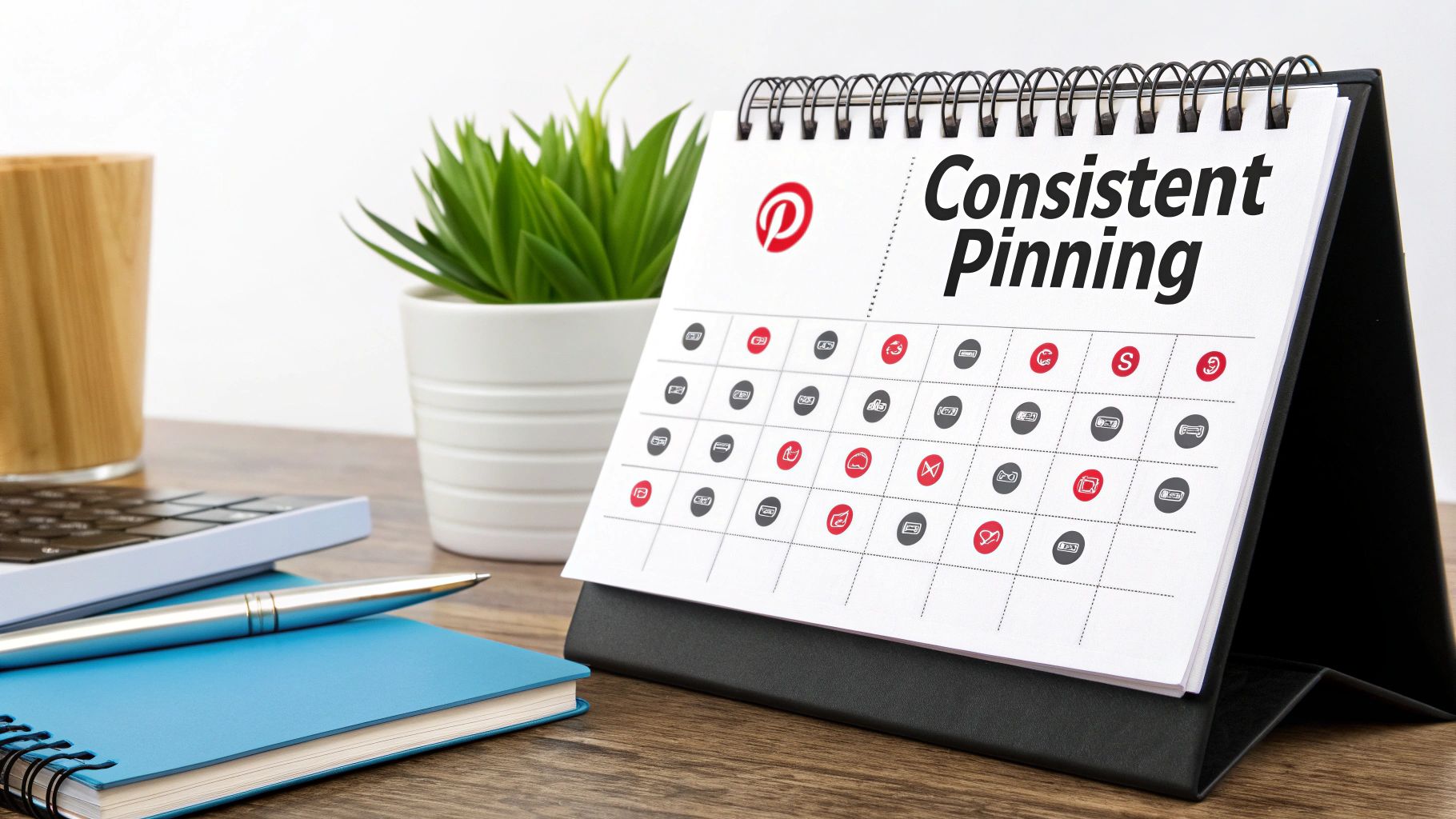
This leads me to one of my favorite time-saving hacks: batch creation. Instead of designing Pins one at a time, block out a few hours each week to create all of your Pins for the next week or two.
Seriously, this small shift in your workflow will save you an unbelievable amount of time and mental energy.
Put Your Consistency on Autopilot
Once your Pins are ready, automation is your new best friend. If you’re serious about growing your Pinterest account, using a scheduling tool is non-negotiable.
It lets you maintain a constant presence and post at the best times, even when you’re busy with everything else on your plate.
By queuing up your content in advance, your profile stays active and consistently signals to the algorithm that you’re a go-to source for fresh ideas.
If you want to get this set up, our full guide on how to schedule Pins on Pinterest walks you through the exact steps to get your workflow running on autopilot.
So, how many Pins should you actually post each day? You’ll see some people swear by pinning 8-10 times a day, but honestly, there’s no single magic number.
The most effective approach I’ve seen is focusing on quality over quantity.
Posting just three high-value, fully optimized Pins every single day is far better for your growth than spamming ten mediocre ones.
Start with a number you can realistically stick to, and then you can always scale up later.
The Smart Repinning Strategy
Consistency isn’t just about new content; it’s also about getting the most mileage out of what you’ve already created. Don’t just publish a Pin once and forget it exists.
A great Pin can—and should—be saved to multiple relevant boards over time.
This technique, often called “smart repinning,” gets your best content in front of different audiences without coming across as spammy.
Here’s a simple way to do it:
- Initial Post: First, publish your brand-new Pin to the single most relevant board.
- Wait and Repin: A few days later, repin it to another closely related board.
- Keep It Going: Continue this cycle over several weeks, spacing out the repins to different boards where the content still makes perfect sense.
This method keeps your top-performing Pins circulating, driving clicks and attracting new followers long after you first hit publish.
This is how you turn your Pinterest profile from something you just post to into a reliable, follower-generating machine.
Want more followers from the Pins you’re already posting without doubling your workload?
Ready to grow your Pinterest followers with content that actually earns clicks, saves, and follows?
Your audience doesn’t just want pretty images, they want Pins that are clear, helpful, and easy to say “yes” to.
When every Pin hits the basics, strong visuals, keyword-rich copy, and a clear promise, your profile becomes the obvious one to follow.
Stop guessing what to fix and start checking every Pin against a simple, repeatable system.
Your Top Pinterest Growth Questions, Answered
As you dive into growing your Pinterest account, you’re bound to run into some of the same questions that trip up everyone else.
Let’s clear up that confusion right now so you can focus on what really matters.
1. Seriously, How Often Should I Pin?
Look, there’s no magic number here. I’ve seen people swear by pinning 10-15 times a day, but for most folks, especially when you’re just starting out, that’s completely unrealistic.
What the Pinterest algorithm really cares about is consistency. A steady, reliable flow of new content is your best friend.
Honestly, pinning 3-5 fantastic, well-optimized Pins every single day will get you much further than flooding the platform with ten so-so ones. Find a rhythm you can actually maintain long-term.
2. Are Group Boards a Waste of Time Now?
The honest answer? It’s complicated. A few years back, group boards were the secret weapon for blowing up your reach.
Their power has definitely waned since then, but that doesn’t mean they’re useless. A super-active group board that’s tightly focused on your specific niche can still give you a nice little bump in visibility.
The trick is to be picky. Before you join, do some digging. Is it a curated space full of great content, or has it turned into a spam-filled dumping ground?
A well-run board can introduce your Pins to a fresh audience. Just don’t make it your main strategy—your own boards are always your top priority.
Don’t burn hours hunting for the perfect group board. Pour that energy into solid keyword research and creating killer Pin designs instead.
Your own well-optimized content is what will deliver consistent, long-term growth.
3. How Long Does It Really Take to See Follower Growth?
This is the one everyone wants to know, and I get it. The truth is, Pinterest is a marathon, not a sprint. It’s a search engine, and just like with Google, it takes time for your content to gain traction and rank.
If you’re consistently pinning good stuff, nailing your SEO, and sticking to a schedule, you should start seeing some real momentum in about 3 to 6 months.
And I’m not just talking about the follower number ticking up; you’ll see it in your outbound clicks and monthly views, too. Patience is key here.
4. Is Follower Count the Only Thing That Matters?
Nope. While watching that number climb feels great, it’s definitely not the most important metric for success. For most businesses and creators, the real gold is in your outbound clicks, saves, and overall impressions.
Those numbers tell you that people are actually doing something with your content—they’re saving it for later and, most importantly, visiting your website.
Think of your follower count as a sign that you’re building a community, but measure your actual success by the traffic and engagement your Pins are driving.
A smaller, die-hard audience that clicks is always better than a massive, passive one.