
Let’s get one thing straight: the group board on Pinterest isn’t the magic ticket to explosive reach that it used to be.
The game has changed. If you want to see real results today, you need a much smarter, more focused strategy.
The Evolved Role of Pinterest Group Boards

I remember the “good old days” when joining dozens of massive group boards was a go-to tactic. The thinking was pretty simple: more boards equaled more eyeballs.
But Pinterest’s algorithm has gotten a lot more sophisticated. It now rewards genuine engagement, fresh content, and niche relevance far more than just sheer volume.
That old “spray and pray” method of pinning to every board you could find? It can actually hurt your account now.
Today, a winning group board Pinterest strategy is all about quality over quantity. Think of it less like shouting in a crowded stadium and more like joining a small, exclusive book club.
The real goal is to find active, well-run communities that are laser-focused on your specific niche.
From Broad Reach to Niche Authority
The true power of a group board in today’s Pinterest landscape is its ability to connect you with a highly targeted audience.
Forget reaching thousands of people who couldn’t care less about your topic. You’re much better off engaging with a few hundred who are genuinely passionate about what you do.
This shift has some major upsides:
- Sky-High Engagement Rates: When you share pins in a niche board, they’re far more likely to get saves and clicks because they actually resonate with the people seeing them.
- Better Algorithm Signals: High engagement sends a clear message to Pinterest that your content is valuable, which can boost its visibility everywhere on the platform.
- Real Community Building: Actively participating in these smaller groups helps you forge relationships with other creators and solidify your reputation as an expert in your field.
The core concept has flipped entirely. Success isn’t measured by how many boards you’ve joined, but by the quality of the engagement you get from a handful of carefully chosen ones.
This isn’t just a hunch; the data backs it up. Many marketers have discovered that pinning to too many generic group boards can actually drag down an account’s performance because of low interaction.
That’s why most experts now recommend zeroing in on just 5 to 7 highly relevant and active group boards.
This focuses your efforts where they’ll make a real difference. If you need a refresher on the basics, you can check out our guide on what is a Pinterest board.
Even Pinterest’s own help documentation frames group boards around collaboration and shared interests.

This screenshot really drives home the point. Group boards are built for community. They’re about multiple creators contributing to a shared collection of ideas.
This just reinforces why finding a relevant niche with active participants is the only way to play the game now.
How to Find Group Boards Worth Joining
Finding a genuinely good group board on Pinterest can feel a bit like searching for a needle in a haystack.
So many of them are either ghost towns, packed with spam, or so ridiculously broad that your carefully crafted content just vanishes into the void.
The secret isn’t to just throw random keywords into Pinterest’s search bar. The real trick is to start by looking at what the top players in your niche are already doing.
Start by ‘Spying’ on Influencers
Honestly, the fastest way to find active, relevant boards is to check out the profiles of influencers and successful competitors you admire.
They’ve already done the hard work of finding and vetting good boards for you.
Make a list of five to ten top pinners in your space. Head over to their profiles and scan their boards.
You’re looking for the ones with multiple little profile pictures in the corner, that’s the visual giveaway for a group board.
Click into those boards and take a look around. Are they truly a good fit for your content? Is there consistent activity from different people?
This reverse-engineering method is a hundred times more effective than just starting with a generic search and hoping for a lucky break.
Smarten Up Your Pinterest Search
When you are ready to use the Pinterest search bar, you’ve got to be strategic. Broad terms will just surface the biggest, and often lowest-quality, group boards.
You need to combine your main topic with specific modifiers to filter out the junk. Try a few of these search formulas to see what works for you:
- “[Your Niche] Group Board”: The most direct approach, and sometimes it works like a charm.
- “[Your Niche] Community Board”: Swapping “group” for “community” can pull up boards with a more collaborative vibe.
- “[Your Niche] Bloggers”: This is great for finding boards made by and for fellow content creators.
Getting the keywords right is part art, part science. If you need some more inspiration, using a free Pinterest keyword research tool can show you what your audience is actually searching for, giving you fresh angles for your board hunt.
The 5-Minute Quality Check
Okay, so now you have a list of potential boards. Don’t just fire off join requests to all of them! Joining a bad group board is worse than joining none at all, it can be a huge waste of your time.
A quick five-minute check can make all the difference.
You’re looking for a healthy ratio of followers to contributors and, most importantly, recent activity. If the last pin was from three months ago, it’s a dead board. Move on.
A great group board should look like a lively conversation, not a digital graveyard. If the recent pins have few to no saves and the content is all over the place, it’s a major red flag that the board lacks an engaged audience.
Before you even think about joining, run each potential board through this quick checklist.
Vetting Pinterest Group Boards for Quality
This simple table will help you quickly decide if a board is a goldmine or a dud.
| Quality Factor | What to Look For | Red Flag |
|---|---|---|
| Clear Niche | A specific, well-defined topic (e.g., “Vegan Keto Recipes” not just “Food”). | An unfocused board with pins on dozens of unrelated topics. |
| Pin Engagement | Recent pins have a reasonable number of saves or clicks. | Most pins have zero saves, indicating low visibility and engagement. |
| Active Contributors | You see pins from various contributors within the last week. | The board owner is the only one pinning recently. |
| Strict Rules | The board description has clear guidelines about content and pinning frequency. | No rules are listed, or the description is vague and unhelpful. |
Taking this methodical approach helps you cut through the noise.
It ensures you focus your energy only on the group boards on Pinterest that will actually move the needle for your account by getting your content in front of a new, engaged audience.
Crafting an Invitation Request That Gets Accepted

You’ve done the legwork and found the perfect group board on Pinterest for your content. Great! But now comes the moment of truth: asking to join.
This is exactly where so many people drop the ball with a generic, low-effort message that board owners spot from a mile away and instantly delete.
Think about it from their perspective. Popular board owners get slammed with requests.
Your job is to cut through that noise and prove you’re a serious contributor who will bring value, not just a link-dropper. A canned, copy-paste request is the fastest way to get ignored.
Personalize Your Pitch
Before you even think about hitting “send,” do a little recon. Actually read the board’s description and any rules they’ve posted.
Find the owner’s name and get a feel for the kind of content they and the other collaborators share. This little bit of effort proves you respect the community they’ve built.
Your message needs to be a short, compelling pitch that shows you’ve done your homework. It’s amazing how much a simple, specific compliment about the board can set you apart.
Here’s what your request absolutely needs to have:
- A Real Greeting: Use their name! “Hi Sarah” is infinitely better than a cold “Hello.”
- An Authentic Compliment: Tell them what you like about their board. Something like, “I’m a huge fan of your ‘Minimalist Home Decor’ board—the focus on sustainable materials is fantastic.”
- Proof of Value: This is key. Explain why your content is a perfect fit. Give them the link to your Pinterest profile and maybe even one or two of your best pins that would feel right at home on their board.
- Rule Acknowledgment: A simple sentence like, “I’ve read over the board rules and I’m on board,” shows you’re ready to be a team player.
A Real-World Example That Works
Let’s say you’re a food blogger who specializes in gluten-free recipes and you want to join a board called “Healthy GF Desserts.”
Subject: Request to contribute to “Healthy GF Desserts”
Hi Sarah,
I’ve been following your “Healthy GF Desserts” board for a while now, and I just wanted to say how much I love the quality of recipes you share. That avocado brownie pin from last week was genius!
My blog is all about creating gluten-free desserts with wholesome ingredients, so I thought my content might be a great fit for your audience. For example, I think my recipe for almond flour cookies would do really well.
You can check out my other pins on my Pinterest profile: [Link to your profile].
I’ve read your board guidelines and will happily follow them. Thanks so much for your time and consideration!
Best,
Alex
See the difference? It’s friendly, specific, and shows Alex is a peer who gets it. This kind of thoughtful approach is what gets you that “yes.”
If you don’t hear back, a polite, professional follow-up after a week is fine, but don’t spam their inbox.
You’ve scored an invite to a great Pinterest group board. Fantastic! But don’t just drop your links and run.
Getting in is just the start, the real magic happens when you become a contributor that the board owner can’t imagine living without.
Think of it this way: a group board is a community, not just a dumping ground for your content. Your success is directly tied to the board’s overall health.
When the board thrives, so does your reach. This all starts with one simple, often-overlooked thing: following the rules.
If the owner sets a limit of three pins per day, respect it. If there’s a specific schedule for certain topics, stick to it.
These guidelines are there for a reason, to keep the feed high-quality and free of spam, which ultimately benefits everyone, including you.
Adopt a “Share-for-Share” Mindset
Here’s a pro-tip that will put you in the top tier of contributors: for every pin of your own that you add, make a point to repin one or two high-quality pins from other members onto your own relevant boards.
This simple act of reciprocity is a game-changer. Why?
- It shows the board owner and other members you’re a team player, building serious goodwill.
- It pumps up the board’s overall engagement, which tells the Pinterest algorithm that this is a valuable, active space.
- It creates a positive feedback loop, making others far more likely to share your content in return.
Becoming a top contributor isn’t just about what you post; it’s about what you share.
Reciprocity is the unwritten rule that separates passive members from influential ones, and it’s what makes a group board truly successful for everyone involved.
Always Bring Your A-Game with Fresh Content
Your main job as a contributor is to add value. That means sharing only your best, most relevant pins that are a perfect fit for the board’s niche. Don’t just phone it in.
To keep things interesting, it’s a great idea to explore diverse social media content ideas so your pins always feel fresh and exciting to the board’s audience.
The beauty of a group board is how it pools together amazing content from hundreds of people, catapulting your reach far beyond your own follower list.
But this powerful engine only works if everyone maintains high standards. Avoid spamming and always prioritize quality over quantity.
Ultimately, you want to be the kind of pinner the board owner is genuinely excited to have.
When you consistently provide top-notch content and actively support the community, you’re not just staying on the board, you’re maximizing your own visibility.
Remember, every pin is an opportunity to grab someone’s attention. Our guide on how to create pins that stand out can show you exactly how to do that.
Creating and Growing Your Own Group Board
Ready to build your own community from the ground up? Launching your own group board is a fantastic way to position yourself as an authority in your niche, but it’s not something you can just set and forget.
It’s about more than just inviting a few people; it’s about curating a valuable, focused resource that attracts quality contributors and a genuinely engaged audience.
Your first move is to define a crystal-clear purpose. A board vaguely named “Everything Food” is practically an open invitation for spam.
It’s just too broad. Instead, get specific. Something like “Vegan Instant Pot Recipes” or “DIY Farmhouse Decor Projects” immediately tells people what to expect and what kind of content belongs there.
This sharp focus is your best defense against irrelevant pins.
Establishing Clear Board Rules
Once you’ve zeroed in on your niche, you need to set some ground rules to protect the board’s quality.
Think of yourself as the host of an exclusive party, you get to set the dress code. The board description is the perfect spot to lay out these guidelines.
Be direct and unambiguous with your rules:
- Pinning Ratio: This is a big one. I often require contributors to share one pin from another member for every one of their own they add. It builds a real sense of community and reciprocity.
- Content Quality: Be explicit. State that only high-quality, vertical pins are welcome. No blurry photos or spammy-looking links.
- Pin Frequency: It’s smart to set a daily limit, like “3-5 pins per day,” to keep any single user from flooding the feed.
These rules aren’t about being bossy; they’re about maintaining the value of the group board on Pinterest for everyone. A well-moderated board is a healthy and effective board.
Creating your own group board is a powerful way to position yourself as an authority in your niche.
The key is to manage it proactively by setting clear rules and fostering a community of high-quality contributors who respect the guidelines.
Inviting and Managing Contributors
Your vetting process for new members is absolutely critical. Don’t just click “accept” on every request that comes through.
Take a minute to actually look at their Pinterest profile. Are their pins well-designed? Is their content a good fit for your board’s topic?
This quick check is your best tool for ensuring you only invite people who will add real value.
As your board grows, so does its potential for impact. We’re talking about Pinterest here, a massive platform where collaborative efforts can seriously pay off.
With around 570 million monthly active users, a tightly-focused group board can connect you with a highly engaged audience hungry for curated content.
Just look at the numbers, users have created over 10 billion boards. That tells you how central this feature is, making your well-run group board a prime piece of digital real estate.
This infographic really nails the core values of an ideal contributor who will help your board thrive.
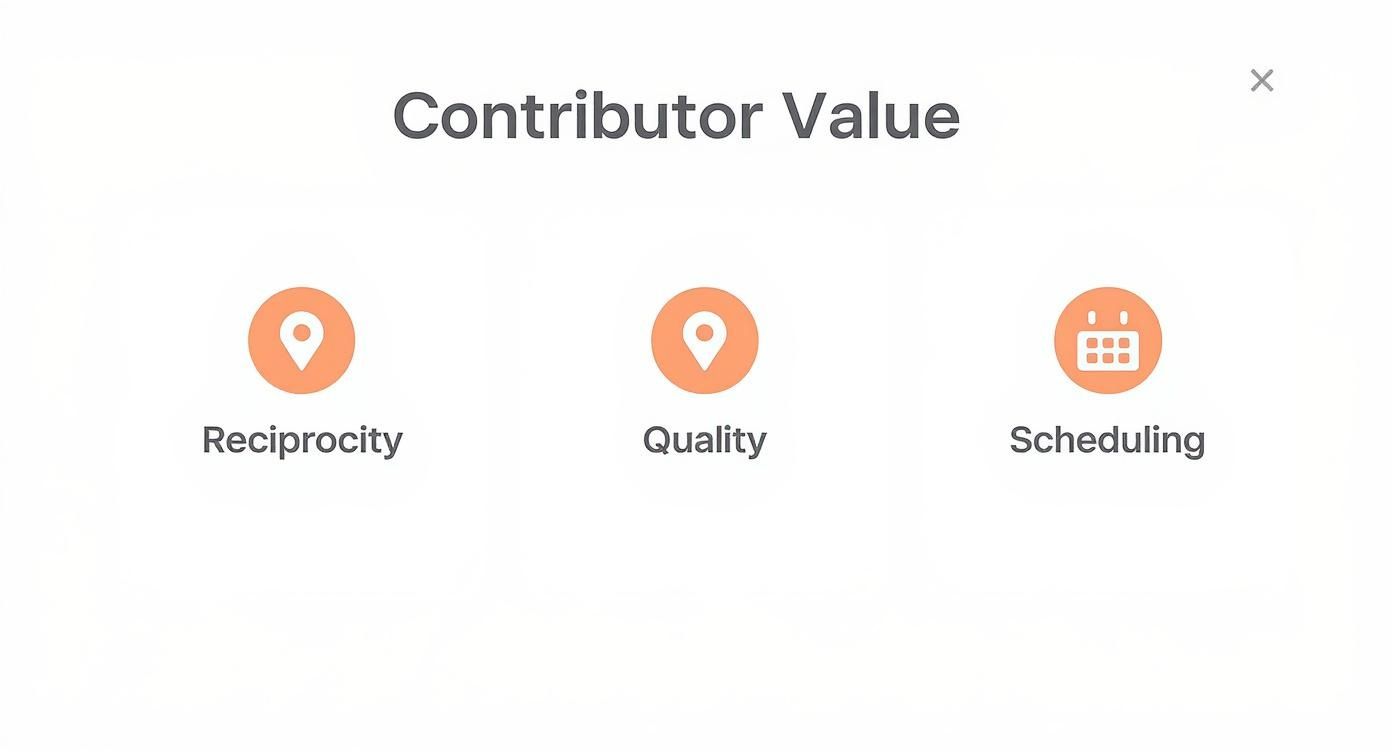
As the visual shows, a successful group board really boils down to members who reciprocate, share top-notch content, and stick to the rules.
To really kick your board’s growth into high gear, you might even consider weaving in some modern influencer marketing strategies with your overall Pinterest plan.
And don’t forget the admin work—regularly removing inactive members and keeping an eye out for spam is non-negotiable if you want to keep your board a top-tier resource.
Turn Your Pinterest Group Boards Into Must-Click Destinations
Ready to give your boards names that actually stop the scroll and attract the right pinners?
Your group board titles are often the first impression people get of your content and the algorithm notices them too.
Use clear, keyword-rich, and niche-specific names so the right audience can find (and follow) you faster.
Spend less time brainstorming and more time pinning content that converts.
Common Questions About Pinterest Group Boards
Even with a solid plan, a few questions always seem to pop up when you’re getting serious about using a group board on Pinterest.
Let’s clear the air on some of the most common ones so you can move forward with total confidence.
1. Are Group Boards Still Relevant?
This is the big one, and the short answer is yes—but their purpose has changed dramatically. Gone are the days of joining massive, free-for-all boards to get a huge spike in reach. That strategy is dead.
Today, group boards are all about targeted, niche engagement.
The real magic isn’t in joining dozens of boards; it’s in finding a small, curated list of maybe 5 to 7 highly active, laser-focused boards where your content is a perfect fit for the audience. Think community, not just a content dumping ground.
2. How Many Group Boards Should I Join?
It’s so easy to fall into the “more is better” trap, but with group boards, it’s a classic case of quality over quantity. Spreading yourself too thin across too many boards means you can’t be a valuable contributor to any of them.
You’ll get much better results by focusing your energy on just a handful of excellent boards. This allows you to actually engage, learn the board’s culture, and build a good reputation.
Once you’ve found a few that really work for you, there’s no need to keep hunting for more.
Trying to manage dozens of boards is a fast track to burnout and mediocre results. It’s far better to master your presence in a few key communities before you even think about expanding.
3. What Should I Do About Spammy Boards?
If you’ve joined a board and it’s turned into a wasteland of off-topic pins, low-quality content, and people ignoring the rules, the answer is simple: get out.
Staying on a spammy or inactive board does absolutely nothing for you. In fact, it can even hurt how Pinterest’s algorithm sees your account. Don’t be afraid to do some spring cleaning.
Periodically go through the boards you’re a part of and ask yourself:
- Are my pins getting any traction here?
- Is the board still active with good stuff from other members?
- Does this board still make sense for my content strategy right now?
If you’re answering “no” to these, it’s time to hit that “Leave board” button. A healthy Pinterest strategy needs regular maintenance.
4. How Can I Tell If a Board Is Actually Working for Me?
This is where your Pinterest Analytics becomes your secret weapon. Dive into the data and see which boards are actually sending you impressions, saves, and (most importantly) outbound clicks.
You might be surprised to find that the classic 80/20 rule applies here—80% of your group board success will likely come from just 20% of the boards you’re on.
Look for the trends. If one group board on Pinterest is consistently performing well, that’s where you should double down.
If another board is a ghost town for your content after a month, it’s probably time to let it go. Let the numbers guide your strategy.