To build a winning Pinterest marketing strategy, you have to start with a crucial mindset shift:
Pinterest is not a social network. It’s a powerful visual discovery engine where people are actively planning, researching, and getting ready to buy.
Why Pinterest Is a Visual Discovery Engine, Not a Social Network
So many creators jump onto Pinterest and treat it just like Instagram or Facebook, posting here and there and crossing their fingers for a viral hit.
This is the single biggest mistake you can make. Social media is all about the past and present, sharing what you did yesterday or what’s happening right now. Pinterest is entirely future-focused.
People on Pinterest, or “Pinners,” come to the platform with a plan. They’re looking for ideas and solutions for their next big thing, whether it’s a home renovation, a wedding, or a new laptop.
Think of it less like a social club and more like a massive, personalized digital mall where shoppers are already wandering the aisles, ready to be inspired.
The Power of User Intent
On social media, your content often feels like an interruption in someone’s scroll. On Pinterest, your content is the very thing they came to find.
This difference in user intent is a game-changer for marketers. Pinners aren’t just killing time; they’re actively planning their next move.
This forward-thinking mindset creates a uniquely commercial atmosphere. In fact, a whopping 46% of weekly Pinners say they’ve discovered a new brand or product on the platform.
They are there to find inspiration and, more importantly, turn it into action. This core “inspiration to action” loop is what makes Pinterest a marketing goldmine.
For a deeper dive, we break down whether Pinterest is considered social media in another guide.
The crucial shift is understanding that Pinterest users aren’t there to connect with friends. They’re there to plan their lives, making it one of the most commercially-intent-driven platforms available.
Moving Beyond Old Myths
Let’s clear the air: the idea that Pinterest is just for recipes and wedding decor is years out of date. While those niches are still huge, the platform has grown into a powerhouse for nearly every industry imaginable.
Today, people use it to plan everything from tech purchases and financial strategies to entire wardrobes and complex travel itineraries.
Your Pinterest marketing strategy has to be built on this reality. You’re not just posting pretty pictures; you’re providing visual answers to the questions your future customers are already asking.
Every single Pin is a chance to insert your brand into their planning process, building trust and preference long before they’re even thinking about clicking “buy.”
Setting Goals and Defining Your Pinterest Audience
Every solid marketing strategy on Pinterest kicks off with two fundamental questions: What are we trying to achieve, and who are we trying to reach?
It’s easy to get lost in the sea of beautiful images, but without a clear destination and a map to get there, you’re just pinning in the dark.
Too many marketers get hung up on vanity metrics like follower counts or monthly views. Sure, those numbers can feel good, but they don’t pay the bills.
The real goal is to focus on actions that directly benefit your business.
Establish Your Primary Business Objectives
Your Pinterest goals shouldn’t exist in a vacuum. They need to be a direct reflection of your larger business objectives. The big question to ask yourself is, “What do I need Pinterest to actually do for my business?”
For most brands, the answer usually falls into one of three buckets.
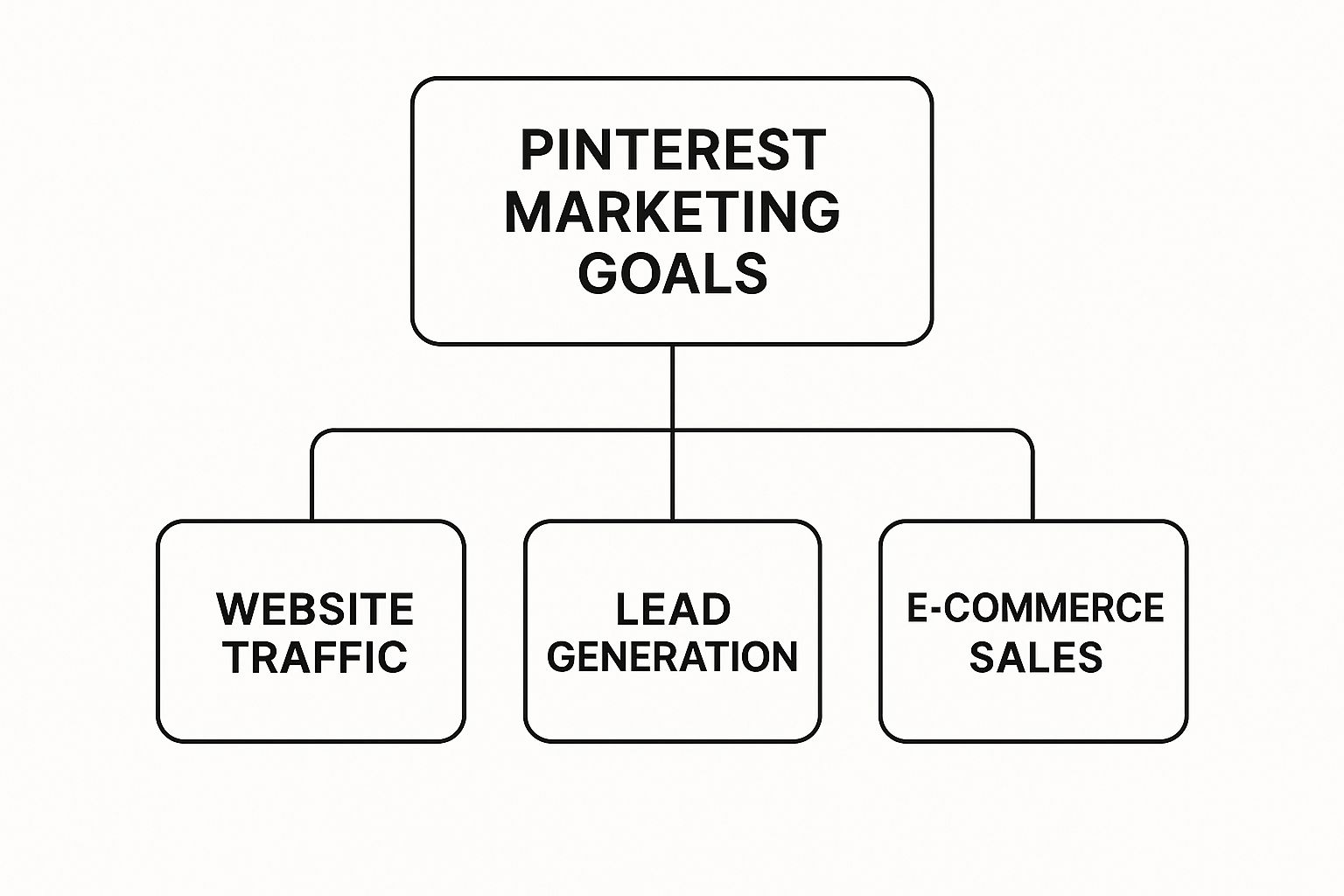
This infographic shows how broad marketing goals translate into specific, trackable outcomes on Pinterest. Here’s how it breaks down:
- Drive Website Traffic: This is the most common starting point. Your aim is to create Pins so compelling that users can’t help but click through to your blog, landing pages, or product collections. Every click is a new person stepping into your digital storefront.
- Generate Leads: If you’re a service-based business or have a longer sales process, Pinterest can be a lead generation powerhouse. The objective here is to turn that traffic into tangible contacts by offering valuable downloads like checklists, e-books, or webinar sign-ups.
- Boost E-commerce Sales: This is where the rubber meets the road. Using Product Pins, shoppable catalogs, and targeted ad campaigns, you can guide users from the moment of inspiration straight to the checkout page. It’s about turning a Pinner’s dream project into a purchase.
Define Your Ideal Pinterest Persona
With your goals in place, it’s time to get crystal clear on who you’re talking to. Your Pinterest audience might not be identical to your Instagram or Facebook followers.
People on Pinterest are in a completely different mindset—they’re planners, dreamers, and doers actively looking for ideas and solutions.
To really connect, you have to get inside their heads. What problems are they trying to solve? What life events are they planning for?
The user base is massive, projected to hit 570 million monthly active users by early 2025, and with Gen Z now making up 42% of the global audience, you can’t afford to be generic.
Your ideal persona isn’t just a demographic profile; it’s a deep understanding of what motivates someone to search, save, and ultimately click on your content.
Use the platform’s own tools to start building this profile.
Dive into the Pinterest Trends tool to see what’s gaining steam, and pay attention to the auto-suggested terms in the search bar—they’re a goldmine of keywords your audience is already using.
For a more structured approach, this guide on defining your target audience is a great resource.
Getting this right ensures every single Pin you create will feel like it was made just for them.
Building Your Pinterest Content and SEO Blueprint
A killer marketing strategy on Pinterest really comes down to two things: eye-catching content that makes people stop scrolling and smart SEO that helps them find it in the first place.
Think of it like a beautiful storefront. The stunning window display (your content) is what draws people in, but the street address and clear sign out front (your SEO) are what help them find your shop to begin with.
If one part is missing, you’re either making incredible Pins that no one ever sees, or you’re getting found for visuals that don’t actually inspire anyone to take action.
This blueprint will walk you through mastering both sides, turning your Pinterest profile into a reliable engine for traffic and growth.
Defining Your Content Pillars
Before you even think about designing a Pin, you need to lock in your content pillars. These are the 2-4 core topics or themes your brand will own.
They’re your North Star, making sure every single thing you post is relevant to your audience and connected to your business goals.
Let’s say you run a sustainable fashion brand. Your content pillars might look something like this:
- Ethical Manufacturing Processes
- Styling Sustainable Wardrobes
- Eco-Friendly Fabric Guides
- Behind-the-Scenes Brand Stories
Having these pillars keeps you from posting randomly. Instead, you’re building a cohesive brand story that attracts a loyal following who knows exactly what kind of value you offer.
The Anatomy of a High-Performing Pin
Not all Pins are created equal. As Pinterest has streamlined its formats, what really matters now is creating high-quality, genuinely helpful content, no matter the type.
The algorithm rewards fresh, engaging Pins that either keep users on the platform or give them a clear, valuable next step.
To make Pins that actually perform, nail these key elements:
- Vertical Aspect Ratio: Always shoot for a 2:3 ratio (e.g., 1000 x 1500 pixels). This format takes up the most screen real estate on a phone, which is where most people are scrolling. More screen space means more attention.
- High-Quality Visuals: Use crisp, clear, professional-looking images and videos. Blurry or poorly lit visuals are a non-starter.
- Compelling Text Overlays: Your Pin image needs a headline. Use bold, easy-to-read fonts to tell people what they’re getting in a split second. Think “5 Easy Vegan Dinner Ideas,” not just a picture of food.
- Subtle Branding: Pop your logo or website URL on every Pin. It should be visible enough to build recognition over time but not so loud that it’s distracting.
A great Pin solves a problem, sparks an idea, or teaches something new. It offers immediate value while creating curiosity for what lies behind the click.
This simple formula works for everything from static images to multi-page Video Pins. The goal is always the same: make it beautiful and make it useful.
To help you decide which format to use, here’s a quick breakdown of what’s available and where each one shines.
Pinterest Content Format Comparison
| Pin Format | Primary Goal | Best For | Key Feature |
|---|---|---|---|
| Standard Pin | Drive Traffic | Blog posts, product pages, lead magnets | Simple, direct link to an external URL. |
| Video Pin | Boost Engagement & Brand Storytelling | Tutorials, behind-the-scenes, product demos | Autoplays in the feed, capturing attention with motion. |
| Idea Pin | Build Audience & Showcase Expertise | How-to guides, recipes, step-by-step processes | Multi-page format that keeps users on Pinterest. |
| Carousel Pin | Feature Multiple Products or Steps | Product collections, telling a sequential story | Users can swipe through multiple images in one Pin. |
Ultimately, a good strategy uses a mix of these formats. Test what resonates with your audience and double down on what works.
Mastering Pinterest SEO

This is the secret weapon so many people overlook. Pinterest isn’t just a social network; it’s a visual search engine. Its algorithm relies heavily on keywords to figure out what your content is about and who to show it to.
Ignoring SEO is like whispering in a crowded room—your message just gets lost. A solid SEO strategy is what ensures your Pins pop up at the exact moment your ideal customer is searching for answers.
You can even use dedicated AI marketing software to speed up content creation and find new keyword ideas.
Your first stop is keyword research, and you can do it right in the Pinterest search bar. Start typing a broad term related to your niche.
If you type “home decor,” Pinterest’s autocomplete will suggest what people are actually searching for, like “home decor ideas living room,” “home decor aesthetic,” or “home decor on a budget.”
Those are your keywords.
Once you have your list, it’s time to put them to work. For a deep dive into the whole process, check out our guide on essential Pinterest SEO tips to really maximize your reach.
Here are the most important places to weave in your keywords:
- Pin Titles: Keep them clear, descriptive, and keyword-focused.
- Pin Descriptions: Write a helpful paragraph or two using a few related keywords naturally.
- Board Titles and Descriptions: Organize your Pins into boards with keyword-optimized titles and descriptions.
- Profile Bio: Use your main keywords to quickly tell people who you are and what you do.
Don’t forget that Pinterest’s influence goes beyond just search. The platform’s annual trend prediction reports have an amazing 80% accuracy rate, which means they literally help shape what millions of consumers search for and buy.
By aligning your content and keywords with these emerging trends, you’re not just getting found today—you’re staying relevant for months and even years.
Designing Pins That Stop the Scroll

Okay, you’ve got your content plan and your keyword strategy locked in. Now comes the part everyone loves: making the Pins themselves. This is where your strategy comes to life.
On Pinterest, where a staggering 97% of top searches are unbranded, your Pin’s design is everything. It’s your first impression, your billboard, and your invitation all rolled into one.
Imagine the Pinterest feed as a bustling, vibrant street market. Everyone is scrolling past hundreds of stalls (Pins) at a brisk pace.
To get someone to stop at yours, you need more than just a good product. You need a bright, eye-catching display that instantly tells them what you’re offering and why they need it.
A bland or confusing design will simply get scrolled past without a second thought.
Core Principles of High-Converting Pin Design
You absolutely do not need to be a graphic designer to make Pins that work. Great Pin design is less about artistic genius and more about clarity and psychology.
The goal is simple: make someone stop, understand the value, and feel compelled to click.
Think of these principles as the foundation for every single Pin you create.
- Stick to Your Brand Vibe: Use your brand’s colors, fonts, and logo consistently. Over time, people will start to recognize your content in a split-second, even before they read a single word. It builds trust and familiarity.
- Use High-Quality Imagery (Always): This is a deal-breaker. Your photos and videos must be sharp, clear, and professional. A blurry, dark, or pixelated image immediately tells a user that the content behind it is probably low-quality, too.
- Write a Headline They Can’t Ignore: Your image needs a bold text overlay. Use a clean, easy-to-read font to spell out the benefit. Don’t just show a picture of a salad; add the text “10-Minute Healthy Lunch Idea.” Tell them exactly what they’re going to get.
- Lean into Color Psychology: Colors have a huge impact on emotion. Want to create excitement or urgency? Use warm colors like red or orange. Building a sense of calm and trust? Go for blues and greens. Pick colors that match the feeling you want your content to evoke.
The best Pin designs don’t just look pretty—they communicate a clear benefit. They instantly answer the user’s silent question: “What’s in it for me?”
A Quick Tutorial Using Canva
Forget expensive, complicated software. Tools like Canva have completely changed the game, offering thousands of ready-made Pinterest templates.
It makes it incredibly easy to create Pins for Pinterest that look like a pro designed them.
Here’s a super simple workflow you can use right now:
- Pick a Template: Search for “Pinterest Pin” and choose a design with the ideal 2:3 aspect ratio (like 1000 x 1500 pixels). This vertical format is king on mobile.
- Swap the Visuals: Drag and drop your own photo or video into the template, or grab a relevant one from Canva’s massive stock library.
- Update the Text: Click on the text boxes to write your own catchy headline. Make sure the font is big enough to be easily read on a phone.
- Add Your Brand: Pop your logo or website URL somewhere on the Pin, usually at the bottom. Keep it subtle but clear.
The secret here is to create a handful of go-to templates. Once you have a few designs you love, you can churn out dozens of fresh, on-brand Pins in minutes.
This frees you up to spend less time on the nitty-gritty design work and more time on the strategy that will actually drive results.
Amplifying Your Reach with Pinterest Ads
While a solid organic marketing strategy on Pinterest is your bedrock for steady growth, sometimes you need to give things a serious push. That’s where Pinterest Ads come in.
Think of your organic Pins as seeds you plant over time; a paid strategy is like adding fertilizer and a high-powered sprinkler system to make them sprout faster and reach a much bigger audience, right now.
The beauty of advertising on Pinterest is that it doesn’t feel like an interruption. Pinners are actively looking for solutions and inspiration, so your ads show up as helpful suggestions, not annoying roadblocks.
This unique user mindset is why the results can be so fantastic.
Choosing Your Campaign Objective
Before you even think about your budget, you need to be crystal clear on what you want your ads to accomplish.
Pinterest helps you do this by organizing campaigns around specific business goals, which in turn tells its algorithm exactly who to show your ads to.
Your objectives will generally fall into one of three classic marketing funnel stages:
- Awareness: This is your top-of-funnel play. The goal is simple: introduce your brand to a wide net of people who have likely never heard of you. It’s all about building that initial brand recognition.
- Consideration: Here, you’re targeting people who are in the middle of their research. You want to drive traffic to your site, get more eyes on your videos, or spark engagement that pulls them deeper into your world.
- Conversions: This is where the magic happens. The focus shifts to driving specific actions—sales, email sign-ups, or getting someone to add an item to their cart. For e-commerce brands, this is the money-maker.
Selecting the right objective is the most critical first step. It tells Pinterest’s ad system exactly what success looks like for you, allowing it to optimize for the most valuable actions.
Leveraging Powerful Targeting Options
The real power behind Pinterest Ads is its incredibly smart targeting. You can go way beyond simple demographics and connect with people based on what they’re actively searching for and pinning.
That level of precision is why these ads just work.
In fact, a Nielsen analysis found that Pinterest ads deliver a 32% higher return on ad spend (ROAS) compared to other digital platforms. T
his isn’t an accident. It’s because users are there with the intent to discover and buy, making them incredibly receptive to brands that fit their search.
You can dig into the numbers in the full breakdown of Pinterest statistics.
To get that kind of return, you have to master the targeting tools at your disposal:
- Interest Targeting: This lets you show your ads to people based on their established interests. Think of categories like “modern home decor” or “healthy vegan recipes.” It’s a great way to find people who are already primed to like what you offer.
- Keyword Targeting: This is a game-changer. You can target users based on the exact phrases they’re typing into the search bar, catching them at the absolute peak of their interest.
- Audience Targeting: Here, you can upload your own customer email lists to reconnect with people who already know you. Even better, you can create lookalike audiences, which tells Pinterest to find new users who behave just like your best customers. It’s a phenomenal way to scale your reach to a highly qualified audience.
How to Measure and Optimize Your Performance

A Pinterest strategy isn’t something you just set and forget. The best ones are living, breathing things that you constantly tweak and improve. But here’s the thing: you can’t improve what you aren’t measuring.
Diving into your analytics is like getting direct feedback from your audience. It shows you what’s hitting the mark, what’s falling flat, and where your real opportunities are hiding.
It’s the difference between guessing what works and knowing what works. This is how you turn raw data into smart decisions that fine-tune everything from your content topics to your ad budget.
Understanding Your Pinterest Analytics
Pinterest gives you a pretty powerful, built-in analytics dashboard that tells you exactly what’s going on with your content.
At first glance, it can feel like a tidal wave of numbers. The trick is to ignore the noise and focus only on the metrics that actually line up with the business goals you set from the start.
Here are the big three you’ll want to keep an eye on:
- Impressions: This is simply the total number of times your Pins were shown on someone’s screen. A high impression count is a good sign that your keywords and visuals are doing their job and getting your content into people’s feeds.
- Saves: This metric is pure gold. A “Save” means someone found your content so useful that they saved it to one of their own boards for later. For the Pinterest algorithm, saves are a huge vote of confidence, signaling that your content is high-quality and relevant.
- Outbound Clicks: This is the number of people who clicked from your Pin all the way through to your website. If driving traffic is your main goal, this is your north star metric.
Think of it like this: Impressions are your window shoppers. Saves are the people adding items to a wishlist.
And Outbound Clicks are the customers actually walking into your store. Each one tells a crucial part of your customer’s journey.
Creating a Simple Optimization Framework
Having all this data is great, but it’s useless without a system for acting on it. Instead of drowning in daily stats, block off some time once a month to do a proper performance review.
This simple, repeatable process ensures your strategy is always getting smarter based on real-world feedback.
During your monthly check-in, ask yourself these three questions:
- Which Pins drove the most outbound clicks? Look for common threads. Are there patterns in the headlines, designs, or topics of your top traffic-drivers? These are the clues to what your audience really wants.
- Which Pins got the most saves? These are the Pins that truly resonated. Figure out what made them so valuable. Was it a step-by-step guide, an infographic, a detailed checklist? This tells you exactly what kind of helpful content you should be making more of.
- Which boards are my most popular? Your best-performing boards are a window into your audience’s biggest interests. Double down on these content pillars, and you might even stumble upon ideas for your next product or service.
The Power of A/B Testing
Once you’ve got a handle on your top performers, you can start making them even better.
A/B testing is just a straightforward way to compare two slightly different versions of a Pin to see which one connects more effectively. You don’t need any fancy tools to get started.
Just take one of your high-performing Pins and create a copy. Now, change just one thing—it could be the headline, the main image, or the call-to-action text.
Publish the new version and let it run for a week or two, then compare the outbound clicks. Did the new version beat the original?
For instance, you could test things like:
- “5 Fall Decorating Ideas” vs. “Get Your Home Ready for Autumn”
- An image showing a person using the product vs. a clean, product-only shot
- A call-to-action like “Shop the Collection” vs. “Find Your Style”
This constant cycle of measuring, analyzing, and testing is what turns a good Pinterest strategy into a great one.
It’s how you go from just posting content to building a dynamic, data-backed system that delivers real, predictable growth over the long haul.
Build Pins That Work Harder Than Your Entire Marketing Strategy
A smart Pinterest marketing strategy is only as strong as the pins you publish. If your designs, titles, and links aren’t fully optimized, you’re leaving traffic, saves, and sales on the table.
Our FREE Pinterest Pin Checklist walks you through every key step before you hit publish—image size, layout, text overlay, branding, keywords, descriptions, boards, and destination URLs.
It’s a simple, repeatable process that transforms your ideas into pins built for search, saves, and clicks.
Use it to audit your existing pins, batch-create new campaigns, and keep your entire Pinterest marketing strategy consistent and conversion-focused, no matter how many pins you’re producing each week.
Make every pin a strategic asset, not just another post in the feed.
Unpacking Your Top Pinterest Marketing Questions
When you’re in the thick of building a Pinterest strategy, a lot of practical questions pop up. It’s totally normal.
Getting clear on these day-to-day details is what separates a strategy that looks good on paper from one that actually works. Let’s dig into some of the most common ones I hear.
Think of these as the tactical nuts and bolts. Nailing them down helps you build real momentum without wasting your time on outdated tactics.
1. How Often Should I Pin?
This is the big one, and the answer has changed a lot. Forget the old advice of pinning 25+ times a day. That’s a surefire way to burn out. Today, consistency crushes volume, every single time.
You’ll want to aim for 1-3 new, “fresh” Pins per day. A fresh Pin is simply a new image or video you haven’t used before, even if it links to an old blog post.
Pinterest’s algorithm loves new creative, so feeding it a steady stream of fresh visuals is how you stay on its good side.
2. Are Group Boards Still a Thing?
Honestly? Not really. Group boards were once the secret weapon for getting seen, but their effectiveness has plummeted. Many have just become noisy, spam-filled free-for-alls that won’t do you much good.
In 2024, your time is much better spent curating your own beautifully optimized boards. You have total control over the quality, the keywords, and the overall vibe and that’s where the real, sustainable growth comes from.
A rare, super-niche group board with active moderation might still be useful, but don’t make it your main focus. Your own boards are your brand’s home on Pinterest, so treat them that way.
3. So, How Many Boards Do I Need?
There’s no magic number here. The golden rule is quality over quantity. It’s far better to have 10-20 hyper-focused, active boards than a hundred boards that are half-empty or all over the place.
Each board should act like a specific category or sub-topic that matters to your audience. Make sure every single one has a keyword-optimized title and a clear description.
This helps both real people and the Pinterest search engine figure out exactly what your content is about.
4. How Long Until I Actually See Results?
This is crucial to understand: Pinterest is a marathon, not a sprint. It’s a search engine, so content needs time to get indexed and start ranking.
It’s the complete opposite of a platform like Instagram, where a post’s lifespan is often less than 24 hours. A well-made Pin can send you traffic for years.
With a consistent strategy, you should start seeing a real uptick in things like clicks and impressions within 3 to 6 months.
That’s the typical timeframe for your content to start gaining traction and building momentum. Stick with it—patience is a superpower here.