Think of Pinterest less like a social club and more like a massive, visual search engine.
The real secret to gaining followers isn’t just about social chatter; it’s about setting up your profile to be a powerful magnet for your ideal audience.
This is your foundation. Get it right, and you’ll convince people to follow you before they’ve even scrolled through your Pins.
Build a Profile That Pulls in Followers
Before you even think about Pinning, your profile has to do all the heavy lifting. It’s your brand’s digital storefront.
It needs to tell people instantly who you are, what you’re about, and exactly why they should hit that “Follow” button. A half-finished or generic profile is a huge missed opportunity.
Your first impression comes down to strong visual branding. This means a sharp, high-quality profile picture (a professional headshot or a crisp logo works best) and a cover image that stops the scroll.
That cover board is prime real estate, use it to show off your brand’s vibe, highlight your best products, or spell out your core promise.
To get it looking just right, check out our guide on the perfect https://www.postpaddle.com/blog/pinterest-cover-photo-size.
Craft a Keyword-Rich Bio
That little “About” section is so much more than a simple introduction. It’s a goldmine for search discovery.
Don’t just describe what you do; strategically weave in the keywords your target audience is actively searching for.
For example, a food blogger shouldn’t just say, “I love cooking.” A far more effective, optimized bio would be something like: “Your go-to for easy weeknight dinners, healthy meal prep ideas, and simple vegan recipes. Follow for delicious, family-friendly meals.”
This approach hits two birds with one stone:
- It boosts searchability. You’re telling the Pinterest algorithm exactly what you’re about, so it can show your profile to the right people.
- It provides instant clarity. Visitors know immediately what value they’ll get from following you.
Remember, people come to Pinterest to find ideas and solve problems. Your profile needs to scream “I have the solution!” from the moment they land on it.
Claim Your Website to Build Authority
Here’s a small technical step with massive benefits: claim your website. Once you do this, you unlock a whole new level of insights.
You’ll get access to detailed analytics showing which Pins are driving traffic and a special “Follow” button will appear on any Pin that comes from your site.
This creates a clear, trustworthy link between your content and your brand. It’s a huge deal, especially when you consider that Pinterest can drive 33% more referral traffic to shopping sites than Facebook.
Claiming your website solidifies your profile’s authority and turns every single Pin into an asset that can bring in new followers.
To make sure you’ve covered all your bases, here’s a quick checklist to run through.
Profile Optimization Checklist
This table breaks down the key elements of a follower-worthy Pinterest profile. Use it as a quick reference to make sure you’re hitting all the right notes.
| Element | Optimization Goal | Why It Matters |
|---|---|---|
| Profile Picture | Use a clear headshot or brand logo. | Instantly builds recognition and trust. |
| Cover Image | Showcase your brand’s aesthetic or top content. | It’s your digital billboard; make a strong first impression. |
| Username | Keep it consistent with your other social media handles. | Makes you easy to find for existing fans. |
| Display Name | Include your brand name + 1-2 primary keywords. | Boosts your visibility in search results for your niche. |
| Bio (“About”) | Weave in relevant keywords and a clear call-to-action. | Tells both users and the algorithm what you’re all about. |
| Website Claim | Verify and link your official website. | Unlocks analytics and adds a “Follow” button to your Pins. |
Getting these details right from the start turns your profile from a simple page into a strategic tool for growth. It sets the stage for everything else you’ll do on the platform.
Create Content That People Actually Want to Follow
Once you’ve polished your profile, the real work begins. Getting more followers on Pinterest comes down to the content you create, pure and simple.
Think of every Pin as a breadcrumb leading back to you. The goal is to lay a trail so compelling that people can’t help but hit that “Follow” button.
At its core, this means understanding how to create engaging content that converts casual browsers into loyal fans. You have to shift from just pinning what you like to pinning what your audience is actively searching for.
Figure Out What Your Audience is Looking For
Before you even think about opening a design tool, you need to get inside the head of your ideal follower. What are they typing into that search bar? Luckily, Pinterest makes this pretty easy.
Just start typing a broad keyword related to your niche into the search bar. Pay close attention to the autocomplete suggestions that pop up, that’s your goldmine.
Those aren’t guesses; they’re real searches from real people.
For example, if you sell home organization products, typing “kitchen organization” might bring up more specific, high-intent phrases like:
- Kitchen organization for small spaces
- Pantry organization ideas on a budget
- DIY kitchen drawer organizers
These are more than just keywords; they’re direct requests for content. Each one is a problem your audience needs help solving.
When you create Pins that offer a solution to these exact problems, you’ll attract people who are a perfect fit for your brand.
Here’s the thing to remember: Pinterest is a visual search engine, not just another social network. The Pins that perform best are the ones that solve a problem or answer a question at a glance. Lead with value, and the followers will follow.
Design Pins That Stop the Scroll
In an endless sea of images, your Pin has to stand out. It needs to be beautiful, sure, but it also needs to be strategic.
Let’s start with the non-negotiables. Always use a 2:3 aspect ratio (think 1000 x 1500 pixels) for your standard Pins. This vertical format is made for mobile and takes up more screen real estate, making it much harder to ignore.
Next, master your text overlays. Your title needs to be big, bold, and instantly readable on a small screen. Use a hook that speaks directly to a pain point or a desire.
Instead of something generic like “Kitchen Tips,” try “5 Genius Hacks to Double Your Pantry Space.” See the difference? One is vague, the other promises a specific, valuable outcome.
If you want to go deeper on this, we’ve got a whole guide on https://www.postpaddle.com/blog/how-to-create-pins.
Write Descriptions That Help You Get Found
While your image is what stops the scroll, your description is what helps your Pin show up in search results in the first place. Don’t just stuff it with keywords; write a helpful, compelling mini-paragraph.
Naturally weave in your target keywords while explaining what the Pin is about and what someone will get by clicking through. You’re catching people in a discovery mindset here.
In fact, a whopping 46% of weekly users have discovered a new brand or product on Pinterest. By creating searchable, value-packed content, you’re putting your brand right in their path.
Nail Your Pinning and Engagement Strategy
Creating great content is a huge first step, but it’s only half the battle. Even the most stunning Pin will go nowhere if you don’t have a smart strategy to get it in front of the right eyeballs. This is where you put on your marketer hat.
Gaining followers on Pinterest isn’t about pinning like a maniac; it’s about being consistent and strategic. The platform’s algorithm really values steady, predictable activity over frantic, all-over-the-place content dumps.
Figure Out Your Pinning Sweet Spot
First things first, let’s bust a myth. You do not need to be pinning 25+ times a day. For most of us, that’s just a fast track to burnout and a nosedive in content quality.
The real sweet spot is usually somewhere between 3 to 10 fresh Pins per day.
What’s a fresh Pin? It’s simply a new image or video you haven’t uploaded to Pinterest before. While re-pinning the same image to different (but relevant!) boards over time is a solid distribution tactic, it’s that steady stream of new content that signals to Pinterest you’re a serious creator.
A classic rookie mistake is thinking more is always better. The truth is, one high-quality, keyword-rich Pin is worth ten rushed, generic ones.
Quality and consistency will always outperform sheer volume when you’re trying to attract real, engaged followers.
This is exactly where a scheduling tool like Post Paddle becomes a game-changer.
Instead of being chained to your desk pinning manually every day, you can batch your content creation, load everything into a queue, and let the tool do the heavy lifting.
This frees you up to focus on what really matters: creating amazing content, not just more of it.
Organize Your Boards for Maximum Impact
Think of your Pinterest boards as more than just a digital dumping ground. They’re carefully curated collections that tell your brand’s story.
If your profile is a magazine, each board is a chapter—and each one needs to be super specific and loaded with relevant keywords.
For example, instead of a giant, vague board called “Marketing,” break it down into focused sub-topics:
- Email Marketing Strategies
- Social Media Content Ideas
- SEO Tips for Bloggers
- Small Business Branding
Getting this specific does two powerful things. It helps someone looking for “SEO tips” find a goldmine of your content, making them way more likely to hit that follow button.
It also gives the Pinterest algorithm crystal-clear signals about your niche, which helps your Pins show up more often in search.
Do More Than Just Pin—Actually Engage
Pinterest might feel like a search engine, but it has a social side that can really kick your growth into high gear.
Don’t just post your content and ghost the platform. Set aside 10-15 minutes a day to actually be on Pinterest.
It doesn’t have to be a huge time-suck. Follow a few accounts in your niche that you genuinely admire. When a Pin catches your eye, leave a thoughtful comment.
These simple actions make your profile more visible to others in your industry and show Pinterest that you’re an active, valuable part of the community.
Remember, pinning is your foundation, but engagement is the accelerator.
When you pair consistent, high-quality content with smart board organization and a little bit of community interaction, you build a powerful system for attracting followers who truly care about what you’re sharing.
Make the Most of Pinterest’s Own Features
Pinterest is constantly changing, and if you want to get ahead, you need to play with the tools it gives you. The fastest way to grow your following is to get really good at using the features the algorithm is pushing right now.
This often means moving beyond the classic static Pins and getting comfortable with more dynamic formats.
It’s easy to forget, but Pinterest is a visual search engine first and a social network second. People come here actively looking for ideas, inspiration, and solutions.
The numbers back this up: a staggering 96% of top searches on the platform are for non-branded terms. People are there to discover. When you create things like Idea Pins or Video Pins, you’re not just making content; you’re providing the very answers they’re searching for.
If you want to dive deeper into how people use the platform, there’s some great info on Pinterest user statistics at sqmagazine.co.uk.
Grab Their Attention with Video and Idea Pins
Static images are still a core part of Pinterest, but if you want to see real engagement, video is where it’s at. Video Pins play automatically as people scroll, making them fantastic for stopping someone mid-flick and keeping their eyes on your content for a few extra seconds.
Don’t just think of it as a place to stick a product video. You can use short-form video for so much more. Try creating:
- Quick-fire tutorials or how-to guides.
- A peek behind the curtain at your creative process.
- A satisfying time-lapse of a project from start to finish.
Idea Pins are another powerhouse format. Think of them as mini-stories for Pinterest. They let you weave together videos, images, and text into a multi-slide format that tells a complete story.
The algorithm tends to favor these because they keep people on the platform longer, which often translates into much better reach for you compared to a standard Pin.
Your goal isn’t just to be seen; it’s to be remembered. Idea Pins and Video Pins are your best tools for telling a story that makes someone feel connected enough to click “Follow.”
To help you decide where to focus your creative energy, here’s a quick breakdown of the different Pin formats and how they can help you grow.
Pinterest Content Format Comparison
| Pin Type | Best For | Follower Growth Impact |
|---|---|---|
| Static Pin | Driving traffic to a specific URL, showcasing a single product, or sharing a high-quality image. | Steady but slow. The foundation of any strategy, but less likely to go viral on its own. |
| Video Pin | Demonstrating a process, telling a quick story, or creating a visually dynamic experience. | High. Autoplay grabs attention in the feed, leading to higher engagement and profile views. |
| Idea Pin | Storytelling, multi-step tutorials, or sharing a collection of ideas in one place. | Very High. Heavily favored by the algorithm. Great for building an engaged community directly on Pinterest. |
| Carousel Pin | Showing different angles of a product, a step-by-step guide, or a “before and after” reveal. | Moderate. More interactive than a static pin, encouraging users to swipe and spend more time with your content. |
Ultimately, a mix of these formats is your best bet. Use analytics to see what your specific audience responds to and adjust your plan from there.
Let Your Analytics Be Your Guide

Posting content without checking your analytics is like driving with your eyes closed. Your Pinterest Analytics dashboard is your map, it shows you exactly what’s connecting with your audience and what’s getting ignored.
Don’t just glance at the big numbers. The real gold is in metrics that signal genuine interest, like Saves and Outbound Clicks.
A Save tells the algorithm (and you) that your content is so valuable someone wants to come back to it later. An Outbound Click means your Pin was so compelling that it convinced someone to leave the platform and check you out.
Make it a habit to check your top-performing Pins. Look for patterns. Is it a certain topic? A specific color palette? A particular style of headline?
Once you spot what’s working, you can do more of it. This isn’t about guessing; it’s about creating a simple feedback loop that turns your content strategy into a predictable system for attracting new followers.
Analyze Your Data to Scale Your Success
If you want sustainable growth on Pinterest, you have to stop guessing. Just pinning content and hoping for the best isn’t a strategy; it’s a lottery ticket.
To consistently attract new followers, you need to get good at reading the signals Pinterest is sending you through its own analytics.
This is where you graduate from being a content creator to a content strategist. Think of your Pinterest Analytics dashboard as your personal roadmap, showing you exactly what’s clicking with your audience.
Instead of getting hung up on vanity metrics, you’ll learn to focus on the numbers that actually drive growth.
Identify What Truly Works
It’s easy to get lost in a sea of numbers, so let’s cut through the noise. For follower growth, you want to track the metrics that signal real engagement and value.
I always tell people to pay close attention to these key indicators:
- Saves: This is arguably the most powerful metric on the platform. When someone saves your Pin, they’re basically telling the Pinterest algorithm, “Hey, this is high-quality stuff!” That signal gives your content a massive distribution boost.
- Outbound Clicks: This one is gold. It means your Pin was so compelling that someone actually left Pinterest to learn more on your site. That’s a huge indicator of high-intent interest in what you’re offering.
- Impressions: While sometimes seen as a surface-level number, a big spike in impressions means your keywords and visuals are doing their job and grabbing attention. If you want to dig deeper, you can learn more about what impressions on Pinterest really mean for your strategy.
The whole process creates a powerful feedback loop. You put out different types of content, like Idea Pins and Video Pins, and your analytics tell you what to create more of.
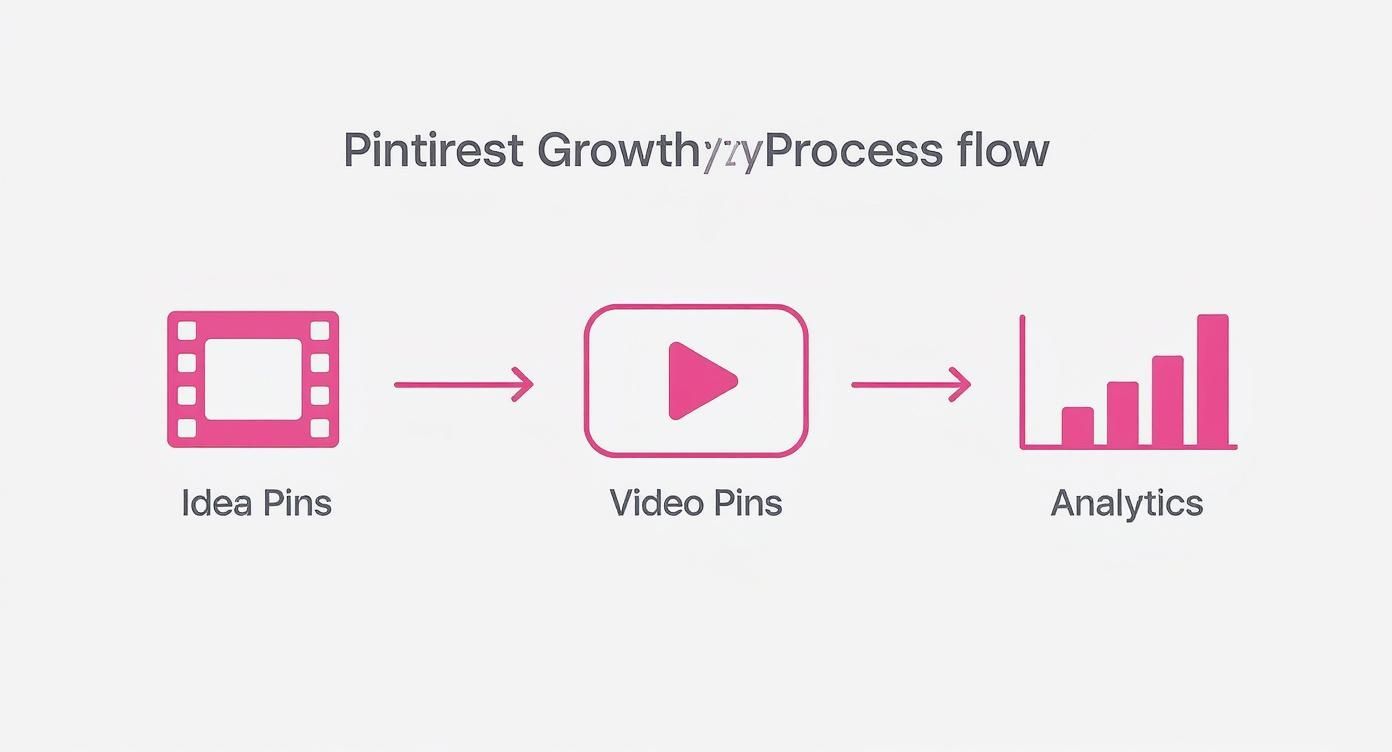
As you can see, mixing up your content formats is the first step, but the magic really happens when you analyze their performance to sharpen your future content plan.
From Data to Actionable Insights
Finding your top-performing Pins is a great start, but it’s only half the battle. The real breakthrough comes when you start asking why they performed so well.
Was it the punchy title? The specific keywords you used in the description? Maybe it was the color scheme or the style of the image itself.
Don’t just replicate your successful Pins, deconstruct them. Figure out the core elements that made them work, then build those principles into your content creation system.
That’s how you create a scalable method for getting more Pinterest followers.
Let’s say you dig into your analytics and find that your top five Pins are all step-by-step tutorials featuring bold, easy-to-read text overlays. That isn’t a coincidence; it’s a direct message from your audience.
That single insight should immediately reshape your content calendar. Your next move? Brainstorm more tutorials you can design with that same proven visual style and keyword strategy.
This data-first approach takes the guesswork out of the equation and turns your pinning efforts into a predictable growth engine.
Optimize Every Pin to Attract More Pinterest Followers
If your goal is getting Pinterest followers, every Pin you publish needs to work like a mini follow-magnet.
It’s not enough to optimize your profile once and hope for the best, your visuals, headlines, and keywords all have to reinforce why someone should follow you for more.
Use a simple, repeatable checklist as your last step before you publish so you’re not guessing.
Run each new Pin through it to double-check clarity, SEO, and click-worthiness, and you’ll start building the kind of consistent quality that turns viewers into followers.
Answering Your Top Pinterest Follower Questions
When you’re trying to grow on Pinterest, it’s easy to get bogged down with questions. Let’s clear up some of the most common ones I hear so you can focus on a strategy that actually works.
1. How Long Does It Take to Get 1000 Followers?
This is probably the number one question people ask, and the honest answer is: it varies. But for most people who stick to a solid strategy, hitting that first 1,000-follower milestone usually takes somewhere between 3 to 6 months.
Your specific niche, how often you’re pinning, and the quality of your content will all play a huge role. Instead of getting hung up on a deadline, concentrate on the daily habits that lead to growth.
If you focus on creating 1-3 fantastic, fresh pins every single day and genuinely engage with others, you’ll find those followers start to come in much faster than you’d expect.
2. Should I Create My Own Pins or Just Repin Content?
When your main goal is to get more followers, the answer is clear: you absolutely have to focus on creating your own fresh, original content.
The Pinterest algorithm loves new pins because they bring new ideas to the platform. More importantly, your original pins are what show off your brand and give people a reason to follow you.
Repinning isn’t bad, it can be a great way to round out your boards and show you’re plugged into your community. But it should never be the heart of your strategy.
Think of it like this: follow the 80/20 rule. Spend 80% of your time creating your own unique content. Use the other 20% to share great pins from others in your niche. This mix positions you as an expert while keeping your profile dynamic and valuable.
3. Do I Really Need to Run Pinterest Ads to Get Followers?
Nope, not at all. It’s a common myth that you have to pay to play on Pinterest, but you can build a massive following without spending a dime on ads. The key is to remember that Pinterest is a visual search engine.
Ads are just an accelerator; they’re not the engine itself. If you consistently publish high-quality, keyword-rich content that helps your target audience, you will grow organically.
My advice is to master your organic strategy first. Figure out which of your pins people love, and then you can think about putting a little ad spend behind them to amplify what’s already working. A strong organic foundation is what leads to real, long-term success.