
So, what does it actually mean to outsource your social media?
Think of it as bringing in a specialized team—whether it’s a dedicated agency or a seasoned freelancer—to take the reins of your brand’s presence on platforms like Instagram, Facebook, and LinkedIn.
It’s a strategic move. Instead of juggling content creation, scheduling, and community engagement yourself, you’re handing those tasks over to pros.
This frees you up to focus on running your business, knowing your digital voice is in expert hands.
What Does Outsourcing Social Media Management Mean

Let’s use an analogy. Say your business is a fantastic new restaurant.
You could try to be the head chef, the maître d’, and the server all at once. It’s possible, but you’d be spread so thin that the food, service, and atmosphere would all suffer.
Outsourcing social media management is like hiring a world-class executive chef for your kitchen. You give them the vision for your menu and access to the best ingredients (your brand identity and goals).
They then use their expertise to craft incredible dishes (engaging content) that keep your customers coming back for more.
This isn’t about just handing over your passwords and crossing your fingers. It’s a true partnership. You provide the high-level direction, and your external team handles the day-to-day execution with professional skill.
The Scope of Outsourced Services
When you start outsourcing social media management, you’re getting far more than just someone to schedule a few posts.
A good agency provides a full suite of services, giving you access to an entire marketing team for what is often a fraction of the cost of a single full-time hire.
So, what’s typically on the menu?
- Strategic Planning: Crafting a smart content strategy that’s directly tied to your business goals—whether that’s building brand awareness, driving traffic to your website, or generating leads.
- Content Creation: This is the creative engine. It includes designing eye-catching graphics, writing captions that connect, and producing short-form video that stops the scroll.
- Community Management: This is all about building relationships. It means actively engaging with your audience, responding to comments and DMs, and cultivating a positive, loyal community.
- Performance Analytics: Your team will track key metrics, figure out what’s working (and what’s not), and deliver clear, regular reports that show a real return on your investment.
In-House vs Outsourced Management
One of the biggest questions businesses face is whether to build an in-house team or outsource. An in-house person knows your brand inside and out, which is a huge plus.
On the other hand, outsourcing gives you immediate access to a deep well of specialized expertise, tools, and talent without the overhead of salaries and benefits.
The real power of outsourcing is getting a full team of specialists—a strategist, a copywriter, a graphic designer, and an analyst—who are completely immersed in social media trends every single day.
Trying to replicate that level of diverse talent with internal hires is often impossible for most small to medium-sized businesses.
To make the choice clearer, it helps to see the differences side-by-side.
In-House vs Outsourced Social Media At a Glance
This table breaks down the main differences between keeping social media management internal versus bringing in an outside partner.
| Aspect | In-House Team | Outsourced Management |
|---|---|---|
| Cost Structure | Fixed salaries, benefits, training, and software costs. | Predictable monthly retainers or project-based fees. |
| Expertise | Generalist knowledge, dependent on individual skills. | Specialized skills across multiple disciplines. |
| Scalability | Difficult and slow to scale up or down. | Flexible; can easily adjust scope based on needs. |
| Tools & Tech | Requires purchasing subscriptions to various tools. | Agency often includes access to premium tools in their fee. |
Ultimately, the choice to outsource comes down to strategy and efficiency.
It’s about deciding to trade the time, cost, and complexity of DIY management for the focused expertise and measurable results a professional team can deliver. It lets you get back to doing what you do best.
The Real-World Impact of Outsourcing Your Social Media
Let’s move past the idea that outsourcing social media is just about offloading tasks. The real value is plugging your brand directly into a high-performance engine of specialized talent and technology.
It’s a strategic move that can fundamentally change how your business grows, competes, and connects with your audience.
Think of it this way: doing social media in-house is like asking one talented musician to play every instrument in an orchestra.
They might be skilled, but they can’t master the violin, cello, and drums all at once.
Outsourcing gives you the whole orchestra—a team of specialists, each a master of their craft, working together to create something powerful for your brand.
You Get an Instant Team of Experts
When you partner with an agency, you’re not just hiring a person; you’re hiring a fully-formed team. Assembling this level of talent internally would be incredibly expensive and time-consuming.
An outsourced team typically includes:
- A Strategist: To build the high-level game plan that aligns with your actual business goals.
- A Content Creator: To design eye-catching visuals and write copy that actually connects.
- A Community Manager: To engage with your followers and build real relationships.
- A Data Analyst: To dig into the numbers, figure out what’s working, and tell the team how to improve.
This setup frees your internal team from the daily grind of content calendars and algorithm updates. They can get back to focusing on their core jobs—developing products, supporting customers, and driving sales.
And this isn’t just a niche idea. The market for outsourcing social media management is expected to jump from USD 7.26 billion in 2024 to a massive USD 22.75 billion by 2034.
That’s a compound annual growth rate of 12.1%, fueled by businesses realizing they need expert help to stand out online.
You Get Access to Premium Tools and Technology
Managing social media effectively requires more than just good ideas. It takes sophisticated tools for scheduling, listening, and analyzing performance.
Subscriptions to these platforms can easily run into thousands of dollars a year.
When you outsource, access to this high-end tech stack is usually part of the package.
Agencies have already invested in the best tools on the market, giving your brand the analytical power of a major corporation without the huge price tag.
By partnering with an agency, you’re not just hiring people. You’re getting access to an entire ecosystem of professional-grade software that delivers deeper insights and more robust reporting than you could ever get with basic tools.
It turns your social media from guesswork into a data-driven operation.
This tech advantage means your team can make smarter decisions on the fly.
They can pinpoint the best times to post, double down on content that resonates, and show you exactly how their efforts are turning into website traffic and leads.
You Get Unwavering Brand Consistency
A consistent brand voice and visual identity are crucial for building trust.
But when social media is a side-task for multiple internal employees, that consistency is often the first thing to go. Posts become sporadic, the tone shifts, and quality drops off.
Outsourcing social media management puts an end to that. You have a dedicated team whose only job is to live and breathe your brand online.
They work from a set of clear guidelines to make sure every single post, comment, and message is perfectly on-brand.
This professional, steady presence builds brand equity and strengthens your audience connection.
For any company trying to gain traction, creating a cohesive presence is non-negotiable. If you want to dig deeper, our guide on building a social media strategy for small business is a great place to start.
Ultimately, outsourcing is a strategic investment in growth. It gives your brand the agility to scale your marketing up or down, react quickly to market shifts, and execute a strategy that delivers real, measurable results.
Navigating the Potential Risks of Outsourcing

Handing over the keys to your social media kingdom can be nerve-wracking.
While bringing in an outside team can be a game-changer for growth, it’s smart to walk into it with your eyes wide open to the potential bumps in the road.
The best partnerships are built by seeing these challenges coming and having a plan in place from day one.
Most of the anxiety boils down to a few key areas: losing your brand’s voice, communication wires getting crossed, and, of course, security.
But these aren’t reasons to call it off. Think of them as hurdles you can easily clear with the right systems and expectations.
A little prep work upfront can turn potential headaches into a stronger, more transparent partnership.
Protecting Your Brand Voice and Authenticity
Your brand’s voice is its personality—it’s that unique spark that connects with your audience. The fear that an agency just won’t “get it” is completely legitimate.
One off-key post can feel jarring to your followers and chip away at the community you’ve worked so hard to build.
The solution? Create a rock-solid brand bible. And I don’t just mean a doc with your logo and hex codes. This needs to be a detailed guide to your brand’s very soul.
- Define Your Tone of Voice: Are you witty and informal? Professional and authoritative? Give them a playbook with real examples of things you’d say and, crucially, things you’d never say.
- Map Out Your Audience Personas: Who are you actually talking to? Get specific. The more your agency understands your ideal customer—their humor, their problems, their values—the better they can connect.
- Set Up a Clear Content Approval Process: Nothing should ever go live without your stamp of approval. A shared content calendar or a tool like Asana works wonders here. It gives you a space to review, tweak, and sign off on every single post before it’s scheduled.
Overcoming Communication and Time Zone Gaps
When your social media team is in a different city (or even a different country), clear communication becomes everything.
Lagging responses and misunderstood feedback can stall campaigns and lead to a whole lot of frustration.
The trick is to establish a communication rhythm right out of the gate. Don’t just wing it.
A partnership without a defined communication plan is like a ship without a rudder.
You need scheduled check-ins and clear channels to ensure everyone is rowing in the same direction, even if you’re in different time zones.
Here’s how to structure your interactions for success:
- Schedule Weekly Check-in Calls: Use this time for big-picture strategy, reviewing what’s working, and brainstorming new ideas.
- Use a Shared Communication Hub: A dedicated Slack channel or project board keeps every conversation and file in one place. No more digging through endless email threads to find that one piece of feedback.
- Define “Urgent”: Agree on what actually constitutes an emergency and the protocol for handling it. This ensures the real fires get put out immediately without crying wolf over every little thing.
Safeguarding Your Account Security
Giving an outside team access to your accounts is probably the biggest leap of faith in the whole process. Protecting your digital assets isn’t just important; it’s non-negotiable.
First rule: never share raw passwords over email or Slack. Instead, use a secure password manager like LastPass or 1Password.
These tools let you grant access to someone without ever revealing the actual password. Better yet, you can revoke their access with a single click, keeping you in complete control.
On top of that, make sure two-factor authentication (2FA) is enabled on every single account. It’s a simple step that adds a massive layer of security against unauthorized access.
Any reputable agency won’t just be okay with this; they’ll insist on it. By tackling these risks head-on, you’re building a partnership on a foundation of trust and setting everyone up for long-term success.
Choosing the Right Social Media Management Partner

Picking a social media partner is a lot like choosing a co-pilot for your brand. The right one helps you navigate turbulence and spot opportunities to get you where you want to go, faster. The wrong one?
They can send you completely off course. It’s a big decision, one that demands you look past a slick sales pitch to find a genuine strategic ally.
This isn’t just about finding someone who can post pretty pictures. You’re vetting for real expertise, a track record of results, and a cultural fit that feels like a natural extension of your team.
A great partnership is built on collaboration, not just execution.
Evaluate Their Portfolio and Industry Expertise
First things first: dig into their past work. A stunning portfolio is nice, but what you’re really hunting for is relevance and results.
Don’t get distracted by vanity metrics like follower counts. You need proof they understand your specific industry and can drive outcomes that actually matter to your bottom line.
As you review their work, ask yourself:
- Do they have experience in my niche? An agency that’s a rockstar for B2C fashion brands might not get the nuances of B2B software marketing. Look for partners who already speak your industry’s language.
- Does their work show strategic variety? A solid portfolio should showcase a range of content and campaign goals, from big-picture brand awareness to direct-response lead generation.
- Can they explain the “why” behind their work? When you talk to them, ask them to walk you through a past project. A great partner can connect the dots between their creative decisions and the strategy that drove them.
Scrutinize Case Studies for Measurable Results
Case studies are where a potential partner has to show their cards. This is how you separate the storytellers from the real strategists.
A compelling case study does more than show off cool designs; it draws a straight line from their social media activity to tangible business growth.
A case study without hard numbers is just a story. Look for concrete data that demonstrates a clear return on investment, such as increased website traffic, lead generation, or a lower customer acquisition cost.
These metrics show they understand that social media is a business tool, not just a branding exercise.
The global outsourcing market, which includes social media management, is expected to hit USD 450 billion by the end of 2025.
This boom is fueled by businesses looking for specialized skills and measurable outcomes, making it even more critical to find a partner who can truly deliver.
You can discover more insights about this trend and its impact on the Virtual Latinos blog.
Ask the Right Questions to Uncover Strategic Depth
Your initial calls are your chance to test their strategic thinking. Go beyond the surface-level questions about their process and dig into how they would tackle your specific challenges and goals.
For many businesses considering outsourcing, a crucial first step is simply understanding the hiring process itself; you can find a complete guide on how to hire a virtual assistant that offers a fantastic framework for these initial steps.
Here’s a checklist of must-ask questions to guide your conversations:
- How will you measure success for our account? Their answer should be tied to your business objectives, not just social media metrics.
- What does your onboarding process look like? A detailed, structured process is a good sign they’re organized and professional.
- How will you adapt your strategy if we aren’t seeing results? This question reveals their agility and problem-solving skills.
- Can you describe your communication and reporting cadence? You’re looking for transparency and a regular, predictable rhythm.
- Who, specifically, will be working on my account? Make sure you know the experience level of the day-to-day team, not just the sales lead.
Prioritize Cultural Fit and Collaboration
Finally, remember that you’re entering a partnership. The best agency won’t just take orders; they’ll challenge your ideas, bring new ones to the table, and act as a true collaborator.
You need to assess whether their team’s communication style and values align with your own.
A partner who gets and shares your vision will be far more invested in your success.
This cultural alignment is often the secret ingredient that turns a good agency relationship into a great one, creating a seamless extension of your team that pushes your brand forward.
Your Framework for a Seamless Onboarding Process
You’ve signed the contract and picked your partner—congratulations. But the real work is just beginning. The first 30 days are absolutely critical; they set the tone for the entire relationship.
A smooth, structured onboarding can be the difference between a frustrating, disjointed experience and a powerful collaboration that gets results right out of the gate.
Think of it like laying the foundation for a house. If you rush it or skip steps, you’re just asking for cracks to show up later.
Taking the time now to get perfectly aligned on goals, assets, and workflows means you’re building a solid base for long-term success when outsourcing social media management.
The right selection process is the first step, even before onboarding officially kicks off. The journey to finding a great partner usually follows a clear path of vetting, evaluating, and then making a final decision.
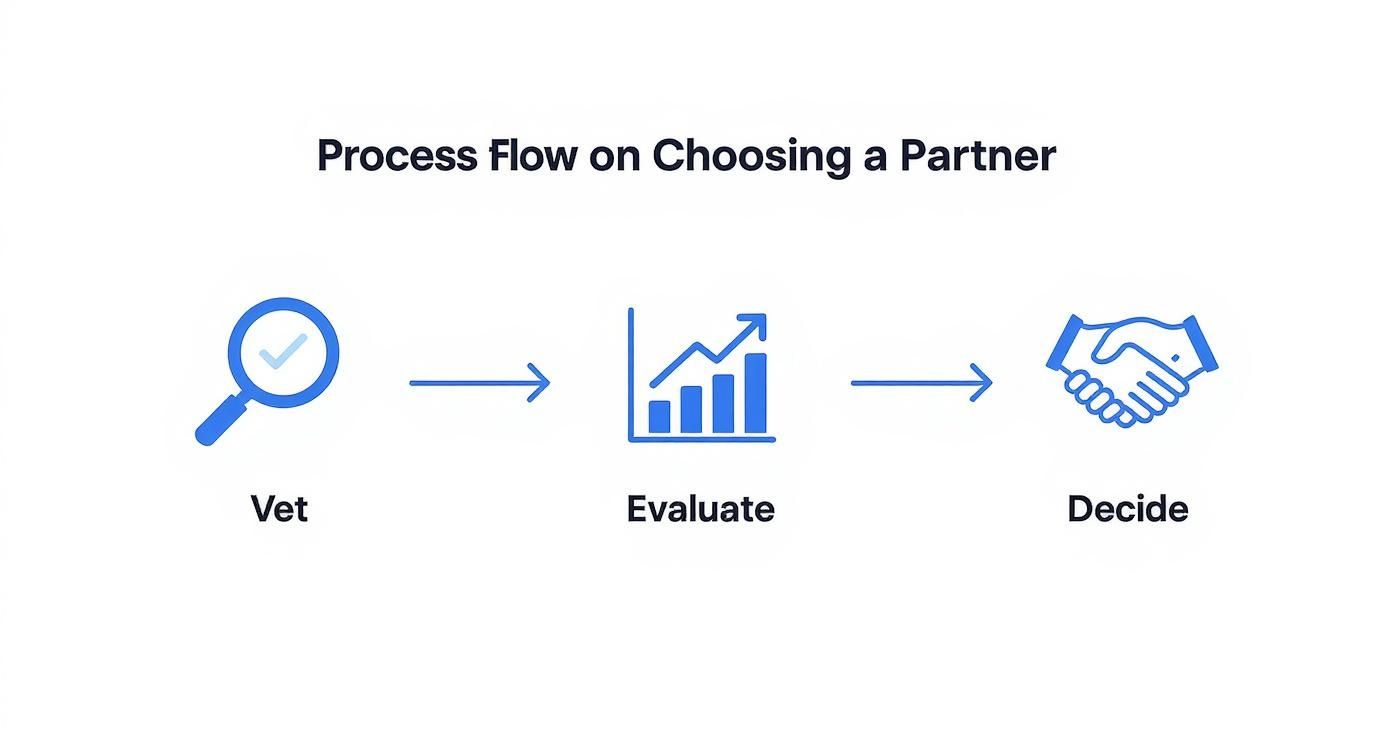
Starting with a deliberate approach like this ensures you’re already on the right foot when the partnership officially begins.
The Kickoff Meeting and Goal Alignment
That first official meeting isn’t just a meet-and-greet; it’s a deep-dive strategy session. This is where you turn your high-level business objectives into concrete, actionable social media goals.
It’s not enough to say you want “more engagement.” You need to define exactly what that looks like.
To get the most out of this meeting, be ready to talk specifics:
- Primary Business Goals: Are you trying to generate leads? Build brand awareness? Drive sales for your e-commerce store?
- Key Performance Indicators (KPIs): Agree on the hard numbers that spell success. This could be conversion rates, click-through rates (CTR), or cost per lead.
- Target Audience Deep Dive: Share everything you have on your ideal customer personas. Who are they? What do they care about?
A successful onboarding isn’t just about handing over logins. It’s about a deep transfer of knowledge.
The more your new partner understands your brand’s DNA—its history, its voice, its mission—the faster they can start creating content that feels authentic and delivers results.
Getting this alignment right from day one means both teams are rowing in the same direction. It kills the guesswork and sets you up for a strategy that’s truly driven by data.
Establishing Workflows and Communication Rhythms
Once the goals are set, it’s time to map out the day-to-day operational details. This is your chance to prevent future bottlenecks and misunderstandings by creating clear, documented processes for how you’ll work together.
You’ll want to lock in three critical workflows:
- Content Approval Process: How will you review and approve content before it’s published? A shared calendar or a project management tool is non-negotiable here. It gives you the final say without slowing the agency down. A good platform makes all the difference; you can explore the benefits of dedicated social media scheduling software to really streamline things.
- Communication Channels: Pick a primary channel for quick, daily chats (like Slack or Microsoft Teams) and set a recurring meeting (weekly or bi-weekly) for bigger strategic reviews. This keeps everyone in the loop without drowning them in emails.
- Asset and Access Handover: Get them everything they need to represent you properly. This includes logos, fonts, brand guidelines, and access to any photo or video libraries you have. When it comes to account access, use a secure password manager to grant permissions. Never just hand over raw passwords—that’s a security risk you don’t need to take.
Understanding Costs and Measuring Real ROI
When you start thinking about outsourcing your social media, one of the first questions that pops up is, “What’s this going to cost me?” It’s a fair question, and the answer isn’t always straightforward.
Prices can be all over the map, but most providers stick to a few common pricing models.
The most popular approach is a monthly retainer. Think of it like a subscription for social media expertise.
For a flat fee—often ranging from $1,000 to$ 5,000+ per month for a solid agency—you get a comprehensive, ongoing service. This is great for budgeting and building a long-term strategy.
Some providers also work on a project basis, which is perfect for a one-off campaign like a new product launch.
And then there are hourly rates, which offer flexibility if you just need some expert advice or help with a few specific tasks.
Decoding Different Pricing Models
The right model really comes down to what you’re trying to achieve. If you’re in it for the long haul and want to build your brand, a retainer is usually the best bet.
For a quick, targeted push, a project fee makes more sense.
- Monthly Retainer: Your go-to for consistent, full-service management. This builds a real strategic partnership.
- Project-Based Fee: Ideal for campaigns with a clear beginning and end. You pay for a specific, defined result.
- Hourly Rate: The most flexible option, perfect for businesses needing occasional help without a big commitment.
The real trick is to stop seeing this as just another expense. It’s an investment.
To see if it’s paying off, you need to understand how to calculate marketing ROI in a way that shows its impact on your actual business goals.
Shifting Focus from Vanity Metrics to Real Results

Likes, shares, and a growing follower count are nice, but they don’t keep the lights on. The real win from outsourcing your social media comes from its impact on your bottom line.
A good partner will look right past the surface-level stats and focus on numbers that show real business growth.
This is more important than ever. In 2025, it’s expected there will be 5.42 billion people on social media, with the average person juggling 6.83 different platforms.
That’s a ton of noise to cut through. Your investment has to do more than just add to it; it needs to deliver a return.
True ROI isn’t about popularity; it’s about profitability. The goal is to connect every dollar spent on social media directly to a measurable business outcome, proving its value far beyond the feed.
So, instead of getting hung up on vanity metrics, a skilled social media manager will track the key performance indicators (KPIs) that actually matter:
- Website Traffic: How many people are coming to your website directly from your social channels?
- Lead Generation: Is social media feeding your sales team with good, qualified leads?
- Conversion Rate: Of the visitors from social media, how many are actually buying something, signing up, or taking that next step?
- Customer Acquisition Cost (CAC): What’s the real cost to bring in a new customer through your social media efforts?
By keeping an eye on these KPIs, you can turn your social media from a fuzzy marketing activity into a predictable revenue generator.
Our guide on how to measure ROI on social media breaks down how to do this. This data-first approach is what makes outsourcing a genuinely smart move.
Write clearer briefs before you outsource
If you want outsourcing to work, your partner needs more than logins and a vague “post consistently.”
They need a clear point of view: what you sell, who you’re talking to, what your brand sounds like, and what success looks like.
When that direction is missing, the results feel generic—wrong tone, weak content, and a calendar that doesn’t move the needle.
Start with a simple foundation you can hand to any freelancer or agency:
Define your brand voice in a few lines (tone, words you use, words you avoid). List your 3–5 content pillars (what you want to be known for).
Add a basic offer map (what you want people to do next). Then outline a weekly rhythm (education, proof, engagement, promotion) so your social doesn’t depend on inspiration.
My free tool makes this faster. Pinterest GPTs can help you draft a brand voice guide, generate content pillar ideas, and turn your offer into weekly post prompts you can approve and delegate—so outsourcing becomes smoother and results come quicker.
Ready to make outsourcing easier (and more effective)?
Frequently Asked Questions
Even with a solid plan, handing over the reins to your social media can bring up a few last-minute questions. It’s totally normal.
Let’s tackle some of the most common concerns we hear so you can move forward with confidence.
Here are some straight-up answers to the questions that are probably on your mind.
How Much Control Do I Actually Keep?
This is a big one, and the answer is simple: you keep as much control as you want. You always own your accounts, period.
Think of it this way: you’re the director of the movie, and the agency is your expert film crew. You set the vision; they handle the cameras and lighting to make it happen.
A good agency won’t just take over. They’ll work with you. You’ll typically have the final say on the overall strategy and approve things like content calendars before anything ever gets posted.
This keeps you in the driver’s seat and ensures everything they create feels authentic to your brand.
Isn’t Outsourcing Social Media Super Expensive?
It’s a common myth that outsourcing is only for big companies with deep pockets. The truth is, it’s often more budget-friendly than hiring someone in-house.
Just think about the real cost of a full-time employee: salary, benefits, training, plus all the expensive software subscriptions they’ll need. It adds up fast.
When you partner with an agency, you’re not just getting one person. You get access to a whole team—a strategist, a copywriter, a designer, an analyst—all for a single, predictable monthly fee.
This approach eliminates all that overhead and gives you a much better return on your investment right from the start.
How Fast Can I Expect to See Results?
Social media is a long game, not a sprint. While you might see a quick bump in likes or followers, the results that actually move the needle for your business—like quality leads, web traffic, and sales—take time to develop.
Realistically, a solid strategy needs about 3 to 6 months to build momentum and deliver a meaningful return. Be wary of any agency that promises you the moon overnight.
A trustworthy partner will set clear, honest expectations from day one and show you exactly how they’re tracking progress toward your goals with regular, easy-to-understand reports.