Right, let’s get this settled once and for all. Is Pinterest a social media platform? Yes, it absolutely is.
But here’s the catch: it doesn’t play by the same rules as networks like Facebook or Instagram.
Think of it less as a place to post photos of what you did last weekend and more as a visual discovery tool for everything you want to do in the future.
It’s this unique blend of social connection and personal search that makes it such a different beast.
A Social Platform in Disguise

At its heart, Pinterest is a massive, worldwide scrapbook. Millions of people come to find, save, and share ideas for just about anything you can imagine.
Where Instagram is all about sharing personal moments (“Here’s the amazing brunch I just had”), Pinterest is focused on future plans (“Here are the brunch recipes I want to try”).
That subtle but powerful shift in user intent is the very reason so many people get tripped up on whether it’s “social media” or not.
But when you look closer, it checks all the boxes. Users create profiles, they “Pin” content, they follow other people and specific Boards, and they can comment and Repin things they like.
All these actions weave together a network built on shared interests and future dreams, whether it’s planning a kitchen remodel or mapping out a dream vacation.
To get a real sense of where Pinterest fits in, it’s helpful to break down its features. It has one foot firmly in the social media world and the other in the world of search engines.
Pinterest at a Glance: Social vs. Search
| Feature | Social Media Trait | Search Engine Trait |
|---|---|---|
| Content | User-generated Pins and Boards | Visually indexed and keyword-searchable |
| Interaction | Following, commenting, Repinning | Saving (Pinning) content for future reference |
| Discovery | Following-based home feed | Keyword-based search and recommendations |
| User Intent | Connecting with others, sharing | Planning, discovering, and collecting ideas |
| Lifespan | Content is often fleeting (like Stories) | Content is evergreen; old Pins can resurface |
This table really drives home the point: Pinterest isn’t one or the other; it’s a powerful combination of both.
Pinterest vs. Instagram by the Numbers
Let’s look at how Pinterest stacks up against a classic social network like Instagram. The differences in how people use them are striking.
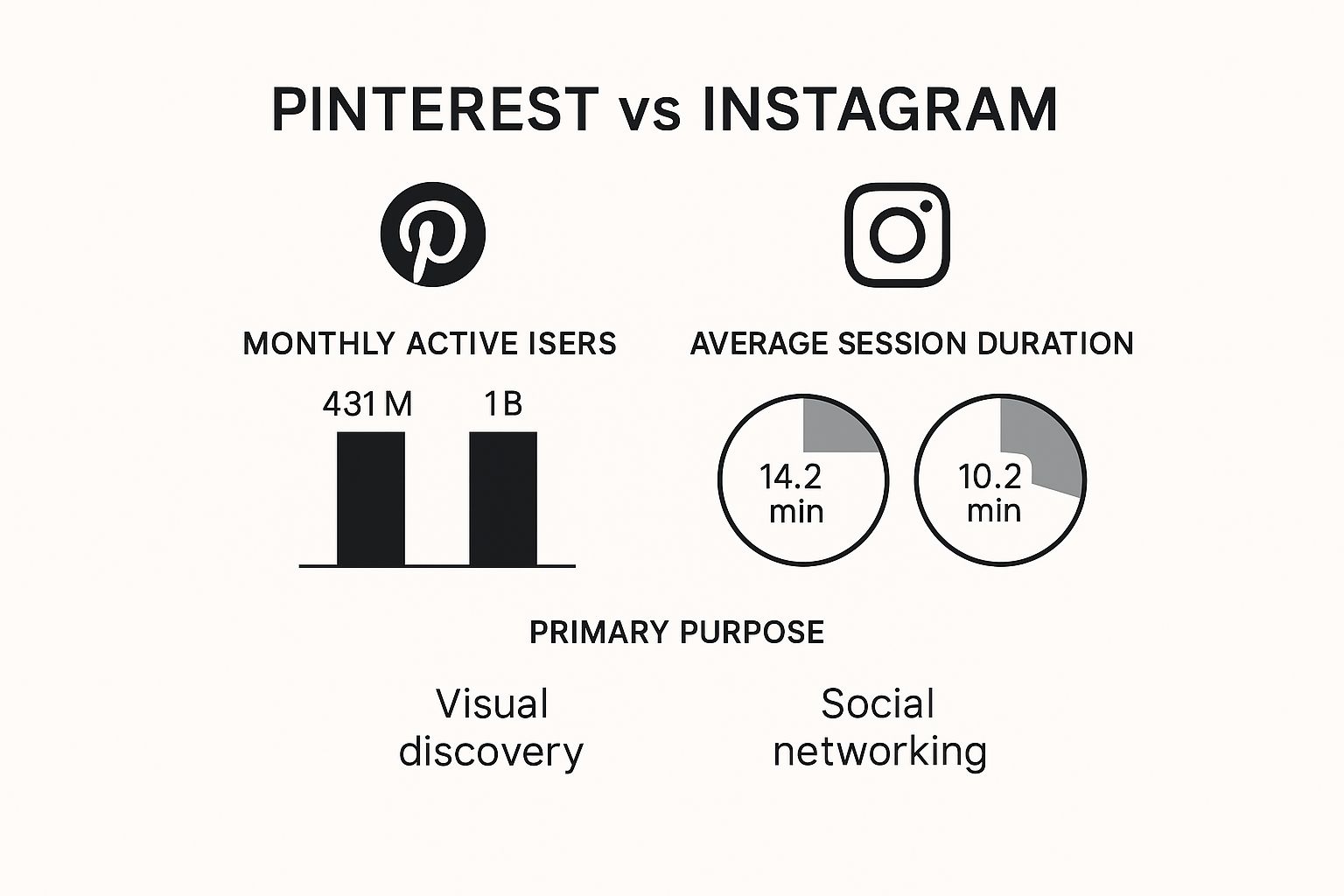
The numbers tell a clear story. While Instagram may have more users, people on Pinterest are often more engaged in longer, more focused sessions.
They aren’t just scrolling; they’re actively planning and researching.
Why This Classification Matters
So, who cares if it’s a social network or a search engine? Well, if you’re a marketer—or even just trying to get your ideas seen—this distinction is everything.
Its social side helps build community and encourages sharing. At the same time, its search function gives your content an incredibly long shelf life.
A great Pin can continue to drive traffic and engagement for months, even years, long after a tweet has been buried.
The most important thing to grasp is that Pinterest is all about the future. People are on the platform actively looking for solutions and inspiration for things they intend to buy or do.
This makes them incredibly open to brands that can help them achieve those goals.
Getting your head around this hybrid model is the first step. Success on Pinterest isn’t just about posting pretty pictures; it’s about becoming a go-to resource for people as they plan the next chapter of their lives.
What Actually Makes a Platform “Social Media”?
Before we can answer the big question—”is Pinterest social media?”—we need to get on the same page about what that term actually means.
The phrase gets tossed around a lot, often slapped onto any app or website with a bit of a following. But real social media platforms are built on a few core, non-negotiable principles.
Think of it like baking a cake. You need flour, sugar, and eggs. Miss one of those key ingredients, and you might end up with a cookie or a pancake, but it’s definitely not a cake.
It’s the same with social media. Without a specific set of foundational features, a platform is something else entirely—maybe a content library or a simple messaging app.
The first and most important ingredient is user-generated content. This is the heart and soul of any social platform.
The entire experience revolves around what users—not the company—create and share.
Your Instagram feed is a perfect example; it’s a living tapestry of photos from your friends, family, and favorite creators, not just official posts from Instagram HQ.
The Pillars of Social Interaction
Beyond a sea of user-generated content, a few other elements are crucial for a platform to truly earn the “social” label.
These features are what turn a static website into a dynamic, living community where people don’t just consume information—they interact with it, and with each other.
So, what are these essential components?
- User Profiles: Everyone gets their own unique space. This profile is your digital identity on the platform, a home base for your content, personal details, and the connections you’ve made.
- Network Connections: You have to be able to connect with other people. This looks different depending on the platform—you might “friend” someone on Facebook, “follow” them on X (formerly Twitter), or add them to your professional network on LinkedIn. These connections are what build your personalized corner of the internet.
- Interactive Engagement: This is where the magic happens. A social platform needs tools that let you react and respond. We’re talking about likes, comments, shares, and direct messages. These actions are the building blocks of conversation and community.
Without these features, you’re just looking at a broadcast medium. A news website has plenty of content, but it typically lacks the profiles and networking tools that create a two-way street. It’s designed for you to read, not to participate.
The real difference-maker is the shift from passive consumption to active participation.
Social media turns a quiet audience into a bustling community of creators and communicators who actively shape the platform’s culture.
This framework—user-generated content, profiles, connections, and interaction—gives us a solid checklist.
Now, we can hold Pinterest up to this standard and see how it measures up. Does it have all the right ingredients?
And if it does, how does it mix them differently than a platform like Facebook or Instagram? Let’s dive in and find out.
How Pinterest’s Features Make It a Social Media Platform
So, when we measure Pinterest against our social media checklist, how does it stack up?
It doesn’t just meet the criteria; it often redefines them in its own unique, visual-first way.
Let’s dig into how its features absolutely confirm its status as a social media powerhouse.
The Building Blocks of a Social Network
At its core, every user gets a profile. This isn’t just a name and a picture; it’s your personal corner of the internet, a hub that showcases who you are and what inspires you.
Your profile is where all your Pins and Boards live, creating a public portfolio of your ideas.
This naturally flows into the heart of any social platform: user-generated content. On Pinterest, we call these “Pins.”
Every time you save an image from a blog or upload a video of your latest project, you’re contributing to a massive, ever-growing library of ideas.
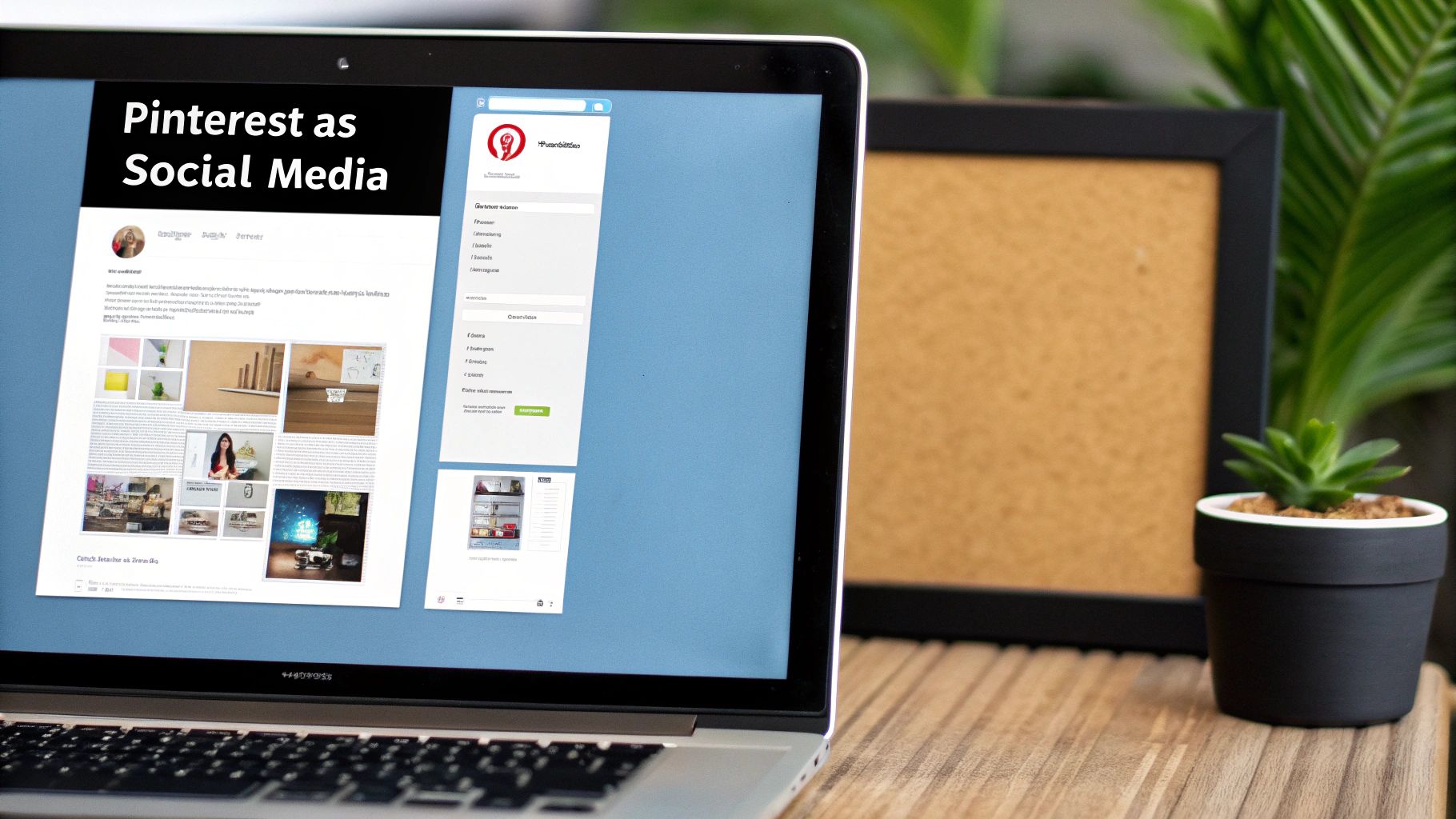
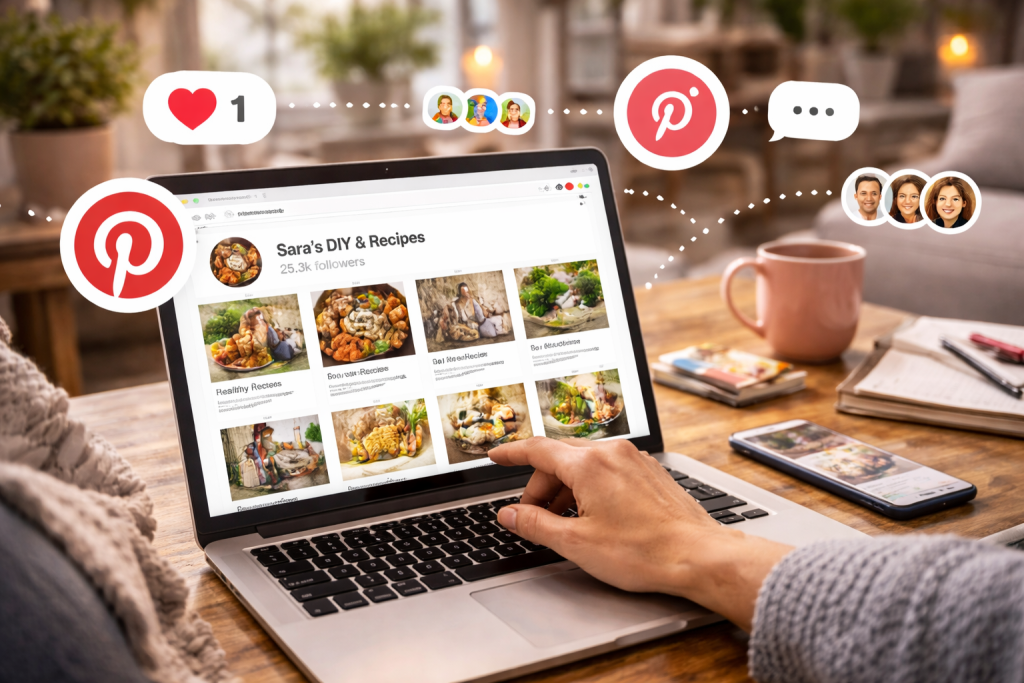
This feed is a perfect example. It’s not curated by a central editor; it’s a dynamic mosaic of user-generated content, with every Pin representing a potential connection point.
It’s All About Connections and Community
Where Pinterest really differentiates itself is in how connections are formed. It’s less about who you know in real life and more about what you love.
You follow other users or specific boards that catch your eye, which curates a feed tailored to your interests.
You might follow a home chef from another continent or a design agency from a city you’ve never visited, all based on a shared passion.
The social mechanics are woven right into the experience. You can:
- Comment: Ask a question about a recipe or share a tip on a DIY project.
- Repin: This is Pinterest’s version of a “share.” When you save someone else’s Pin to your own board, you’re not just bookmarking it—you’re amplifying it to your own network.
- Create Collaborative Boards: This is where the magic really happens. You can invite friends, family, or colleagues to a shared board to plan a wedding, brainstorm a marketing campaign, or just gather dinner ideas.
The whole system is built for interaction, even if it feels more discovery-based than conversational.
The most powerful Pins tell a story, and understanding the core principles behind visual storytelling strategies on social media can make a huge difference in creating content that resonates and gets shared.
A Social Ecosystem, Not Just a Digital Corkboard
If you still think of Pinterest as just a solo scrapbooking tool, the numbers might surprise you. Users have created over 500 billion Pins across more than 10 billion boards.
That’s a staggering amount of shared content.
Every Pin and every Board is a social object. Each time someone saves a Pin, they’re essentially upvoting that idea, sharing it with their followers, and telling the Pinterest algorithm, “this is valuable.”
These collections, or Boards, are what give Pinterest its structure. They let you organize your thoughts and inspirations into neat categories, making everything easy to find and share later on.
To get a better handle on this key feature, you can read our guide that explains in detail what are Pinterest Boards.
From user profiles and endless streams of user-generated content to follows, comments, and collaborative features, Pinterest doesn’t just check a few boxes—it embodies what it means to be a modern social media platform.
The Social Side of Pinterest User Behavior
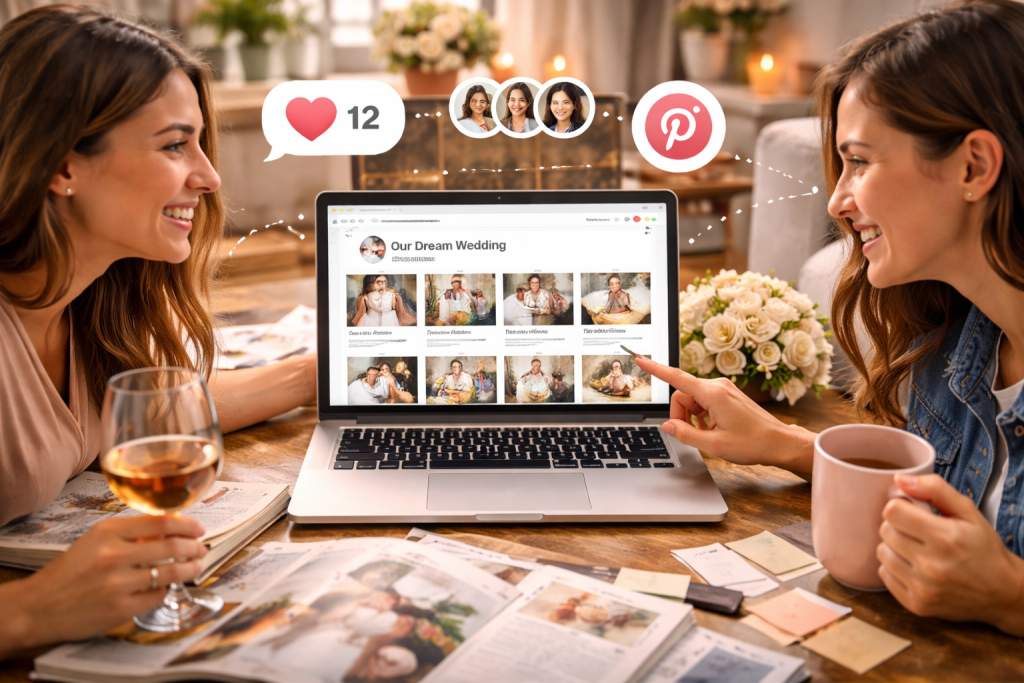
The features give us the blueprint, but how people actually use Pinterest tells the real story. When you look closely at user behavior, you start to see social dynamics that are much deeper than just simple bookmarking.
It’s a place where a personal “aha!” moment quickly becomes a shared source of inspiration.
People aren’t just hoarding ideas for themselves. They’re creating collaborative boards to plan a wedding with the bridal party, map out a home renovation with a partner, or swap recipes with friends.
This is a fundamentally social activity, but it’s all about future plans, not documenting what happened yesterday.
This forward-looking behavior is exactly why Pinterest lands in the social media category, even if it doesn’t feel like other networks. It’s less about “Look what I did” and much more about “Look what we could do.”
From Personal Planning to Community Curation
The social heartbeat of Pinterest isn’t always as loud as a comment thread on an Instagram post. It’s often more subtle, woven right into the way ideas travel across the platform.
Every single time someone saves a Pin to one of their boards, they’re performing a social action.
That simple click signals value—both to their followers and to the Pinterest algorithm—which helps great ideas reach an even bigger audience.
Think of it as a massive, ongoing brainstorming session where the best concepts get passed around and built upon.
Someone might follow an interior designer for a spark of inspiration, and that designer’s Pins end up getting shared and re-shared by thousands of others, creating this huge, interconnected web of shared taste.
Statistically, this behavior lines up perfectly with social media norms. On average, users spend about 14 minutes per day on the platform.
While that might not sound like a lot, it fits the discovery-focused nature of the app.
More telling is the fact that a staggering 80% of weekly Pinners have found a new brand or product there, highlighting its massive influence on what people decide to buy.
You can dig into more of these social media demographics on Sprout Social.
The act of Pinning is inherently social. It’s a vote of confidence in an idea, a recommendation to one’s network, and a contribution to a collective pool of inspiration.
The Social Proof of User Engagement
While you can send direct messages and leave comments, the real social currency on Pinterest is the Pin itself.
The simple visibility of what a person saves and how they organize it creates a kind of passive social interaction.
You can get a pretty good read on someone’s goals, tastes, and interests just by looking through their boards.
If you’re curious about just how much others can see, we have a guide that breaks down whether you can see who views your Pinterest profile and Pins.
Ultimately, this transparency is what powers the platform’s social engine. People follow each other not just for who they are, but for the future they are actively planning.
It’s this unique, aspiration-driven connection that truly cements Pinterest’s place in the social media world.
How Pinterest Breaks the Social Media Mold
Sure, Pinterest has all the familiar social features—profiles, followers, comments. But if you’ve spent any time on the platform, you know it just feels different.
The real distinction isn’t in the features; it’s in why people are there in the first place.
Think about it. Platforms like Facebook and Instagram are all about the present and the past.
People share what they’re doing right now or what just happened on their vacation. Pinterest, on the other hand, is almost entirely about the future.
It’s a place for planning and dreaming. Users aren’t there to show off their lives; they’re there to organize ideas for the life they want.
This is why Pinterest often feels less like a social hangout and more like a powerful visual discovery engine—a tool for collecting inspiration, not just broadcasting your day.
Discovery Over Dialogue
This future-facing mindset changes everything about how the platform operates. On most social media, the algorithm is obsessed with what’s new.
It pushes the most recent posts and real-time conversations to the top of your feed. Pinterest’s algorithm, however, thinks more like a search engine.
It cares more about helping you discover relevant, high-quality ideas, no matter when they were first Pinned.
A brilliant home renovation idea from three years ago can easily show up at the top of your search results today if it’s a good fit.
This gives content an incredibly long shelf life, turning every Pin into a lasting asset, not just a momentary update that disappears in a day.
It’s no surprise that Pinterest itself has often shied away from the “social media” label.
They position the platform as a space for personal discovery, where the primary goal is finding things for yourself, not performing for an audience.
At its core, Pinterest is a search engine for ideas curated by millions of people. The social connections are a byproduct of shared inspiration, not the main event.
A Hybrid with Growing Social Muscle
Even with its search engine DNA, you can’t ignore Pinterest’s massive social influence, especially in key markets.
In the U.S., for instance, about 35% of adults use the platform, ranking it as the fourth most popular social network for the 18-65 crowd.
And it’s getting younger. Gen Z now makes up 42% of its audience, with their searches on the platform jumping 30% year over year.
This demographic is also ready to buy; they are 30% more likely to make online purchases through Pinterest.
For a deeper dive into these numbers, check out the latest social media statistics on Hootsuite’s blog.
This mix of search and social is what makes Pinterest so unique. People find ideas with search-like intent but interact with them using familiar social tools like Repinning and creating collaborative boards.
It’s this hybrid identity that makes it a bit tricky to define but incredibly powerful when you know how to use it.
Pinterest breaks the mold by putting personal inspiration first, creating a space that’s both intensely personal and widely collaborative.
Why This Distinction Matters for Your Marketing

Figuring out that Pinterest is a social media platform built around a search engine isn’t just a neat little trivia point—it’s the absolute key to unlocking its power as a marketing tool.
If you treat it just like Facebook or Instagram, you’re going to miss the boat entirely. Why? Because the mindset of a user is completely different.
Think about it. When someone is scrolling through their Instagram feed, they’re usually just killing time, passively looking at what their friends are up to. But when they’re on Pinterest, they’re in active planning mode.
They are looking for ideas, hunting for solutions, and, most importantly, searching for products to buy. This crucial difference means your content strategy has to serve two masters: social discovery and active search.
A Hybrid Strategy for a Hybrid Platform
So, your marketing approach really needs to be two-pronged.
First, think of your Pins as a long-term SEO play. You need to sprinkle relevant keywords throughout your Pin descriptions, titles, and even on your boards.
This is what helps your content show up in search results for months—sometimes even years—down the line, attracting people who are ready to make a purchase.
Second, don’t forget the “social” part of the equation. Lean into the community aspect. You can create collaborative boards, respond to comments, and encourage engagement.
The social proof that comes from Repins and saves signals to the Pinterest algorithm that your content is high-quality, which in turn boosts its visibility.
Knowing how brands use different platforms is essential, especially when you start incorporating powerful tactics like user-generated content marketing.
By combining smart SEO practices with genuine community engagement, you create a powerful flywheel.
Search brings new people to your content, and the social signals then amplify its reach across the entire platform.
Actionable Takeaways for Your Pinterest Plan
To get the ball rolling, you need to focus on creating content that is both easy to find and impossible not to share.
- Optimize for Search: Use clear, keyword-rich titles and descriptions. Put yourself in your customer’s shoes: what terms are they typing into that search bar? Create Pins that directly answer their questions.
- Encourage Social Sharing: This is a visual platform, so make your Pins pop. Design eye-catching, vertical images that people instinctively want to save to their own boards. A great visual is your single best tool for earning those valuable Repins.
- Build a Foundation: To really tap into all the marketing features Pinterest offers, you’ll need a proper business profile. We’ve got a simple guide that shows you exactly how to create a Pinterest business account step-by-step.
Stop Treating Pinterest Like Instagram—Start Using It Like a Search Engine
Pinterest is social media, but it rewards search behavior more than real-time posting.
That means your growth comes from showing up for the right keywords—so your Pins get discovered weeks (and months) after you publish.
Use our free Pinterest Keyword Research tool to uncover what people are actually typing, build better board + Pin titles faster, and write descriptions that earn saves and clicks.
Once your keywords are set, everything in this post becomes easier to apply—and easier to repeat every week.
Got Questions? We’ve Got Answers.
Let’s clear up a few common questions people have about Pinterest. Think of this as a quick-reference guide to help everything we’ve talked about really sink in.
So, What’s the Big Idea Behind Pinterest?
At its heart, Pinterest is all about visual discovery and inspiration. People don’t hop on Pinterest to broadcast what they had for breakfast; they come to find and save ideas for the future.
Imagine it as a massive, interactive mood board for your life. Whether you’re planning a wedding, a kitchen remodel, or a new marketing campaign, it’s a place to collect and organize visual ideas.
While you can connect with others, its real job is to be a personalized search engine for your dreams and projects.
Can Businesses Actually Get Results from Pinterest?
You bet. Pinterest is a powerhouse for marketing, especially if your business is visually driven. Think retail, home decor, food, fashion, and travel.
Users are in a “discovery” mode, actively hunting for ideas and products, which makes them incredibly open to brand content.
Here’s the secret sauce: the long lifespan of a Pin. A Facebook post is old news in a few hours, but a solid Pin can keep sending traffic and generating sales for months—sometimes even years.
It’s a fantastic way to meet customers right at the beginning of their buying journey.
How Is Pinterest Not Just Another Instagram?
It all comes down to why people use it. Instagram is about the “now.” It’s a “look at what I’m doing” or “look at what I just did” platform, centered on sharing personal moments.
Pinterest is the complete opposite; it’s all about the “next.” It’s a “look at what I want to do” platform. The content is geared toward future plans and inspiration, not real-time life updates.
This is why Pins are saved and revisited, giving them a much longer shelf life than an Instagram post that’s gone from the feed in a flash.