
Repurposing content is all about taking one great piece you’ve created and smartly spinning it into multiple new formats.
Think of it this way: that one killer blog post doesn’t have to just be a blog post. It could be a snappy video, a viral social media thread, an eye-catching infographic, or even an audio clip.
It’s not about copy-pasting; it’s about reimagining your best ideas to give them a longer life and a much broader reach.
Why Repurposing Content Is a Non-Negotiable Strategy

Sure, the most obvious win with repurposing is saving time, and that’s definitely a perk. But if you stop there, you’re missing the bigger picture.
The real magic happens when you treat repurposing as a core part of your marketing strategy, not just a shortcut.
At its heart, this approach is about meeting your audience where they actually hang out. Let’s be real: not everyone is going to sit down and read your 2,000-word deep dive.
Some people would rather watch a 60-second video on TikTok. Others tune into podcasts on their morning commute, and a whole other group prefers to swipe through a visual carousel on LinkedIn.
By adapting one core idea for all these different platforms, you give it so many more chances to connect with the right people.
Amplify Your Message and Brand Voice
If you want to build a strong brand, consistency is everything. When you repurpose content, you’re not just reusing an idea—you’re reinforcing your core message over and over again.
It builds a cohesive brand identity that people start to recognize and trust.
You’ve probably heard of the old marketing “Rule of Seven,” which says someone needs to see or hear your message at least seven times before they’ll even think about taking action.
Repurposing makes that happen without you having to constantly reinvent the wheel.
It also helps you completely own the conversation around your key topics. By pushing out different versions of your expert content across various channels, you start to build serious authority.
The more high-quality content you have out there in different formats, the more you become the go-to resource in your space.
Repurposing content isn’t about being lazy; it’s about being strategic. It ensures your most valuable insights reach the largest possible audience, regardless of how they prefer to consume information.
Fuel Your SEO and Marketing Funnel
From an SEO standpoint, repurposing is a goldmine. You’re essentially creating a web of interconnected assets that can all rank for your target keywords.
A single blog post can become a YouTube video, a Pinterest infographic, and a LinkedIn article, with each one linking back to your site and sending strong signals to search engines.
For a deeper dive, there are many proven content repurposing strategy techniques that highlight these benefits.
This multi-format approach also strengthens your brand messaging, ensuring everything feels consistent no matter where someone finds you.
Ultimately, it’s a powerful way to scale your content marketing efforts. When you distribute keyword-rich content across blogs, videos, and social media, you’re not just boosting search rankings; you’re making your brand more discoverable everywhere.
You can read more about how this is a key driver for brand growth here: https://www.postpaddle.com/blog/how-to-scale-content-marketing.
Finding Your Golden Nuggets for Repurposing

Let’s be honest, not every piece of content you’ve ever created deserves a second life. The real magic in content repurposing comes from being selective.
You want to pour your energy into the proven winners—the content that already resonates with your audience. This isn’t about guesswork; it’s about digging into your data like a prospector searching for gold.
Forget about vanity metrics. Raw page views can be misleading and don’t paint the full picture. We need to look deeper for metrics that scream value and engagement.
Think of yourself as a detective, piecing together clues to find which content is ready for its next big break.
Identifying Your Evergreen Performers
First things first, jump into your analytics. Whether you use Google Analytics or your website’s built-in dashboard, you’re hunting for content that performs well consistently over time, not just the pieces that saw a one-time traffic spike.
We’re looking for your “evergreen” assets, the ones that stay relevant month after month.
Keep an eye out for posts and pages with these characteristics:
- High Organic Traffic: Which articles are your steady workhorses, reliably pulling in visitors from search engines? This is a huge indicator of SEO strength and audience interest.
- Significant Time on Page: If people are sticking around for several minutes, you know you’ve got something good. It means the content is captivating and thorough.
- Low Bounce Rate: A low bounce rate is a great sign. It tells you that visitors landed, found exactly what they needed, and felt encouraged to see what else you have to offer.
This initial sweep will help you create a shortlist of your most valuable content. These are your top candidates for repurposing.
Gauging Audience Connection and Authority
Next, it’s time to look for direct proof of audience love and industry respect. These signals show that your content isn’t just being seen—it’s actually making an impact.
Tools like Ahrefs or Semrush are fantastic for this, but you can also find plenty of clues right in your social media and email platform analytics.
Pay close attention to:
- Backlinks: Which posts have other reputable sites linked to? A backlink is basically a vote of confidence, showing that others view your content as a go-to resource.
- Social Shares and Comments: When a piece gets a ton of shares and comments, it means the topic hit a nerve and sparked a real conversation.
- Conversion Rates: Does a specific article consistently lead to newsletter sign-ups or sales inquiries? That piece is clearly motivating people to take action.
By focusing on content that already excels in traffic, engagement, and authority, you remove the guesswork. You’re not just hoping the repurposed piece will succeed; you’re betting on a proven winner.
To keep everything straight, I personally use a simple “Repurposing Pipeline” spreadsheet. I create columns for the original URL, its key stats (traffic, backlinks, shares), and a few ideas for new formats (like video, infographic, or Twitter thread).
This simple system turns a pile of data into a clear, actionable roadmap, making it easy to decide which blog post should become your next viral video.
Matching Your Content to the Right New Format
You’ve sifted through your content and found the gold—those high-performing pieces your audience already loves.
Now for the fun part: figuring out what they’ll become next. This isn’t about just randomly picking a new format.
It’s a strategic choice, one that hinges on understanding the culture of each platform and what your audience expects to see there.
You have to start thinking like a multi-format producer. That dense, data-heavy blog post you wrote? It’s practically begging to become a series of clean, compelling infographics.
Those are perfect for Pinterest and LinkedIn, where people are scrolling fast and visuals grab their attention.
Or that long, insightful interview you published? The conversational back-and-forth is already structured like a podcast episode.
Aligning Format with Platform Culture
Every social media platform has its own vibe, its own unwritten rules. What works on the polished, professional feeds of LinkedIn would fall completely flat on the chaotic, trend-driven world of TikTok.
The trick is to make your repurposed content feel like it was born on that platform, not just dropped there.
Think about it this way: a deep-dive case study might be a home run as a long-form LinkedIn article. But for Instagram, you’d need to slice it up.
A visually punchy carousel post pulling out key stats and powerful customer quotes for each slide would be the way to go.
This is where understanding engagement patterns becomes so important. The data doesn’t lie.
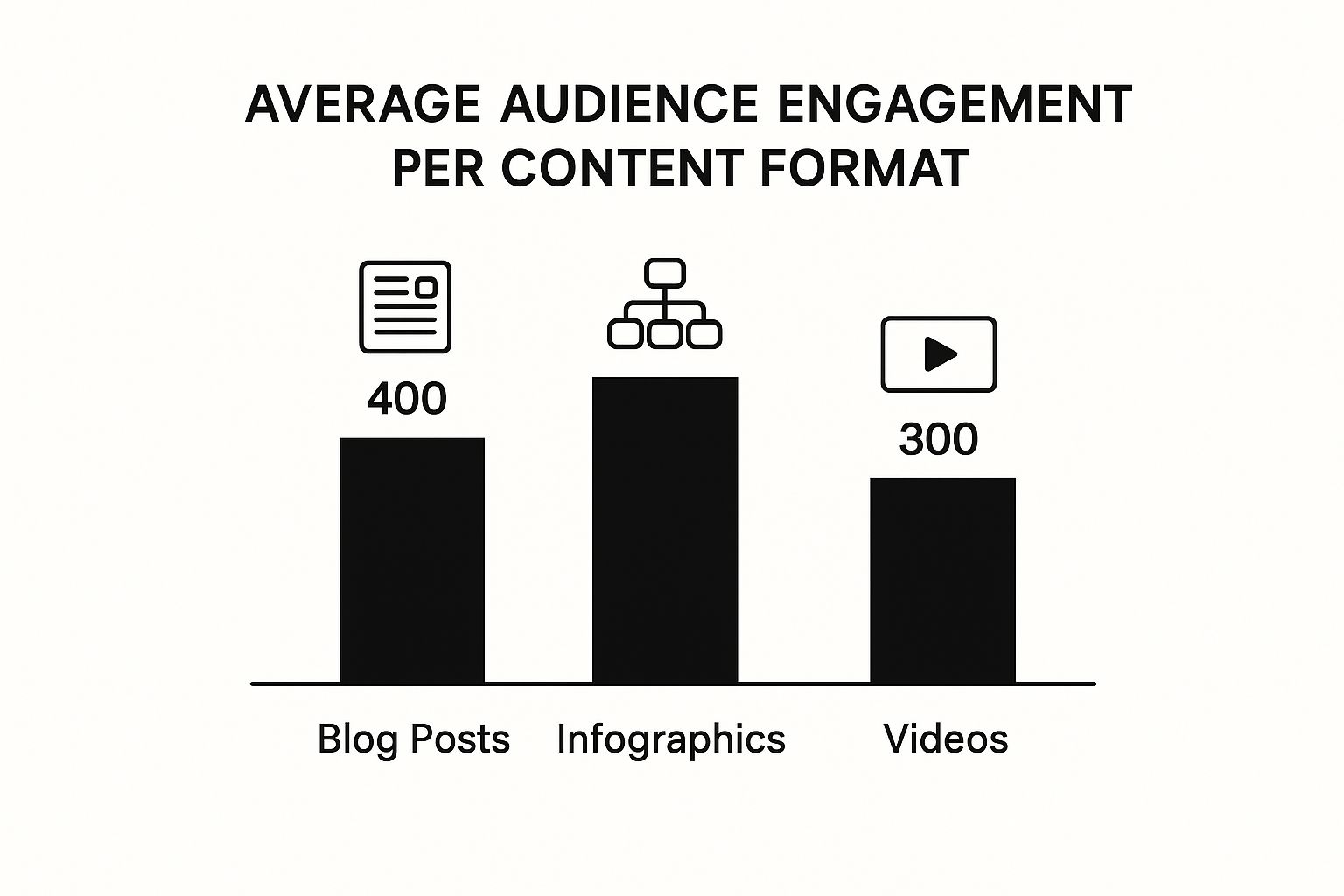
As you can see, visual formats often drive more interaction than plain text. This reinforces the idea that turning a text-heavy article into something like an infographic is a smart move for boosting engagement.
From a Single Piece to a Content Ecosystem
The best way to do this is to stop thinking about a single asset and start thinking about a content ecosystem.
How can one core idea splinter into a dozen different formats that all support each other? Each new piece should offer value on its own while also subtly guiding people back to the original, more in-depth content.
Here are a few real-world examples to get your wheels turning:
- You Have: A comprehensive “how-to” blog post.
- Turn It Into: A step-by-step video tutorial for YouTube, a printable checklist graphic for Pinterest, and a thread of quick tips for X.
- Turn It Into: A step-by-step video tutorial for YouTube, a printable checklist graphic for Pinterest, and a thread of quick tips for X.
- You Have: A customer success story.
- Turn It Into: A short video testimonial for your homepage, a powerful quote graphic for Instagram, and a downloadable PDF case study to capture leads.
- Turn It Into: A short video testimonial for your homepage, a powerful quote graphic for Instagram, and a downloadable PDF case study to capture leads.
- You Have: A data-rich industry report.
- Turn It Into: A live webinar to discuss the findings, an infographic breaking down the key stats, and a series of LinkedIn posts, each highlighting one surprising insight.
Choosing the right format is half the battle. This quick guide can help you match your original content’s strengths to the formats where it’s most likely to shine.
Content Repurposing Format Matching Guide
| Original Content Type | Key Strength | Best Repurposed Formats | Why It Works |
|---|---|---|---|
| Blog Post / Article | In-depth information, structured text | Infographics, Video Scripts, Podcast Episodes, X Threads | Extracts key points for visual or audio consumption, making complex info easy to digest. |
| Webinar / Presentation | Visuals + Audio, Expert Commentary | Blog Posts, Short Video Clips, Quote Graphics | The transcript becomes a detailed article, while key moments can be clipped for social media. |
| Podcast Episode | Conversational, Audio-focused | Audiograms for Social, Blog Post Summaries, Quote Graphics | Turns audio into visual, shareable snippets and makes key takeaways scannable in text form. |
| Case Study / Report | Data, Evidence, Credibility | Infographics, Testimonial Videos, LinkedIn Articles | Visualizes compelling data and humanizes the success story for different audiences. |
By thinking through these pairings, you can create a content plan that feels cohesive and works much harder for you.
Don’t just copy and paste. The art of repurposing is in the translation. Ask yourself: “How would the audience on this specific platform want to consume this information?”
This act of translation is what separates great repurposing from lazy content sharing.
For a great deep-dive on this, check out these strategies for turning PowerPoints into notes, which show the thought process behind adapting one format to another.
When you strategically choose the right home for your content, you give your best ideas more chances to find the right people.
The Art of Adapting Your Content
This is where the magic really happens. Repurposing isn’t just about transferring your content from one place to another; it’s about a complete transformation. Slapping a blog post onto LinkedIn and calling it a day just doesn’t work anymore.
For this to be successful, every new piece you create has to feel like it was born on that platform. It needs to offer real value all on its own.
The goal is to adapt your core message so effectively that even someone who read your original 2,000-word article will still find your new Twitter thread fresh and engaging.
Breaking It Down for Maximum Impact
Think of your original, long-form content as a big block of marble. Your job is to chip away at it, carving out smaller, perfectly formed sculptures.
This means you need to pull apart your core asset and identify its most valuable components.
A single, in-depth blog post is a goldmine of potential micro-content. You can easily pull out things like:
- Key Statistics: Find the most surprising numbers and turn them into bold, shareable graphics for Instagram or LinkedIn.
- Actionable Tips: Each major tip or “how-to” step in your guide can become its own slide in an Instagram carousel or a quick point in a video script.
- Powerful Quotes: Lift insightful sentences or expert opinions and feature them in a visually striking format.
This whole process is really about finding the “aha!” moments in your original piece. Which sentences make a reader stop and think? Those are the golden nuggets you’ll use to build everything else.
Tailoring Your Tone and Call to Action
Adapting content goes way beyond just changing the format. It requires a fundamental shift in your tone and what you’re asking the audience to do.
The professional, detailed voice you use in a whitepaper is worlds away from the witty, punchy tone needed for a thread on X (formerly Twitter).
Let’s imagine you have a detailed case study about a client’s success. Here’s how you’d adapt it:
- For LinkedIn: You’d write a professional article focusing on the business results, the challenges you overcame, and the strategic insights learned. Your call to action (CTA) might be to download the full case study.
- For Instagram: You could create a visually engaging Reel featuring the client, using upbeat music and quick text overlays to highlight the amazing outcome. The CTA would be much simpler, like “Comment ‘Success’ to learn how they did it!”
The essence of brilliant content repurposing is empathy. It’s about asking, “What does my audience on this platform need to hear, and how do they want to hear it?”
This adjustment is absolutely critical. A CTA that works perfectly in an email newsletter will likely feel awkward and out of place on TikTok.
Each piece of content needs a purpose that’s custom-fit to its environment, guiding the audience toward an action that feels natural for that platform.
Many marketers now use specialized AI content creation tools to help generate these platform-specific copy variations, which saves a ton of time while ensuring the tone is spot-on.
Why Every Piece Needs to Stand Alone
Every repurposed piece you create should be able to stand on its own two feet. A viewer shouldn’t need to have read your original blog post to understand and appreciate your new infographic.
Each asset has to deliver a complete, satisfying nugget of value all by itself.
This approach is exactly why content repurposing has become a cornerstone of modern marketing. A recent survey revealed that 94% of marketers actively repurpose their content.
They’re not just doing it to fill the calendar; many report it saves up to 42% of their content marketing time.
This efficiency frees you up to focus on the creative adaptation that makes each new piece truly connect with its audience.
By making each asset a self-contained gem, you create dozens of new entry points into your brand’s world, building authority and reaching a much wider audience than a single piece ever could.
Putting Your Content Distribution on Autopilot

So, you’ve created a fantastic library of repurposed content. That’s a massive achievement, but it’s only half the job. If all those new assets are just collecting digital dust on a hard drive, they’re not actually working for you.
The real magic happens when you build a smart, sustainable distribution plan to get your hard work in front of the right people at the right time.
This isn’t about just dumping everything online at once. A truly effective strategy is all about timing and rhythm.
You need a content calendar that thoughtfully spaces out your repurposed assets. This simple step maximizes your reach over the long haul and, crucially, avoids overwhelming your audience—a common trap when you suddenly have a ton of fresh content to share.
Building a Workflow That Actually Works
Consistency is everything, and a solid workflow is how you achieve it. The first step is to simply map out your distribution channels. Where do you want this content to go? Your blog, your email list, LinkedIn, Pinterest, X—lay it all out.
For every single repurposed piece, decide where it’s going and when it will be published. This completely eliminates that last-minute panic of trying to find something to post just to stay active.
This whole process becomes so much easier with the right tools. For instance, a platform like Post Paddle can automate your presence on visual-heavy channels like Pinterest, which means you can maintain a steady flow of content without having to manually post every single day.
Here’s a look at the Post Paddle dashboard. You can see how easy it is to manage different boards and get your content scheduled well in advance.
When you organize your repurposed content visually, you can see your entire month at a glance. This helps you ensure you have a balanced mix of topics and formats going out, keeping your feed interesting.
The Power of the Promotional Flywheel
This organized approach is what I like to call a promotional flywheel. The concept is pretty straightforward: every piece of content you share should help promote the others.
This creates a self-sustaining cycle that drives traffic and keeps your audience engaged.
Your goal isn’t just to schedule posts. It’s to build an interconnected web where each piece of content gives another one a little boost. This is how you turn one great idea into a true multi-channel campaign.
So, what does this look like in the real world?
- Email Newsletter: You kick things off by announcing your new, in-depth YouTube video (which you repurposed from a blog post).
- Social Media: Over the next few days, you share short, punchy clips from that video on Instagram Reels and LinkedIn to build curiosity.
- Community Engagement: You post the full video link in a few relevant online communities or forums, asking a question to get a conversation started.
- Blog Update: Finally, you circle back and embed the YouTube video right into the original blog post, adding even more value for anyone who finds it later.
This multi-touchpoint system ensures you squeeze every last drop of value from each asset you create. If you’re hungry for more ideas on how to structure this, our guide on effective content distribution strategies dives into even more frameworks.
Building this machine turns content repurposing from a one-off task into a powerful, ongoing growth engine for your brand.
Repurpose Your Top Posts Into Scroll-Stopping Pinterest Pins
Repurposing your content doesn’t have to mean rewriting everything from zero. If you already have solid blog posts, guides, or case studies, you’re sitting on a pile of Pinterest content — you just need a faster way to spin it out.
That’s exactly where Pinterest GPTs by Post Paddle comes in. Paste in your existing content, and let the AI do the heavy lifting by turning it into multiple Pinterest-ready angles in a few clicks.
With Pinterest GPTs, you can quickly:
- Turn a single blog post into multiple Pin ideas, hooks, and angles
- Generate keyword-rich Pin titles and descriptions tailored to your niche
- Get copy variations for Standard Pins, Idea Pins, and Promoted Pins
- Align every Pin with clear CTAs that drive clicks back to your site
- Plug your new Pin copy straight into your Post Paddle scheduler for hands-off posting
Instead of letting your best content collect dust, you can turn it into a steady stream of fresh, “Pinterest-optimized” Pins that keep working for you long after you hit publish.
Got Questions About Repurposing Content? Let’s Clear Things Up.
Jumping into content repurposing for the first time usually sparks a few questions. That’s a good thing. It’s smart to iron out the wrinkles early to make sure all that hard work actually pays off.
Let’s walk through some of the common hurdles I see marketers run into.
Right off the bat, the big one is almost always SEO. People worry, “Will Google penalize me for putting similar content in different places?”
The short answer is a resounding no—as long as you’re genuinely adapting the content, not just hitting copy-paste.
Think of it less like duplication and more like translation. You’re not just creating a copy; you’re crafting a new, distinct piece for a totally different audience and context.
A long-form blog post and a punchy YouTube script might share the same core message, but their delivery, language, and structure are worlds apart.
How Much Do I Really Need to Change the Original Piece?
This is where the rubber meets the road. As a practical guideline, I always suggest aiming for at least 30-40% new material or a complete shift in format.
This isn’t some rigid SEO law, but it’s a solid benchmark to ensure each new piece stands on its own and offers unique value.
So, what does that actually look like?
- Blog Post to Video: You’re not just reading the blog post aloud. The script needs to be more conversational, broken into bite-sized chunks. You’ll be adding in visual elements, graphics, and B-roll footage that completely transform how the information is consumed.
- Webinar to Blog Post: A straight transcript is a no-go. You’ll need to write a proper introduction and conclusion, craft clear headings for scannability, and add descriptive text to fill in the gaps where a speaker would have provided context.
- Article to X (Twitter) Thread: This is all about radical condensation. You have to distill every key idea into a 280-character snippet, find or create compelling visuals for each tweet, and rewrite everything for an audience that’s scrolling at lightning speed.
The whole point is transformation. If the new asset feels native to its new platform and serves a slightly different need, you’re doing it right.
The goal isn’t to hide the original content. It’s to reimagine it so effectively that it feels like it was born on the new platform.
How Do I Know if Repurposing Is Actually Working?
Tracking the ROI of repurposed content can feel a bit fuzzy, I get it. These assets are often top-of-funnel—they build brand awareness and drive traffic back to your bigger pieces, so you have to look beyond a simple “buy now” button.
The trick is to give each repurposed asset a single, clear job. Are you trying to drive traffic? Boost engagement? Or capture leads?
- For Driving Traffic: Get comfortable with UTM parameters. If you create an infographic for Pinterest that links back to your original guide, a specific UTM tag will tell you precisely how many clicks that one pin sent your way. No guesswork involved.
- For Boosting Engagement: This is about tracking the platform’s native metrics—shares, comments, likes, and saves. When a repurposed clip on Instagram gets tons of saves, you know that specific idea is really hitting home with that audience.
- For Capturing Leads: Let’s say you bundle five related blog posts into a downloadable eBook. The number of new email subscribers you get from that specific download form is your measure of success.
When you assign a clear purpose to every piece you create, you can easily draw a straight line between your repurposing efforts and real business results.