If you’re serious about growing your blog, you can’t just rely on one source of traffic.
Real, sustainable growth comes from a smart mix of different channels working together.
Think of it as a blueprint: SEO, deep-dive content, social media, and email outreach are your core components.
When you get these channels working in harmony, the magic starts to happen.
Each one feeds the others, creating a powerful system that isn’t vulnerable to a single algorithm change or a slow season.
Why You Can’t Put All Your Eggs in One Basket
I’ve seen it happen too many times: a blogger relies solely on Google, and then one algorithm update later, their traffic plummets overnight.
Spreading your efforts across multiple channels is your best defense.
When search rankings dip, a strong email list or an engaged social media following can keep your traffic stable.
This isn’t just about protection; it’s about smart growth.
Diversifying your traffic sources is the single best way to protect your blog from the inevitable ups and downs of algorithm changes and seasonal trends.
The infographic below breaks down the highest-impact tactics across three of these core channels.
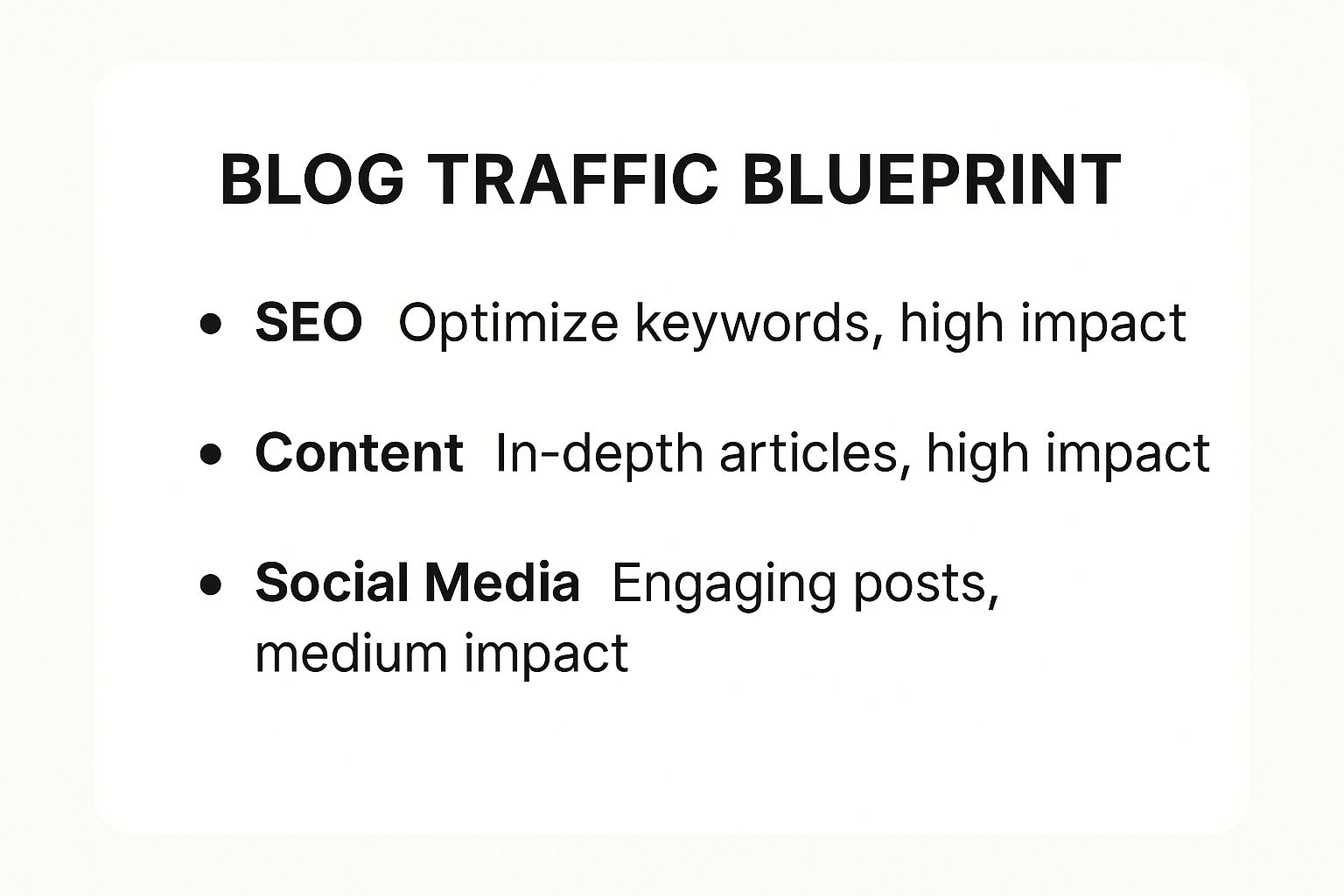
As you can see, SEO and Content are your long-term powerhouses, while Social Media is fantastic for driving consistent, immediate referral traffic.
To give you a clearer picture, let’s break down how these channels function in a growth strategy.
Core Traffic Growth Channels at a Glance
This table summarizes the main channels, what you need to do for each, and the results you can expect.
| Traffic Channel | Primary Action | Expected Impact |
|---|---|---|
| SEO | Optimize content around high-intent keywords, both broad and long-tail. | A significant and steady increase in organic visitors from search engines. |
| Content | Publish in-depth articles (1,500–2,000 words) that solve specific problems. | Higher search rankings, longer time on page, and establishes authority. |
| Social Media | Share compelling visuals, video clips, and post in relevant community groups. | Consistent referral traffic and a major boost in brand awareness. |
| Build your list and send out regular newsletters or automated sequences. | Drives repeat visits from your most loyal readers and improves engagement. |
By focusing on these four areas, you build a resilient system where each part supports the others.
The Unbeatable Power of a Consistent Blogging Schedule
One of the most foundational pieces of this puzzle is simply showing up and publishing regularly.
Blogging is still one of the most effective ways to drive traffic, period.
The numbers don’t lie. Companies that publish 16 blog posts per month get about 3.5 times more traffic than those publishing four or fewer.
A busy blog also gets your site indexed more often by Google, leading to 434% more indexed pages and 97% more backlinks—both of which are pure gold for SEO.
You can dig into more of these stats on Hostinger’s blog.
How to Prioritize Your Efforts Without Getting Overwhelmed
Okay, so where do you start?
First, take a look at your current analytics. Find those “low-hanging fruit” posts—articles that get decent engagement but aren’t ranking well. A little SEO love could give them a huge boost.
From there, it’s all about focus. Don’t try to do everything at once. If you’re a small team (or a team of one!), pick one or two channels to master this quarter.
Maybe it’s nailing your on-page SEO or building a Pinterest presence.
- Set aside dedicated time for each channel based on its potential ROI.
- Measure what matters. Track organic sessions, click-through rates, and email subscriber growth.
- Document what works and what doesn’t. This feedback loop is crucial for refining your strategy over time.
Make a commitment to test one new tactic every single month. You’ll be amazed at what hidden opportunities you uncover.
Set up a weekly check-in to review your traffic sources. See what’s working and align your upcoming content with what your audience is responding to.
Keep testing everything—headlines, images, calls-to-action—because small tweaks often lead to the biggest wins.
Mastering SEO to Dominate Search Rankings

Search Engine Optimization (SEO) is the engine that drives consistent, long-term blog traffic.
While a viral social media post might give you a nice spike in visitors, mastering SEO turns your blog into an asset that attracts your ideal audience 24/7.
It’s how you make Google your single biggest source of traffic.
But don’t be mistaken—modern SEO isn’t about stuffing keywords into your posts anymore.
It’s about deeply understanding what people are searching for and then creating the absolute best, most helpful answer on the internet.
Get this right, and you’ll build a sustainable flow of organic traffic that snowballs over time.
Uncovering Hidden Opportunities with Keyword Research
The entire foundation of a winning SEO strategy is built on solid keyword research. Instead of just guessing what your audience wants, this process gives you cold, hard data on the exact phrases they’re typing into Google.
Think of it as your secret weapon for learning how to increase blog traffic.
Your goal here is to find a healthy mix of keywords, but the real gold is often buried in long-tail keywords.
These are longer, more specific phrases—usually three words or more—that signal a searcher knows precisely what they’re looking for.
For instance, trying to rank for a broad term like “travel tips” is a massive uphill battle.
But a long-tail keyword like “best travel tips for solo female backpackers in Southeast Asia” is a different story.
The search volume is lower, sure, but the user’s intent is crystal clear, and the competition is far less intimidating. Nailing these is your shortcut to ranking faster.
Don’t just target what you think your audience is searching for. Use keyword research tools to find out what they are actually searching for. The data will often surprise you and reveal untapped content ideas.
Building Your Content for Readers and Robots
Once you’ve got your target keywords, it’s time to weave them into fantastic content. This is where on-page SEO comes in.
It’s all about optimizing your individual blog posts so search engines can easily understand what they’re about and who they’re for.
Here are the on-page elements that absolutely have to be on your radar:
- Title Tag: This is the clickable headline people see in the search results. It must include your main keyword and be magnetic enough to earn that click.
- Meta Description: This is the short blurb that appears under your title. While not a direct ranking factor, a great meta description acts like an ad for your content, seriously boosting your click-through rate.
- Header Tags (H1, H2, H3): Use these to give your article a logical structure. Your main title gets the H1 tag, with H2s for major sections and H3s for subsections. This creates a clean hierarchy that both Google and your readers will love.
- Internal Links: Linking to other relevant articles on your own blog is a simple but powerful strategy that too many people ignore. It helps search engines discover more of your content and establishes your site’s authority on a subject.
A smart internal linking structure does more than just help with SEO. It keeps visitors on your site longer, guiding them from one helpful post to the next.
This lowers your bounce rate and sends strong signals to Google that your site is a valuable resource.
Boosting Authority with Backlinks and Compelling Snippets
While on-page SEO covers everything you can control on your site, off-page SEO is all about building your blog’s reputation across the web. The main currency here? Backlinks.
A backlink is simply a link from another website to yours. Google sees high-quality backlinks as votes of confidence, and they can dramatically boost your domain authority and search rankings over time.
So, how do you get them?
- Create “link-worthy” content: Think original research, ultimate guides, or free tools that other people in your industry will want to reference.
- Guest post on other blogs: Write for reputable sites in your niche and include a link back to your blog in your author bio.
- Collaborate with other creators: Co-authoring content often means your partners will share and link back to the final piece.
Finally, remember that ranking is only half the battle. You still need people to actually click on your link in the search results.
Crafting a title and meta description that sparks curiosity is an art form in itself.
To really master this, you should learn more about how to improve click-through rates and make sure all your hard work translates into real traffic.
Creating Content That Attracts and Converts

Let’s be honest: great content is the engine of any blog that gets real traffic. SEO might draw the map for
Google to find you, but your content is the destination. It’s what makes people stick around, click through, and actually come back.
This is where we shift from just “writing posts” to building valuable, long-lasting assets for your business.
The real goal isn’t just to hit “publish” on a regular schedule. It’s to create articles so ridiculously helpful and thorough that they become the go-to resource for that topic.
When you do that, the backlinks, social shares, and audience trust tend to follow naturally.
The Power of In-Depth Articles
Ever notice how the top results in Google are rarely those short, 500-word blurbs from a decade ago? There’s a very good reason for that.
Longer, more comprehensive content consistently smokes shorter articles when it comes to search rankings and keeping readers hooked.
These deep-dive posts don’t just answer one question; they solve complex problems and cover a topic from every angle.
Put yourself in your reader’s shoes. They don’t want to open five different tabs to piece together a solution. They want one definitive guide that has it all.
When you create that guide, you’re sending a powerful signal to both people and search engines that you’re an authority.
Creating content isn’t just about answering one question. It’s about anticipating the next ten questions your reader will have and answering those, too. That’s how you build a truly valuable resource.
The data doesn’t lie. The average blog post length keeps creeping up, now sitting around 1,427 words. But the sweet spot for engagement often lands on posts closer to 1,750 words.
Longer content simply tends to rank higher, which is a critical piece of the puzzle if you’re trying to figure out how to increase blog traffic.
You can dig deeper into these blogging statistics and trends to see just how much content depth matters.
Different types of content serve different purposes and attract different kinds of attention. Here’s a quick breakdown of how to think about it.
Content Format vs. Traffic Potential
| Content Format | Ideal Word Count | Primary Traffic Goal |
|---|---|---|
| How-To Guides | 1,700 – 2,500 words | High search traffic, long-term asset |
| Listicles | 1,500 – 2,000 words | High social shares, viral potential |
| Case Studies | 1,000 – 1,500 words | Attract qualified leads, build authority |
| Pillar Pages | 3,000+ words | Broad topic authority, rank for head terms |
| News/Trend Analysis | 800 – 1,200 words | Short-term traffic spikes, timely relevance |
Choosing the right format for your topic is just as important as the word count.
A pillar page aims for long-term SEO dominance, while a trend analysis piece is built for a quick, targeted burst of traffic.
Structuring Your Content for Success
Even the most brilliant information will fail if it’s presented as a massive wall of text. People don’t read online; they scan.
A solid structure is your best friend for making long-form content feel approachable and easy to digest. I never start writing until I have a clear outline.
A good outline should always include:
- A hooky introduction: Grab the reader right away by stating their problem and promising a clear, valuable solution.
- Logical H2 and H3 headings: Break the article into bite-sized, scannable sections that guide the reader on their journey.
- Planned takeaways: Decide ahead of time where you’ll drop in bullet points, bolded text, or blockquotes to make the most important info pop.
- A strong conclusion: Don’t just trail off. Summarize the key points and give a clear call-to-action that tells the reader what to do next.
This isn’t just about making things pretty. A well-structured article helps search engines understand the hierarchy and key themes of your content, which can be a nice little boost to your rankings.
Go Beyond Words with Compelling Visuals
Visuals are not just filler. They are a core part of your content strategy. They break up long stretches of text, make complex ideas easier to grasp, and can seriously boost your views and shares.
In fact, articles with relevant images get a whopping 94% more total views than those without.
Instead of just grabbing the first generic stock photo you find, try creating custom visuals.
- Custom Graphics & Infographics: Use a tool like Canva to quickly create simple charts, branded graphics, or checklists that summarize key data.
- Screenshots with Annotations: If you’re writing a tutorial, nothing beats a series of screenshots with arrows and callouts walking readers through each step.
- Original Photography: If it fits your niche, high-quality, original photos make your blog feel way more authentic and professional.
For a masterclass in this, look at the food blog “Pinch of Yum.” It’s not just about the recipes.
They combine stunning, original photography with incredibly detailed guides, helping them rank for nearly 110,000 keywords and pull in over 2 million visitors every month.
It’s a complete, visually-driven experience.
Don’t Forget to Refresh Existing Content
One of the most powerful and overlooked traffic strategies is simply breathing new life into your old posts. Your archives are a goldmine!
Over time, information gets stale, links break, and new competitors can sneak past you in the rankings.
A “content refresh” means updating and improving an old article to make it relevant again.
The best candidates are usually posts already hanging out on the second or third page of Google—they just need a little push.
When you’re doing a refresh, you can:
- Update facts and stats with the latest available data.
- Add new sections or expand on existing ones to make the post more comprehensive.
- Re-optimize the on-page SEO with better keywords or a stronger meta description.
- Swap out old visuals for new infographics or better images.
- Improve internal linking by pointing to newer, relevant articles on your blog.
This is all about working smarter, not just harder. A content refresh often takes a fraction of the time it takes to write a post from scratch but can deliver a huge and surprisingly fast boost in traffic.
Smart Promotion Beyond Hitting Publish
It’s a great feeling to hit “publish” on an amazing, in-depth article. But that’s only half the battle. Your work has just begun.
What you do after your content goes live is what separates a blog that actually gets traffic from one that just gathers digital dust.
Promotion isn’t an afterthought; it’s a crucial part of your entire content process.
Too many creators will spend 20 hours writing a masterpiece and then a measly 20 minutes sharing it on a couple of social profiles, hoping it takes off.
To really see your blog traffic grow, you need to flip that ratio. A solid promotion plan gets your hard work in front of the right people, long after publication day.
Build Your Most Valuable Asset: Your Email List
From day one, nothing should be more important than building your email list.
Seriously. Social media platforms are fantastic, but you’re building on rented land where a single algorithm change can wipe out your reach overnight.
Your email list? That’s an asset you own. These are your people.
These subscribers have literally given you permission to show up in their inbox, which makes them far more likely to click through and read what you’ve just published.
Your email list is a direct line to your most loyal audience. It’s the only traffic channel you have complete control over, making it one of the most reliable ways to drive repeat visitors to your blog.
The best way to start is by offering something genuinely useful for free—think checklists, a short e-book, or a handy template—in exchange for their email.
Sprinkle sign-up forms in high-visibility spots on your blog: in the sidebar, at the end of every post, and maybe even a polite pop-up.
Then, every time a new article goes live, you can send out a broadcast and watch the initial wave of traffic roll in.
Get Strategic with Social Media
Just dropping a link to your latest post on every social media account you own isn’t a strategy—it’s noise.
To make social media work, you have to tailor your message to fit the platform and the people who hang out there.
Don’t try to be everywhere at once. You’ll just burn out. Instead, figure out where your ideal reader spends their time—maybe it’s one or two platforms—and go all-in on those.
For a B2B blog, that might be LinkedIn and X (formerly Twitter). If you’re in the lifestyle or DIY space, Pinterest and Instagram are probably your best bet.
Once you know where you’re focusing, create specific assets for each platform:
- Shareable Graphics: Use a tool like Canva to create eye-catching images featuring a compelling quote or a key stat from your post.
- Key Snippets: Pull out interesting takeaways and turn them into short, text-based posts or threads that spark curiosity.
- Short-Form Videos: Create a quick Reel, Short, or TikTok that summarizes the main points of your blog post in an engaging way.
These diverse content distribution strategies are what grab attention in a crowded feed.
By giving people a taste of the value inside your article, you make that click-through to your blog almost irresistible.
For a much deeper look, check out our guide on building effective content distribution strategies.
Tap into Existing Communities for Targeted Traffic
Want a shortcut to getting your content in front of a relevant audience?
Stop waiting for them to find you and go where they already are.
Look for active online communities that are buzzing with conversations about your niche. This could mean:
- Facebook Groups: Find groups where your ideal readers ask questions and share ideas. Become a helpful, known member of the community.
- Reddit Subreddits: Identify the right subreddits and share your expertise. Redditors appreciate genuine value.
- Quora: Search for questions related to your blog topics and write thoughtful, comprehensive answers, subtly linking back to your articles for those who want to learn more.
The secret to making this work is to provide value first. Don’t just show up and spam your links; you’ll get ignored or kicked out.
Instead, genuinely engage in discussions, answer questions, and build a reputation as a helpful expert.
When you finally do share a link to your content, it’s seen as a valuable resource, not just self-promotion.
Unlocking Explosive Traffic Growth with Pinterest
So many bloggers make the mistake of lumping Pinterest in with platforms like Instagram or Facebook. That’s a massive oversight.
Pinterest isn’t a social network; it’s a visual search engine. For many niches, it’s one of the most potent tools you can possibly use to drive more traffic to your blog
Think about it this way: a tweet has a lifespan of a few minutes, maybe an hour.
A well-optimized Pin, on the other hand, can continue sending you steady traffic for months, sometimes even years.
People are on Pinterest to plan, search for solutions, and discover ideas.
Your blog post is the answer they’re looking for, and your Pin is the signpost pointing them right to it.
Why Pinterest Is a Game-Changer for Bloggers
Let’s get inside the user’s head for a second. When someone is scrolling through Pinterest, they are actively hunting for something—recipes for dinner, DIY project instructions, travel guides, or business tips.
This audience has high intent. They are primed and ready to click through to your blog for the full story, which makes Pinterest an incredible source of qualified, engaged readers.
Growing your blog traffic can feel like a slow burn, especially when you’re just waiting for Google’s SEO to kick in.
In fact, real-world data shows it can take up to six months of consistent work just to hit your first 1,000 monthly visitors. This is why putting all your eggs in the Google basket is risky.
Pinterest can be the bridge you need. It often delivers results much faster than traditional SEO while simultaneously building up a long-term stream of traffic.
Setting Up Your Pinterest for Success
Before you even think about pinning, you need to approach your Pinterest account with the same strategic mindset you use for your blog’s SEO.
- Optimize Your Profile: Your business profile name and bio are prime real estate. Pack them with keywords relevant to your niche so Pinterest immediately understands what you’re about and who to show your content to.
- Create Keyword-Rich Boards: Don’t settle for a generic board name like “Recipes.” Get specific with titles like “Easy Vegan Dinner Recipes” or “Healthy Gluten-Free Desserts.” Use the board description to sprinkle in even more related keywords.
- Design Click-Worthy Pins: Your Pin design is your first impression, so make it count. Use bright, high-quality images, add bold text overlays that scream value, and always include your blog’s URL or logo. Remember, vertical pins with a 2:3 aspect ratio perform best.
A great Pin doesn’t just look pretty; it makes a promise. The text on your Pin should spark curiosity and clearly state what problem your blog post solves. Make that click irresistible.
The Power of Automation with Post Paddle
The real secret to winning on Pinterest? Consistency. The platform’s algorithm loves accounts that share fresh, quality content regularly throughout the day.
But seriously, who has the time to manually pin 15-25 times a day? This is where automation becomes your secret weapon.
Tools like Post Paddle are built to do the heavy lifting for you. Instead of being chained to your desk scheduling Pins, you can automate the entire process.
This ensures a steady flow of content goes out at the most effective times, even while you sleep.
Automating your pinning strategy is what separates the bloggers who get trickles of traffic from Pinterest from those who turn it into a firehose.
You can see how this works in more detail in our guide to blogging on Pinterest.
Crafting the Perfect Pin Description
Your Pin’s design is what grabs someone’s attention, but the keyword-rich description is what helps it get found in the first place.
A solid Pin description does two crucial jobs: it tells the Pinterest algorithm what your content is about, and it convinces the user to click.
- Lead with Keywords: Start your description with your most important target keywords.
- Write for Humans: After the keywords, write a natural, compelling sentence or two explaining the value a user will get by clicking through to your post.
- Use Hashtags: Tack on a few relevant, niche-specific hashtags at the end to broaden your reach.
By combining killer designs with keyword-focused descriptions and a consistent schedule powered by automation, you can transform Pinterest from just another social account into one of your blog’s top traffic drivers.
Give Every New Post a Pinterest Traffic Boost
If you’re serious about increasing blog traffic, publishing the post is only half the job.
The real growth happens when every new article is backed by Pins that are easy to find, easy to understand, and worth clicking.
A simple checklist keeps you focused on what actually moves the numbers: clear keywords, scroll-stopping visuals, benefit-driven headlines, and descriptions that align with what people are already searching for.
Instead of guessing why one Pin sends traffic for months while another dies in a day, you move through each step with a plan.
Over time, this turns each blog post into a small traffic asset and your Pinterest account into a reliable discovery engine, not just a place to drop pretty images.
My free Pinterest Pin Optimization Checklist walks you through the key steps before you hit publish, so every Pin has a better shot at ranking, getting clicked, and sending readers back to your latest content.
Common Questions About Growing Blog Traffic
Diving into the world of blogging can feel like you’ve been given a map with half the roads missing.
You’re pouring your heart into creating amazing content, but that traffic graph just isn’t climbing the way you hoped. It’s totally normal to have questions—and trust me, you’re not the only one asking them.
Let’s tackle some of the biggest questions and roadblocks that trip up bloggers on the path to growing their audience. The answers aren’t always a quick fix, but they are always actionable.
How Long Does It Realistically Take to See a Significant Increase in Blog Traffic?
This is the million-dollar question, isn’t it? The most honest answer I can give you is that it takes a whole lot of patience.
A killer post might go viral on social media and give you a nice, temporary spike, but building a steady stream of organic traffic from Google is a marathon, not a sprint.
For most new bloggers, you’ll start seeing some real, consistent growth around the 6 to 9-month mark.
Now, that’s assuming you’re consistently putting out high-quality, SEO-focused content (think once or twice a week) and actually getting it out there.
Hitting a big milestone like 10,000 monthly visitors? That often takes well over a year. The growth is almost never a straight line.
The first few months are a slow, tough grind, but once your domain authority starts to build, you’ll see things begin to snowball.
Should I Focus on SEO or Social Media First?
For traffic that keeps coming in long after you’ve hit “publish,” SEO needs to be your top priority from day one.
Seriously, every single post you write should be built on a solid SEO foundation. That said, in the early days, waiting for Google to notice your brand-new blog can feel agonizingly slow.
This is why you need to play both the long and short game.
- Think of SEO as your long-term investment. Get your keyword research and on-page optimization right from the very beginning.
- Use social media for your short-term wins. At the same time, push your content hard on one or two platforms where you know your audience hangs out.
For a lot of bloggers, Pinterest is a fantastic way to drive that initial traffic while your SEO efforts are still brewing. It’s a two-pronged attack that really works.
How Important Is Updating Old Blog Posts?
Updating old content is one of the most powerful—and most overlooked—traffic strategies out there. Your archives are basically a goldmine waiting to be rediscovered.
Google absolutely loves fresh, relevant content, and giving your old posts a facelift signals that your site is still valuable.
Making a habit of auditing your old posts (say, every 6 to 12 months) allows you to add new info, refresh outdated stats, fix broken links, and beef up the SEO.
This “content refresh” can give you a massive rankings boost, often for way less work than writing an entirely new article from scratch.
A pro tip? Start with the posts that are already lingering on the second or third page of Google. They’re on the cusp of greatness, and a little TLC is often all it takes to push them onto that coveted first page.
Can I Really Increase Blog Traffic Without a Big Budget?
Absolutely, one hundred percent. While throwing money at ads can definitely get you faster results, the foundational strategies for growing a blog are incredibly budget-friendly.
Your biggest investment will be your time and your consistency.
Just look at these powerhouse methods that don’t cost a dime:
- Search Engine Optimization is free. It all comes down to smart research and creating genuinely helpful content.
- Social Media Marketing can be done completely organically by building a real community and sharing things people care about.
- Guest Posting on other blogs in your niche is a fantastic way to build backlinks, and it only costs you the time it takes to write a great piece.
The real secret is to create content so ridiculously helpful that people can’t help but share it and link back to it. That’s the best, most cost-effective marketing you can possibly do.